




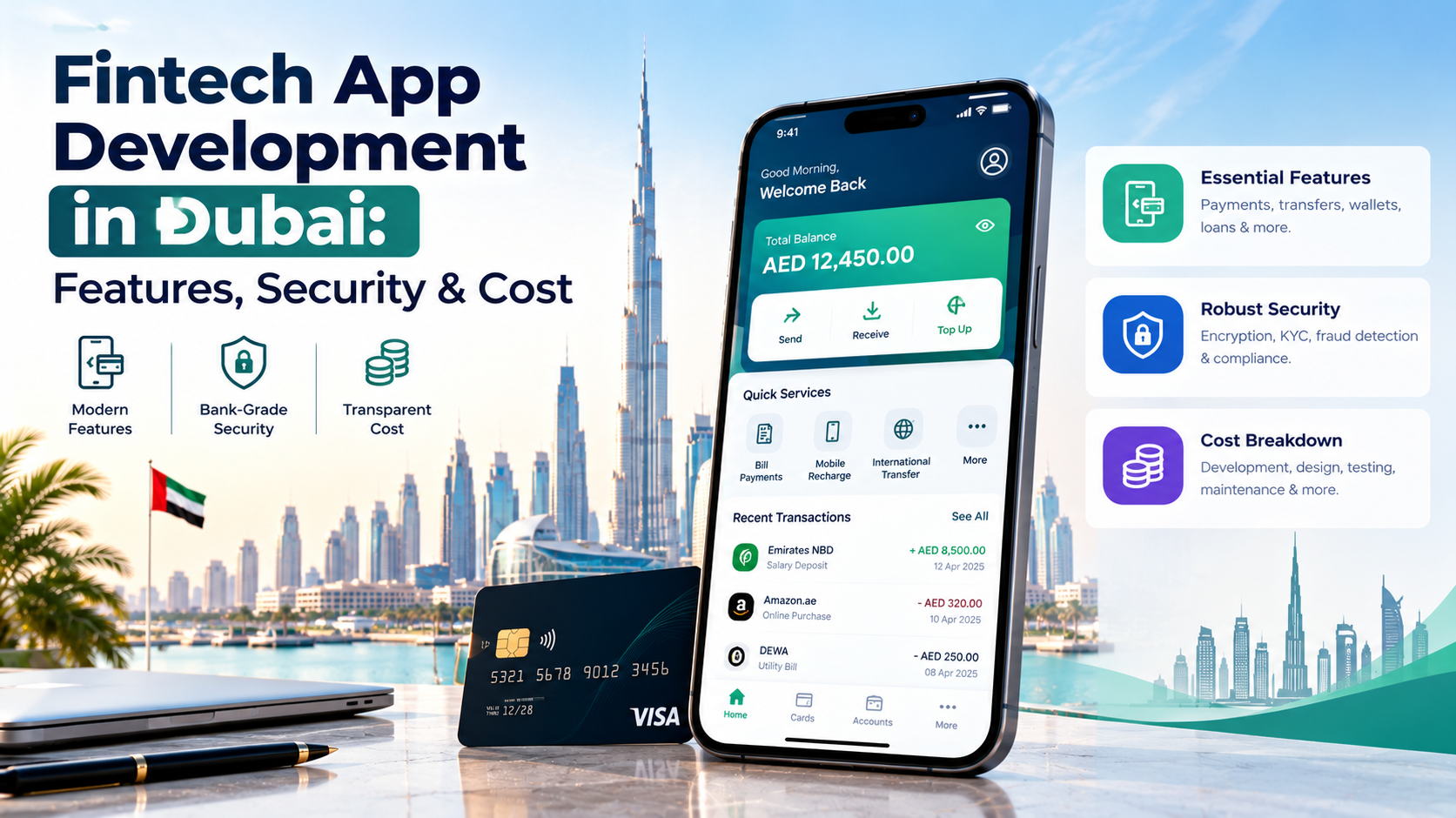
Fintech App Development in Dubai: Features, Security & Cost
As financial services become increasingly digital, businesses in the UAE are exploring mobile applications that make payments, account management, and financial transactions more convenient. Working with a Fintech App Development Company in Dubai can help founders and business owners turn a financial technology idea into a secure, user-friendly digital product. From digital wallets and payment applications to personal finance tools and business banking platforms, the right solution depends on the problem you want to solve, your target customers, and the financial activities your application will support.
However, fintech development involves more than building an attractive mobile interface. Security, data protection, payment integrations, regulatory requirements, and reliable transaction processing must be considered from the beginning. This guide explains the essential fintech app features, security measures, development process, cost factors, and technology choices businesses should understand before investing in a fintech application.
What Is Fintech App Development?
Fintech app development is the process of designing, building, testing, and maintaining software that uses technology to deliver or improve financial services.
Depending on the business model, a fintech application may help users transfer money, make payments, track expenses, manage accounts, access financial information, or interact with regulated financial service providers.
Common fintech application categories include:
- Digital wallet and payment applications
- Personal finance and budgeting apps
- Digital banking interfaces
- Business expense management platforms
- Investment and wealth management applications
- Lending and financing platforms
- Insurance technology applications
- Payment management tools for businesses
Not every fintech app performs regulated financial activities itself. Some applications provide information or connect users with licensed providers, while others may facilitate payments, credit, investments, or other activities that require specific approvals.
Defining the app’s actual role is an important first step because it affects the architecture, integrations, compliance requirements, timeline, and overall development budget.
Why Businesses Are Investing in Fintech App Development in Dubai
Dubai provides a business environment where startups, established companies, and financial service providers can explore digital financial products. For businesses, a fintech application can create a more convenient way to serve customers and manage financial workflows.
Improve Customer Convenience
A well-designed application can make routine financial tasks easier to complete. Depending on the service, customers may be able to view transactions, manage payment methods, review spending, or receive account notifications through their mobile devices.
Create New Digital Business Models
Fintech can support business ideas such as expense management for SMEs, payment tools for merchants, budgeting services, and financial dashboards. The opportunity comes from solving a specific customer problem rather than simply adding financial features to an app.
Automate Business Processes
Businesses can use fintech applications to reduce manual work in areas such as transaction reconciliation, expense tracking, payment notifications, and financial reporting. The extent of automation depends on the integrations and workflows supported by the product.
Serve Customers Across Digital Channels
A fintech platform may combine mobile applications, web dashboards, customer support tools, and backend systems. This can give customers convenient access while helping businesses manage operations through connected digital services.
Essential Features of a Fintech Application
The right features depend on whether your application handles payments, provides financial insights, connects users to financial institutions, or supports another financial service. Start with the functions required to deliver your core value proposition.
1. Secure User Registration and Authentication
Registration should be straightforward while providing appropriate protection for user accounts.
Depending on the service, authentication options may include:
- Email or mobile number verification
- Multi-factor authentication
- Device recognition and session management
- Biometric authentication supported by the device
- Secure account recovery
- Additional verification for sensitive actions
Authentication requirements should be proportionate to the risks associated with the application and the transactions it supports.
2. Digital Payments and Transaction History
For payment-focused applications, users may need to make or receive payments, review transaction records, and receive confirmations.
Important capabilities may include payment initiation through an approved provider, transaction status updates, receipts, refunds where supported, and clear handling of failed or pending transactions.
The application should not treat a payment as successful until it receives an appropriate confirmation from the payment system.
3. Account and Financial Dashboard
A dashboard can help users understand their financial activity without navigating through multiple screens.
Depending on the business model, it may display balances supplied by an authorized source, recent transactions, expense categories, payment history, or account summaries.
Financial information should be presented clearly, with appropriate timestamps and explanations of pending transactions or unavailable data.
4. Notifications and Alerts
Notifications can inform users about payment status, account activity, security events, and important service updates.
Users should be able to manage notification preferences where appropriate. Sensitive information should not be unnecessarily exposed in notifications that may appear on a locked screen.
5. Admin Dashboard and Reporting
An administration interface helps authorized staff manage platform operations. Features may include customer support workflows, transaction monitoring, account status management, operational reporting, and audit records.
Access to sensitive functions should be restricted by role, with appropriate logging and approval processes for high-risk actions.
6. Third-Party Integrations
A fintech app may need to connect to payment gateways, banking APIs, identity verification providers, fraud monitoring tools, accounting systems, or other approved services.
Integration requirements should be defined early. Each provider may have its own onboarding, technical, contractual, and compliance requirements, which can affect the project schedule and cost.
Fintech App Security: What Businesses Must Prioritize
Security should be built into the application architecture, development process, and operating procedures. It should not be treated as a final checklist immediately before launch.
Data Encryption
Sensitive information should be protected in transit and, where appropriate, at rest using suitable encryption practices. Encryption helps reduce exposure, but it must be supported by proper key management, access controls, and secure infrastructure.
Secure Authentication and Access Controls
Use appropriate authentication mechanisms and restrict access to sensitive data and administrative functions. Staff accounts should have only the permissions needed for their roles.
For higher-risk operations, additional verification or approval may be appropriate.
Fraud Detection and Transaction Monitoring
Depending on the product, risk controls may include transaction limits, suspicious activity alerts, device and session signals, velocity checks, and risk-based verification.
More advanced systems may use machine learning to identify unusual patterns. Such systems need careful evaluation and monitoring to reduce false positives and avoid unjustified blocking of legitimate users.
Secure APIs and Backend Systems
Fintech applications frequently communicate with external services. APIs should use appropriate authentication, authorization, input validation, rate limiting, and monitoring.
Sensitive credentials should not be embedded in mobile app code. Payment and financial processing logic should be handled through appropriately secured backend systems and approved providers.
Testing and Vulnerability Management
Before launch, conduct security-focused testing alongside functional and performance testing. Depending on the product’s risk profile, this may include code analysis, dependency checks, penetration testing, and independent security assessments.
Security responsibilities continue after launch through patching, monitoring, incident response planning, and periodic reviews.
Privacy and Data Protection
Collect only the information needed for the stated purpose, explain how data is used, and apply suitable retention and deletion practices. Access to personal and financial information should be carefully controlled.
The relevant privacy and data protection obligations depend on the business, its activities, its users, and the jurisdictions involved.
Fintech Regulations and Compliance in the UAE
Regulatory requirements are a critical part of fintech planning. The rules that apply depend on what the application actually does, which entity provides the financial service, and where the business operates.
For example, a budgeting app that organizes information may face a different regulatory profile from an application that directly provides payment services, lending, stored value, or investment products.
Before development begins, businesses should identify:
- The legal entity operating the service
- The financial activities performed by the platform
- Whether a regulated or licensed partner is required
- Applicable licensing and approval requirements
- Know-your-customer and anti-money-laundering obligations, where relevant
- Data protection and recordkeeping responsibilities
- Payment security and third-party provider requirements
Depending on the proposed activity, the relevant UAE authorities may include the Central Bank of the UAE or the regulator responsible for the applicable financial free zone. Businesses should obtain qualified legal and regulatory advice rather than assuming that an app-store release or a software development contract provides permission to offer financial services.
A development partner can help implement technical requirements, but it cannot replace the legal approvals or licences required for the business.
How Much Does Fintech App Development Cost in Dubai?
The cost depends on the app category, number of platforms, security requirements, integrations, user workflows, and compliance-related technical scope.
The following figures are broad illustrative estimates for software development planning, not verified market quotations or guaranteed project prices.
| Fintech App Type | Indicative Development Cost |
|---|---|
| Basic financial management MVP | $15,000–$35,000 |
| Payment or digital wallet application | $35,000–$80,000+ |
| Advanced fintech platform | $80,000–$180,000+ |
| Complex multi-service financial platform | $180,000+ |
A basic budgeting app may be simpler than a platform involving payment processing, identity verification, transaction monitoring, and multiple external financial integrations.
These estimates may not include licensing, legal advice, independent security audits, provider onboarding fees, transaction charges, or ongoing operational expenses. Projects involving regulated financial activities can require substantial work beyond ordinary app development.
What Factors Affect the Development Budget?
Feature complexity: More user roles, transaction types, approval workflows, and reporting functions generally require more development and testing.
Platform selection: Building for Android and iOS may involve additional implementation and quality assurance. Cross-platform development can share code, but it does not eliminate platform-specific testing.
Security requirements: Sensitive financial workflows may require additional architecture, risk controls, independent assessments, and monitoring.
Third-party integrations: Each external provider introduces technical requirements and potentially separate onboarding or service fees.
Compliance-related requirements: Audit trails, identity verification, reporting, record retention, and controls can affect the scope, depending on the service.
Ongoing support: Hosting, monitoring, maintenance, security updates, and provider charges should be budgeted separately from initial development.
Request an itemized proposal that identifies included features, assumptions, exclusions, third-party costs, and post-launch responsibilities.
How to Build a Fintech App: Step-by-Step Process
Step 1: Define the Business Problem
Identify the customer problem your app will solve. Decide whether you are building a payment tool, financial dashboard, expense management product, or another type of service.
A clearly defined purpose prevents unnecessary features from expanding the budget.
Step 2: Establish the Business and Compliance Model
Determine which services the platform will provide directly and which will be delivered by licensed or approved partners. Seek regulatory advice early, particularly if the product involves payments, lending, investments, or stored value.
Step 3: Define the MVP
Select the smallest feature set that can deliver value while meeting the product’s security and operational requirements. An MVP should not mean skipping essential security or compliance controls.
Step 4: Design the User Experience
Create prototypes for registration, account access, key financial tasks, transaction confirmation, and support. Test whether users can understand important information and recover safely from errors.
Step 5: Select the Technology and Integrations
Choose the app framework, backend architecture, database, hosting environment, and external providers based on the product requirements. The development team should explain the trade-offs between cost, maintainability, reliability, and scalability.
Step 6: Develop and Test
Build the core workflows, integrate required services, and test transaction states, permissions, error handling, performance, and security. Financial workflows need particular attention to duplicate requests, interrupted connections, and inconsistent provider responses.
Step 7: Prepare for Launch
Complete the required provider onboarding, operational checks, privacy documentation, support workflows, and applicable approvals. Confirm who is responsible for monitoring the service after release.
Step 8: Monitor and Improve
After launch, review reliability, user feedback, support requests, transaction outcomes, and security alerts. Use this information to prioritize improvements and manage risk as the user base grows.
Choosing a Mobile App Development Company in Dubai
Selecting the right development partner can affect the product’s reliability, maintainability, and long-term cost.
When evaluating a Mobile App Development Company in Dubai, look for a team that can explain its approach to secure architecture, integration planning, testing, deployment, and ongoing support.
Ask prospective partners about:
- Relevant mobile application experience
- Backend and API development capabilities
- Secure authentication and access control
- Payment or financial provider integrations
- Testing and vulnerability management
- Code ownership and technical documentation
- Delivery milestones and project exclusions
- Maintenance arrangements after launch
A Mobile App Development Company in UAE should also be able to discuss how the proposed solution fits your target market and operating model. The development partner does not necessarily need to provide legal advice, but it should recognize when specialist regulatory input is required.
Whether you work with a local or international Mobile App Development Company, compare the proposed scope and technical approach rather than relying on price alone.
Android or iOS: Which Platform Should You Choose?
The choice depends on your intended users, product requirements, and budget.
An Android App Development Company can build an Android application for your target customers, while an iOS App Development Company can develop the version for Apple devices.
You may launch on both platforms or use a phased rollout if that aligns with your business strategy. Cross-platform technologies can reduce duplicated development work, but sensitive workflows, device security features, notifications, and performance must still be tested on supported devices.
The platform decision should follow user research and product planning—not assumptions that one operating system is always cheaper or more suitable.
How A2Solutions Can Help With Fintech App Development
A2Solutions can be considered as a development partner for businesses planning a custom financial technology application. The process should begin with understanding your business model, intended users, core workflows, integrations, and technical requirements.
Depending on the project, development may involve mobile app interfaces, backend systems, account management, dashboards, approved third-party integrations, and security-focused testing.
If you are planning a fintech product, prepare a brief describing what the application will do, which markets it will serve, and whether financial services will be delivered directly or through a partner. This helps establish a clearer scope and a more realistic development estimate.
Discuss your requirements with A2Solutions to explore the appropriate app architecture, delivery stages, and support needs for your project.
Frequently Asked Questions
How much does fintech app development cost in Dubai?
A basic financial management MVP may cost approximately $15,000–$35,000, while a more complex fintech platform may cost $80,000–$180,000 or more. The actual cost depends on features, integrations, platforms, security, and the business model.
How long does it take to develop a fintech app?
A focused MVP may take around three to six months, while a more complex product may take six to twelve months or longer. These are indicative estimates; integrations, security reviews, provider onboarding, and regulatory approvals can affect the timeline.
What are the most important fintech app security features?
Important controls include secure authentication, access permissions, encryption, API security, fraud monitoring where relevant, audit logging, secure data handling, and ongoing vulnerability management. The precise controls should reflect the risks and activities of the application.
Do fintech apps need approval in the UAE?
Some financial activities require specific licences, approvals, or regulated partners. Requirements depend on the service and operating model, so businesses should obtain qualified regulatory advice before launch.
Can I start with a fintech MVP?
Yes, provided the MVP is appropriately scoped and includes the security, operational, and regulatory controls required for its intended activities. Start with the core customer problem and expand features as the business develops.
Should I build my fintech app for Android and iOS?
That depends on your target audience and launch strategy. You can develop both platforms together or consider a phased approach. Platform selection should account for user needs, cost, testing, and ongoing maintenance.
Can AI be added to a fintech app?
AI can support customer service, spending insights, fraud-risk signals, and other functions, depending on the product. Sensitive decisions require appropriate validation, oversight, privacy safeguards, and monitoring.
Final Thoughts
Fintech app development in Dubai can help businesses create digital financial products that improve convenience, streamline workflows, and address specific customer needs. But the strongest starting point is not a long list of features. It is a clearly defined business problem, an appropriate operating model, and a realistic plan for security, integrations, and compliance.
Begin with the essential user experience, establish the technical and regulatory requirements, and choose a development partner that can explain the costs and trade-offs clearly. A well-planned fintech application can then evolve through measured improvements based on user feedback and business priorities.
Also Read:- How to Build a Property App Like Property Finder in the UAE
