




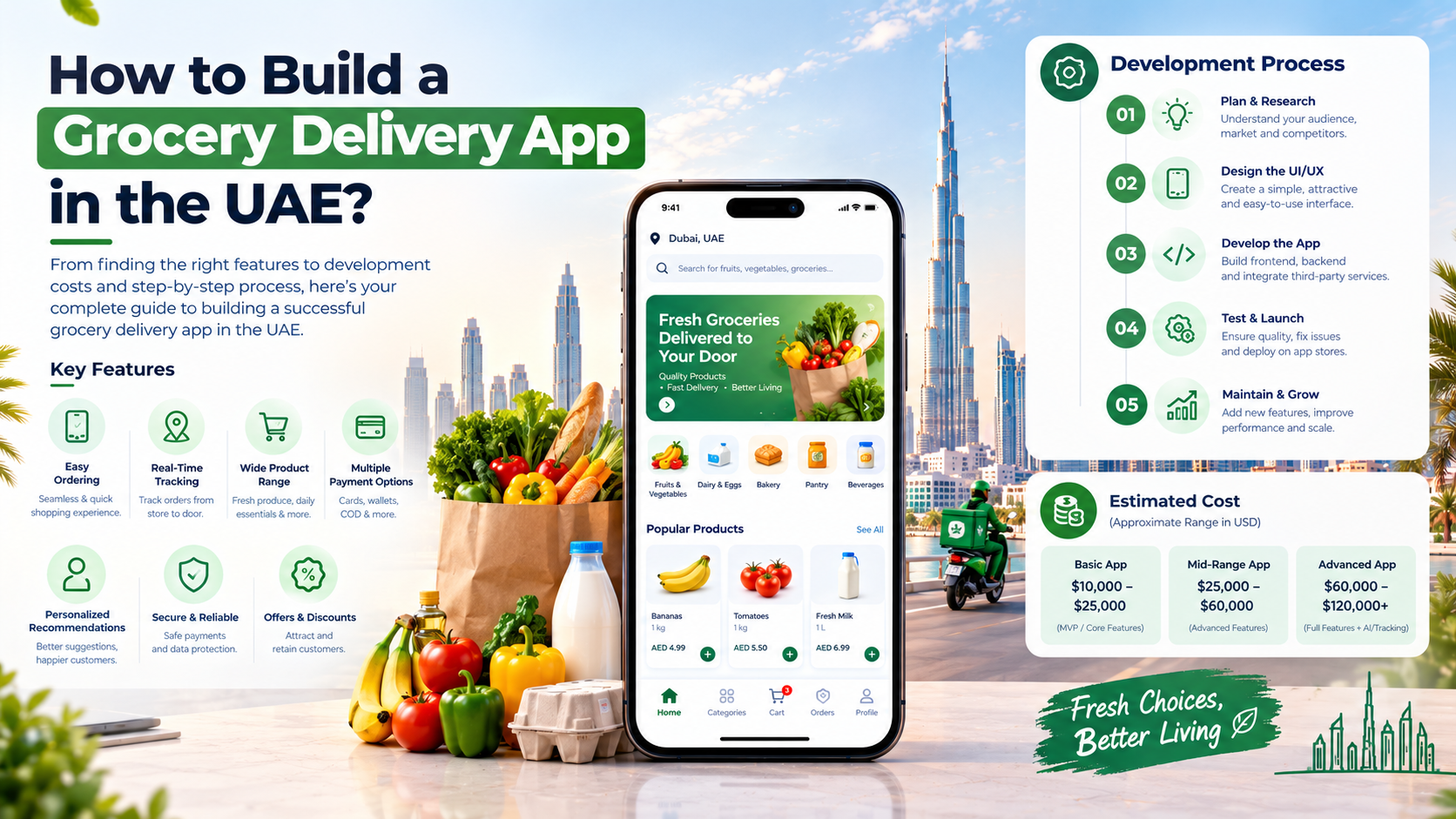
How to Build a Grocery Delivery App in the UAE?
The growing demand for convenient online shopping has created opportunities for supermarkets, grocery retailers, entrepreneurs, and startups across the UAE. Building a grocery delivery app allows businesses to reach customers digitally, simplify ordering, and create new revenue opportunities.
However, a successful grocery delivery platform requires more than an attractive mobile interface. It must connect customers, stores, delivery partners, payments, inventory, and business operations through a reliable technology ecosystem.
Working with an experienced Grocery Delivery App Development Company in Dubai, UAE, can help businesses transform their ideas into practical digital solutions. From selecting the right business model to developing an MVP and planning future enhancements, every stage requires a clear strategy.
This guide explains how to build a grocery delivery app in the UAE, covering essential features, business models, technology options, development steps, cost factors, and how to choose the right development partner.
What Is a Grocery Delivery App?
A grocery delivery app is a digital platform that allows customers to browse products, check prices, place orders, make payments, and receive groceries at their preferred locations.
Depending on the business model, the application can serve a single supermarket, multiple grocery retailers, independent stores, specialty food businesses, or dedicated fulfilment centres.
A typical grocery delivery platform consists of three primary systems.
1. Customer Application
The customer app provides the interface for browsing products and placing orders. Common features include:
- User registration and login
- Product categories and search
- Product details, prices, and availability
- Shopping cart and checkout
- Delivery address management
- Payment options
- Order status updates and tracking
- Offers, ratings, and customer support
2. Store or Seller Dashboard
The store dashboard enables supermarkets and sellers to manage their daily operations. It typically includes:
- Product catalogue and category management
- Inventory and price updates
- Order acceptance and preparation
- Product availability management
- Discounts and promotions
- Sales reports and order history
3. Admin Dashboard
The administration panel gives the platform owner control over the entire business. Its functionality may include customer management, seller onboarding, order monitoring, delivery assignments, payment records, commissions, service areas, promotional campaigns, reporting, and customer support.
Together, these systems create an integrated platform for managing the complete grocery ordering and delivery process.
Why Build a Grocery Delivery App in the UAE?
The UAE offers opportunities for businesses seeking to expand their retail operations through digital channels. A well-planned grocery application can help retailers improve convenience, strengthen customer relationships, and extend their reach beyond physical stores.
Key business benefits include:
- Expanded market reach: Serve customers across selected neighbourhoods and delivery zones.
- Convenient ordering: Allow customers to shop without visiting a physical store.
- Direct customer relationships: Build a digital channel for communication, promotions, and repeat purchases.
- Improved operational visibility: Monitor orders, stock availability, and fulfilment activities.
- Repeat purchase opportunities: Introduce shopping lists, saved carts, and recurring orders.
- Customer insights: Analyse purchasing patterns and product demand to support business decisions.
- Flexible growth: Expand into additional locations or onboard more stores as the business develops.
Before investing in development, businesses should define their target audience, product range, delivery coverage, fulfilment strategy, and revenue model. These decisions help determine which features are necessary for launch and which can be introduced later.
Choose the Right Grocery Delivery Business Model
The business model determines how the platform operates, manages orders, and generates revenue.
Single-Store Grocery App
This model is designed for an individual supermarket or grocery retailer. The business controls its products, pricing, inventory, order processing, and delivery arrangements.
It is suitable for established retailers that want to develop their own online sales channel and maintain control over the customer experience.
Multi-Store Grocery Marketplace
A marketplace connects customers with multiple supermarkets or independent grocery stores through one application.
Potential revenue streams include:
- Seller commissions
- Delivery fees
- Subscription plans
- Sponsored product placements
- Advertising and promotional campaigns
This model requires additional functionality for seller registration, store-specific inventory, commissions, payouts, and order allocation.
Hyperlocal Grocery Delivery Platform
A hyperlocal platform focuses on a specific neighbourhood, city district, or delivery zone. Starting with a limited service area can help businesses test demand, manage delivery costs, and improve fulfilment before expanding.
Grocery Subscription Service
A subscription-based model supports recurring purchases or scheduled deliveries. Examples include weekly grocery orders, monthly household essentials, and curated product boxes.
Subscriptions can encourage repeat purchases when pricing, product selection, and delivery schedules provide meaningful value to customers.
Essential Features of a Grocery Delivery App
A grocery delivery platform should prioritise features that support convenient shopping and reliable fulfilment. The exact requirements depend on whether the application serves one store or operates as a multi-vendor marketplace.
Customer Registration and Profile Management
Provide a straightforward registration process using appropriate authentication methods, such as mobile OTP, email, or supported social login options.
Customers should also be able to manage their profiles, saved addresses, order history, and communication preferences.
Location and Address Management
Location functionality helps determine whether an order can be delivered to a customer’s address.
Useful capabilities include GPS-based location detection, manual address entry, saved addresses, delivery instructions, and serviceability checks.
Product Catalogue and Search
Organise products into clear categories, including:
- Fruits and vegetables
- Dairy products
- Meat and seafood
- Bakery items
- Snacks and beverages
- Frozen foods
- Household essentials
- Personal care and baby products
Search, sorting, and filtering options should help customers find items by product name, brand, price, availability, and relevant attributes.
Product Details and Inventory
Product pages should display accurate names, images, sizes, prices, descriptions, and availability.
Inventory management is especially important for grocery businesses because stock can change throughout the day. The system should minimise orders for unavailable products and support suitable substitution or refund workflows.
Shopping Cart and Checkout
The cart should display product quantities, prices, discounts, delivery charges, applicable taxes, and the final payable amount.
A streamlined checkout process should allow customers to confirm their address, select an available delivery slot, choose a payment method, and submit their order without unnecessary steps.
Payment Integration
The application can support payment methods offered by the selected payment provider, including eligible credit and debit cards, digital wallets, and cash on delivery where appropriate.
The payment workflow should also account for transaction failures, cancellations, refunds, payment confirmation, and reconciliation.
Order Management and Tracking
Customers should receive clear updates throughout the fulfilment process.
Typical order statuses include:
- Order placed
- Order confirmed
- Being prepared
- Ready for pickup
- Out for delivery
- Delivered
- Cancelled
Live location tracking can be introduced when the delivery operation and mapping integration support it.
Delivery Partner Application
Businesses managing their own delivery fleet may need a dedicated delivery app or interface.
Common features include assigned orders, pickup confirmation, navigation, delivery status updates, customer contact options, and proof of delivery.
Promotions and Loyalty
Promotional functionality can include coupon codes, product discounts, seasonal campaigns, loyalty points, and referral rewards.
Businesses should define promotion rules carefully to protect product margins and maintain a sustainable customer acquisition strategy.
Advanced Features for Grocery Delivery Applications
Once the core ordering process is stable, businesses can introduce additional features based on customer feedback and operational requirements.
AI-Powered Product Recommendations
Recommendation systems can suggest relevant products using suitable purchase history, browsing activity, and product relationships. For example, customers may receive suggestions for frequently purchased household essentials or complementary grocery items.
Smart Grocery Search
Intelligent search can help customers find products even when their queries do not match exact catalogue names. Natural-language search may also support requests such as finding breakfast products within a specified budget.
Its effectiveness depends on accurate product data, well-defined attributes, and the quality of the search implementation.
AI Shopping Assistant
A shopping assistant can help users discover products, compare available options, create shopping lists, and find alternatives. Product information should remain accurate, and complex support requests should be escalated to a human representative when necessary.
Digital Shopping Lists and Repeat Ordering
Saved shopping lists help customers organise recurring purchases for weekly groceries, household supplies, or other regular needs. Reordering functionality can reduce the time required to complete subsequent purchases.
Scheduled Delivery
Delivery slots can be allocated according to store preparation capacity, delivery partner availability, service areas, and order volume.
Analytics and Demand Forecasting
Business analytics can help operators identify popular products, monitor repeat purchases, understand cancellations, and plan inventory. More advanced forecasting may support stock planning when sufficient reliable data is available.
Advanced functionality should be introduced according to measurable business needs rather than added simply to make the application appear more sophisticated.
How to Build a Grocery Delivery App in the UAE
A structured development process helps businesses control scope, manage costs, and prepare for operational challenges.
Step 1: Define the Business Model
Determine whether you are building a single-supermarket app, a multi-store marketplace, a hyperlocal service, or a subscription-based grocery platform.
Your decision will influence the application’s features, administrative workflows, delivery operations, and revenue structure.
Step 2: Research the Market and Target Audience
Study competing grocery platforms and identify customer expectations in your intended service areas.
Evaluate product selection, pricing, delivery fees, minimum order values, customer reviews, promotional offers, service coverage, and app usability.
Use this research to identify opportunities to differentiate your service instead of simply replicating existing applications.
Step 3: Prepare the Minimum Viable Product
A minimum viable product (MVP) includes the essential functionality required to test the business model with real customers.
A grocery app MVP may include:
- Customer registration and address management
- Product catalogue and search
- Shopping cart and checkout
- Payment integration
- Order management
- Basic delivery management
- Notifications
- Store or seller dashboard, where required
- Admin dashboard
Advanced AI, complex loyalty systems, and extensive automation can be considered after the core ordering process has been validated.
Step 4: Design the UI/UX
Create a simple shopping experience that makes it easy to discover products, compare prices, and complete purchases.
Important customer screens include the home page, categories, search results, product details, cart, checkout, orders, and profile.
Store and delivery interfaces should be designed separately to reflect the tasks each user needs to perform.
Step 5: Select the Technology Stack
The technology stack should reflect the application’s scope, performance requirements, integrations, and future roadmap.
Potential technologies and services include:
- Native Android and iOS development
- Cross-platform frameworks such as Flutter or React Native
- Backend APIs and database systems
- Cloud infrastructure
- Payment gateways
- Mapping and geolocation services
- Push notifications
- Analytics and reporting tools
- AI services, where justified
The best choice depends on the business requirements rather than the popularity of a particular framework.
Step 6: Develop the Backend and APIs
The backend coordinates the application’s business logic and data.
It may manage users, stores, products, inventory, orders, payments, promotions, delivery assignments, notifications, and reporting.
The architecture should support accurate order processing, appropriate access controls, reliable integrations, and future growth.
Step 7: Integrate Payments, Maps, and External Services
Select appropriate providers for payment processing, geolocation, navigation, SMS, email, push notifications, analytics, and any required inventory or CRM integrations.
Confirm service availability, commercial terms, technical compatibility, and operational requirements before committing to an integration.
Step 8: Test the Complete Ordering Journey
Testing should cover the full process from product discovery to successful delivery.
Important scenarios include:
- Registration and login
- Location and serviceability
- Product search and stock updates
- Cart calculations and discounts
- Payment success and failure
- Order cancellation and refunds
- Delivery assignment and status updates
- Notifications and tracking
- Security and access permissions
- Performance across devices and network conditions
Testing real-world edge cases is essential because grocery operations involve changing inventory, substitutions, and time-sensitive deliveries.
Step 9: Launch in a Defined Service Area
Begin with a manageable launch area, a suitable product range, and a fulfilment operation that can reliably handle expected orders.
Train store staff and delivery partners, establish customer support procedures, and monitor order processing before expanding coverage.
Step 10: Measure Performance and Improve
Track business and operational metrics such as:
- Orders and conversion rate
- Repeat purchase rate
- Cart abandonment
- Average order value
- Order preparation time
- Delivery time
- Cancellation and refund rates
- Product availability
- Customer satisfaction
- Store and delivery partner performance
Use these insights to prioritise product improvements and decide when to expand into additional areas.
How Much Does Grocery Delivery App Development Cost in the UAE?
The cost of developing a grocery delivery application in the UAE depends on its features, platforms, integrations, and operational complexity. A single-store application generally has different requirements from a multi-store marketplace with seller management, delivery applications, advanced inventory controls, and AI functionality.
Major cost factors include:
- Number of applications and platforms
- UI/UX design requirements
- Customer, store, delivery, and admin functionality
- Backend architecture and APIs
- Inventory and order management
- Payment and mapping integrations
- Third-party services
- Security and quality assurance
- Cloud hosting and infrastructure
- Ongoing maintenance and technical support
A practical estimate should be prepared after defining the business model, MVP requirements, user roles, integrations, and expected launch scope.
Businesses should also budget for operational expenses beyond development, including payment processing, delivery operations, customer support, marketing, infrastructure, and ongoing product improvements.
Native vs Cross-Platform Development
Choosing between native and cross-platform development depends on the application’s technical requirements and business objectives.
Native App Development
Native development uses platform-specific technologies for Android and iOS. It may be appropriate when an application requires specialised platform capabilities or extensive platform-specific optimisation.
Cross-Platform App Development
Frameworks such as Flutter and React Native allow developers to share a significant portion of the application code across platforms.
This approach can simplify development and maintenance, although some platform-specific implementation may still be necessary.
The decision should consider the target audience, feature requirements, development budget, performance expectations, integrations, and long-term roadmap.
How to Choose a Grocery App Development Company in Dubai
Selecting the right development partner can influence the application’s quality, maintainability, and ability to support business growth.
When evaluating a Mobile App Development Company in Dubai, consider the following factors.
Relevant Development Experience
Look for experience with e-commerce, delivery platforms, inventory systems, payment integrations, or multi-vendor applications.
Technical and Design Capabilities
Evaluate the team’s ability to deliver mobile applications, backend systems, APIs, dashboards, UI/UX design, testing, and cloud infrastructure.
Operational Understanding
Ask how the proposed solution will handle stock changes, unavailable products, order substitutions, delivery assignments, failed payments, refunds, and cancellations.
Security and Quality Assurance
Discuss authentication, role-based access, data protection, payment security responsibilities, testing procedures, and system monitoring.
Project Transparency
Confirm the project scope, milestones, deliverables, communication process, documentation, and acceptance criteria before development begins.
Ownership and Post-Launch Support
Clarify source-code ownership, access to project repositories, deployment responsibilities, maintenance arrangements, and ongoing support costs.
A low initial quotation may exclude important operational functionality. Compare proposals based on the complete scope and expected long-term value rather than price alone.
Working With a Mobile App Development Company in the UAE
A capable development partner should understand the complete grocery business workflow, not just the customer-facing application.
Depending on the project, the solution may include:
- Customer mobile application
- Store or seller dashboard
- Delivery partner application
- Admin dashboard
- Backend services and APIs
- Payment and mapping integrations
- Notifications and analytics
- Cloud deployment and monitoring
Businesses may also evaluate an Android App Development Company or an iOS App Development Company when planning platform-specific applications.
The development team should translate the business objectives into a practical roadmap, recommend suitable technologies, and identify operational risks before implementation begins.
How A2Solutions Can Help With Grocery App Development
A2Solutions can support businesses planning to launch grocery delivery applications tailored to their operational requirements and target markets.
Depending on the project scope, the development process can cover:
- Product discovery and requirements analysis
- Business model and MVP planning
- UI/UX design
- Android and iOS app development
- Cross-platform development
- Backend and API development
- Store and inventory management
- Delivery management
- Payment integration
- Third-party service integration
- AI-powered features where appropriate
- Testing, deployment, and maintenance
The focus should be on creating a platform that offers customers a convenient ordering experience while helping businesses manage inventory, fulfilment, and delivery efficiently.
Before selecting a development approach, businesses should establish their initial requirements, identify operational dependencies, and agree on a realistic project scope.
What to Prepare Before Starting Development
Preparing a clear project brief makes it easier to evaluate development proposals and compare costs.
Business Model
Explain whether the platform will serve one supermarket, multiple retailers, or a specialised grocery category.
Target Market
Identify the initial customer segments and delivery locations you plan to serve.
Product Catalogue
Estimate the number of products, categories, variants, and stock updates the system will need to support.
Delivery Strategy
Determine whether orders will be delivered by your own team, third-party providers, or a combination of both.
Revenue Model
Consider product margins, delivery charges, seller commissions, subscriptions, memberships, and advertising where relevant.
MVP Scope
Separate essential launch features from functionality that can be introduced after the business model has been validated.
Future Roadmap
Identify potential enhancements such as AI recommendations, smart search, loyalty programmes, recurring orders, advanced analytics, and operational automation.
This preparation gives your development partner a clearer understanding of the project and supports a more realistic estimate of the investment required.
Conclusion
Building a grocery delivery app in the UAE requires a coordinated approach to business planning, mobile development, inventory management, payments, and delivery operations.
The most effective starting point is to identify the target customer, select a suitable business model, define the MVP, and establish the operational processes needed to fulfil orders reliably.
A focused launch can help validate customer demand and reveal where improvements are needed. As the business grows, features such as AI-powered recommendations, smart search, loyalty programmes, and advanced analytics can be introduced when they offer measurable value.
If you are planning to launch a grocery delivery application in Dubai or elsewhere in the UAE, A2Solutions can help you plan and develop a solution aligned with your business objectives, from initial requirements and design to implementation, integrations, testing, and ongoing improvements.
The ultimate goal is to build more than a shopping application: it is to create a reliable digital grocery business that delivers convenience to customers and supports sustainable growth.
Frequently Asked Questions
How much does it cost to develop a grocery delivery app in the UAE?
The cost depends on the number of platforms, features, dashboards, backend requirements, integrations, inventory complexity, security, testing, and maintenance. A focused MVP typically has a different scope from a full-scale multi-store marketplace. A detailed estimate requires a defined feature list and technical scope.
How long does it take to build a grocery delivery app?
The timeline depends on the application scope, number of user roles, mobile platforms, integrations, and testing requirements. Defining an MVP and agreeing on clear deliverables can make planning more predictable.
What are the essential features of a grocery delivery app?
Core features generally include registration, address management, product browsing, search, cart, checkout, payments, order management, notifications, store management, delivery workflows, and an admin dashboard.
Can I build a grocery app for my supermarket?
Yes. A supermarket can develop a dedicated application for product discovery, online ordering, payments, delivery scheduling, and order updates. The functionality can be tailored to its inventory and fulfilment processes.
Can a grocery delivery app support multiple stores?
Yes. A multi-store marketplace can connect customers with different grocery retailers. It requires additional functionality for seller onboarding, store-specific products, inventory, commissions, payouts, and order management.
Can AI be integrated into a grocery delivery application?
Yes. Appropriate use cases include product recommendations, natural-language search, shopping assistance, product categorisation, demand forecasting, and personalised offers. Each feature should be evaluated against its expected business value and data requirements.
Should I launch Android and iOS applications together?
The decision depends on your target audience, budget, and launch strategy. Businesses may launch on both platforms, start with one platform, or choose a cross-platform development approach to support both ecosystems.
What is the difference between a grocery app and a grocery marketplace?
A grocery app may serve a single supermarket or retailer, while a grocery marketplace connects customers with multiple stores. Marketplaces usually require more complex seller management, commissions, payouts, and multi-store order workflows.
Can I start with an MVP?
Yes. An MVP allows businesses to test the ordering and delivery process with essential functionality before investing in advanced features. Improvements can then be prioritised using customer feedback and operational data.
Also Read:- How to Build a Marketplace App in Dubai: Complete Guide
