




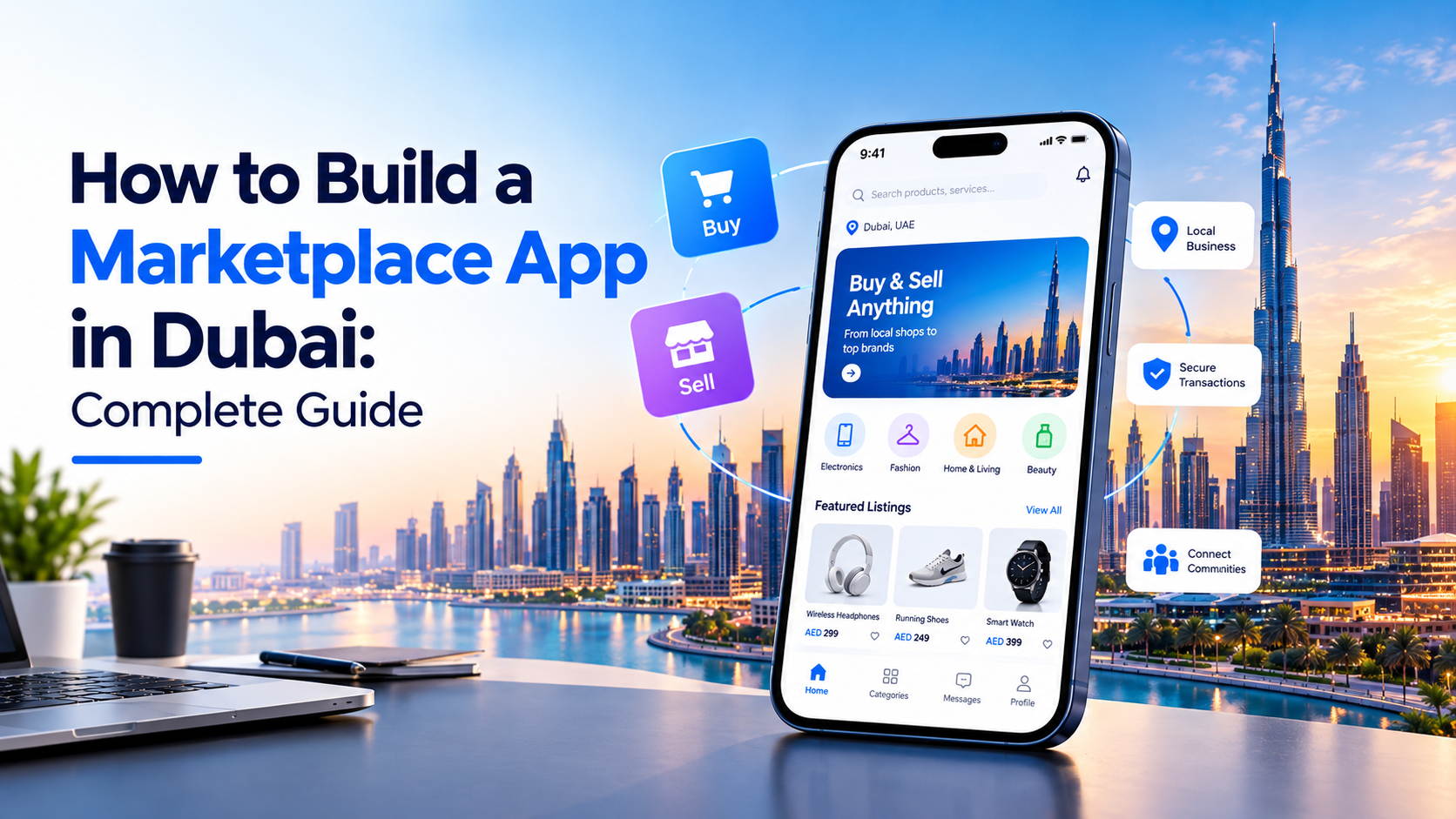
How to Build a Marketplace App in Dubai: Complete Guide
For founders and business owners planning to create a digital marketplace, choosing the right Marketplace App Development Company in Dubai can be an important step toward turning a business idea into a scalable mobile platform. A marketplace app can connect customers with multiple sellers, service providers, or businesses through one convenient digital ecosystem.
From product discovery and seller onboarding to payments, order management, commissions, notifications, and analytics, marketplace applications require considerably more planning than a standard mobile shopping app. The technology is only one part of the equation. Businesses also need to define their marketplace model, target customers, revenue strategy, seller experience, customer journey, and long-term growth plan.
Whether you are a startup founder with a new marketplace idea, an established business expanding into digital commerce, or an entrepreneur looking to build a niche platform, this guide explains the major steps involved in marketplace app development in Dubai.
What Is a Marketplace App?
A marketplace app is a digital platform that brings together multiple sellers, service providers, or businesses and customers in one application.
Unlike a single-vendor shopping app, where one company controls the products and transactions, a marketplace typically allows multiple businesses or independent sellers to offer products or services through the same platform.
Examples of marketplace business models include:
- Multi-vendor e-commerce
- Grocery marketplaces
- Fashion marketplaces
- Electronics marketplaces
- Food and restaurant platforms
- Beauty and wellness marketplaces
- Home-service marketplaces
- Automotive marketplaces
- Real-estate marketplaces
- B2B supplier marketplaces
- Local service marketplaces
The marketplace owner generally provides the technology, customer experience, seller management system, payment infrastructure, and operational framework.
The business may generate revenue through commissions, subscriptions, listing fees, advertising, transaction charges, delivery fees, or a combination of different models.
Why Should Businesses Build a Marketplace App in Dubai?
Dubai has a strong digital-business environment and is home to businesses across retail, hospitality, logistics, real estate, healthcare, professional services, and other industries.
For business owners, a marketplace app can create an opportunity to build a digital ecosystem rather than selling only one company’s products or services.
A well-planned marketplace can help businesses:
- Connect multiple sellers with customers
- Create a centralized digital platform
- Generate revenue from transactions or commissions
- Expand product and service selection
- Build a direct customer relationship
- Collect useful business insights
- Introduce loyalty and retention programs
- Scale into additional categories or locations
However, building a marketplace simply because the model is popular is not enough.
The platform needs a clear reason for customers and sellers to use it.
A successful marketplace should answer two fundamental questions:
Why should sellers join the platform?
Why should customers use it instead of existing alternatives?
Your answer to these questions should influence the product strategy from the beginning.
Types of Marketplace Apps You Can Build
Before development starts, founders should identify the marketplace model.
1. Product Marketplace
A product marketplace allows multiple sellers to list physical or digital products.
Typical features include:
- Seller registration
- Product listings
- Categories
- Search
- Filters
- Cart
- Checkout
- Payments
- Order tracking
- Seller dashboard
- Commission management
This model can work for fashion, electronics, grocery, beauty products, specialty goods, and many other categories.
2. Service Marketplace
A service marketplace connects customers with professionals or service providers.
For example, the platform could connect customers with:
- Home-service professionals
- Cleaning providers
- Maintenance companies
- Beauty professionals
- Consultants
- Fitness trainers
- Automotive service providers
Service marketplaces may require booking, availability, scheduling, location, reviews, and provider management.
3. B2B Marketplace
A B2B marketplace connects businesses with suppliers or other businesses.
It can include:
- Business accounts
- Supplier profiles
- Wholesale pricing
- Bulk ordering
- RFQ functionality
- Invoices
- Negotiation workflows
- Purchase management
- Supplier ratings
4. Niche Marketplace
A niche marketplace focuses on one specific industry or customer group.
This can be an attractive strategy for startups because a focused marketplace may allow the business to develop a clear value proposition instead of competing across every category.
How Does a Marketplace App Work?
A marketplace generally has three primary sides:
Customer Side
Customers can:
- Register or log in
- Browse sellers or products
- Search and filter
- View product or service details
- Add items to a cart or booking
- Make payments
- Track orders or bookings
- Rate sellers
- Receive notifications
Seller Side
Sellers or service providers can:
- Register
- Submit business information
- Complete verification
- Create their profile
- Add products or services
- Manage inventory or availability
- Receive orders
- Process orders
- View earnings
- Track performance
Admin Side
The marketplace owner can manage:
- Customers
- Sellers
- Products
- Categories
- Orders
- Payments
- Commissions
- Promotions
- Reviews
- Disputes
- Reports
- Notifications
- Content
- Platform settings
This three-sided structure is one reason marketplace development can be more complex than building a conventional business app.
Essential Features of a Marketplace App
The right features depend on the business model, but most marketplaces need a strong foundation.
Customer Registration and Login
Customers should have a straightforward registration process.
Depending on the product strategy, authentication can include:
- Mobile number
- Password
- OTP
- Supported social sign-in options
The objective should be to make account creation convenient without collecting unnecessary information.
Seller Registration and Onboarding
Seller onboarding is one of the most important marketplace workflows.
A seller may need to provide:
- Name or business name
- Contact details
- Business information
- Required documents
- Product or service categories
- Bank or payout information
The platform can then include an approval or verification process before sellers become active.
Seller Profiles
Customers should be able to understand who they are purchasing from.
A seller profile can display:
- Business name
- Logo
- Description
- Products or services
- Ratings
- Reviews
- Location
- Operating information
- Policies
For service marketplaces, availability and service areas may also be important.
Product or Service Listings
Sellers need an easy way to create and manage listings.
Product listings can include:
- Images
- Product name
- Description
- Price
- Discount
- Variants
- Availability
- Specifications
- Seller information
- Reviews
For service marketplaces, listings may instead include pricing, service descriptions, duration, availability, and booking information.
Search and Filters
Search is critical when a marketplace contains a large number of products or services.
Useful functionality can include:
- Keyword search
- Category filters
- Price filters
- Location
- Ratings
- Availability
- Brand
- Seller
- Sorting
- Personalized recommendations
The search experience should help customers reach relevant results quickly.
Cart and Checkout
For product marketplaces, the cart should provide a clear overview of selected items.
The checkout experience may include:
- Address
- Delivery option
- Order summary
- Discounts
- Taxes where applicable
- Payment method
- Order confirmation
If multiple sellers are involved in one transaction, the backend must also handle seller-specific order processing and settlement logic.
Payment Integration
A marketplace needs a reliable payment architecture.
Depending on the business model, payment functionality may support:
- Cards
- Digital payment methods
- Wallets
- Cash on delivery where appropriate
- Refunds
- Partial refunds
- Seller settlements
Marketplace payments can be more complicated than standard e-commerce because the platform may need to calculate commissions and manage seller payouts.
Order and Booking Management
Customers should be able to see the current status of their transactions.
Depending on the marketplace, statuses may include:
- Order placed
- Payment confirmed
- Processing
- Ready for dispatch
- Shipped
- Delivered
- Cancelled
- Refunded
A service marketplace may instead use:
- Booking requested
- Confirmed
- Scheduled
- In progress
- Completed
- Cancelled
Ratings and Reviews
Reviews can help establish trust between customers and sellers.
A marketplace can allow customers to rate:
- Products
- Sellers
- Services
- Delivery
- Overall experience
A moderation system should also be considered to handle inappropriate or fraudulent reviews.
Advanced Features for a Modern Marketplace App
Once the core marketplace is validated, businesses can introduce advanced functionality.
AI-Powered Recommendations
AI can help personalize product or service discovery.
For example, recommendations can be influenced by relevant signals such as:
- Search behaviour
- Product interactions
- Previous purchases
- Categories viewed
- Saved products
The exact approach depends on the available data and business requirements.
Intelligent Search
Traditional search may require customers to enter specific keywords.
An AI-assisted search experience can potentially understand more natural requests such as:
“Show me running shoes under AED 400.”
If product information is structured properly, the system can identify relevant attributes and return suitable results.
AI Shopping or Service Assistant
An AI assistant can help users:
- Find products
- Compare options
- Understand listings
- Answer common questions
- Navigate the platform
- Find relevant services
For complex issues, businesses should maintain appropriate human support.
Personalized Offers
A marketplace can use customer behaviour and business rules to present relevant promotions.
Examples include:
- Category-based offers
- Seller promotions
- Loyalty rewards
- Personalized discounts
- Referral benefits
Personalization should be useful rather than intrusive.
Seller Analytics
Seller dashboards can provide information such as:
- Sales
- Orders
- Revenue
- Product performance
- Customer reviews
- Conversion
- Inventory
- Payouts
This can give sellers a reason to remain active on the platform.
Loyalty and Rewards
Marketplace owners can create retention programs through:
- Points
- Memberships
- Referral rewards
- Coupons
- Cashback structures
- Exclusive offers
The exact model should support the marketplace’s economics rather than simply adding another feature.
Marketplace App Development Process
Building a marketplace requires a structured development process.
Step 1: Define the Business Model
Before development, establish:
- What will the marketplace sell?
- Who are the customers?
- Who are the sellers?
- How will sellers join?
- How will customers pay?
- How will sellers receive payouts?
- How will the platform generate revenue?
- What makes the marketplace different?
These decisions influence the entire application architecture.
Step 2: Research Customers and Competitors
Study the existing market.
Look at:
- Customer pain points
- Seller challenges
- Existing alternatives
- Pricing
- Commissions
- Customer experience
- Seller experience
- Delivery or fulfilment
- Reviews
- Gaps in current solutions
The objective should be to identify a real opportunity rather than simply replicate another marketplace.
Step 3: Define the MVP
An MVP should contain the minimum functionality required to test the business model.
For example, a product marketplace MVP might include:
- Customer registration
- Seller registration
- Seller approval
- Product listings
- Search
- Product details
- Cart
- Checkout
- Payment
- Orders
- Reviews
- Seller dashboard
- Admin dashboard
Advanced AI, complex loyalty systems, and sophisticated analytics can be added later if they are not essential to the initial launch.
Step 4: Create UI/UX Design
The design should consider three different user experiences:
Customer experience
How easily can customers discover and purchase?
Seller experience
How easily can sellers manage their business?
Admin experience
How easily can the marketplace operator control the platform?
A good marketplace design should make all three workflows understandable.
Step 5: Select the Technology
The technology stack can include:
- Android
- iOS
- Flutter
- React Native
- Backend APIs
- Database systems
- Cloud infrastructure
- Payment services
- Maps and location services
- Analytics
- Notification systems
- AI services
Technology should be selected based on the application’s actual requirements, expected scale, integrations, and long-term roadmap.
Step 6: Develop the Application
The development phase can involve:
- Customer application
- Seller application or seller portal
- Admin dashboard
- Backend
- APIs
- Database
- Authentication
- Payment workflows
- Notifications
- Business logic
For larger platforms, development may be organized into separate modules and releases.
Step 7: Integrate Third-Party Services
A marketplace may require integrations with:
- Payment providers
- Maps
- SMS
- Push notifications
- Delivery providers
- CRM
- ERP
- Analytics
- AI platforms
Every integration should be evaluated for reliability, security, pricing, and long-term availability.
Step 8: Test the Platform
Testing should cover both individual features and complete user journeys.
Important areas include:
- Registration
- Seller onboarding
- Product listing
- Search
- Cart
- Checkout
- Payment
- Order processing
- Seller payouts
- Notifications
- Reviews
- Admin workflows
- Security
- Performance
- Device compatibility
Marketplace testing is especially important because an issue affecting one user role can sometimes impact another part of the ecosystem.
Step 9: Launch the MVP
The first release should focus on the core marketplace experience.
Rather than waiting until every possible feature is complete, businesses can launch with a focused scope and collect real-world feedback.
Step 10: Improve Based on Data
After launch, monitor:
- Customer activity
- Seller activity
- Conversion
- Orders
- Abandoned carts
- Retention
- Reviews
- Support requests
- Platform performance
These insights can guide future development.
How Much Does Marketplace App Development Cost in Dubai?
There is no universal development price for a marketplace app.
The investment depends on:
- Marketplace type
- Number of platforms
- Customer features
- Seller features
- Admin functionality
- UI/UX complexity
- Backend architecture
- Payment integration
- Seller payouts
- Delivery integration
- Third-party APIs
- AI functionality
- Security
- Testing
- Cloud infrastructure
- Maintenance
A niche service marketplace with a focused MVP will have very different requirements from a large multi-vendor commerce platform with thousands of sellers.
The best way to estimate the investment is to define the MVP and technical scope first.
What Can Increase Marketplace Development Costs?
Multiple User Roles
Customer, seller, delivery partner, support staff, and administrator accounts all require different permissions and workflows.
Complex Seller Management
Seller verification, commissions, payouts, product approvals, inventory, and seller analytics can significantly expand the platform.
Payment and Settlement Logic
Marketplace transactions may require more sophisticated payment workflows than a standard shopping app.
Advanced Search
Large catalogues may require optimized indexing, filters, search infrastructure, and potentially AI-assisted discovery.
Real-Time Features
Live order tracking, chat, availability, and real-time notifications can add development complexity.
Custom Integrations
ERP, CRM, logistics, accounting, inventory, and other external systems can increase development requirements.
Scalability
A platform designed to support a growing number of sellers and customers needs an architecture that can evolve as usage increases.
Native vs Cross-Platform Marketplace Development
Businesses often consider native development or cross-platform frameworks.
Native development can provide platform-specific functionality and may be suitable for products with specialized requirements.
Cross-platform technologies such as Flutter or React Native can be useful when a business wants to support Android and iOS while using a shared development approach.
Neither option is automatically better.
The decision should consider:
- Target users
- Performance
- Required integrations
- Development resources
- Maintenance
- Budget
- Product roadmap
A capable Mobile App Development Company should explain these trade-offs based on your marketplace rather than recommending a technology simply because it is popular.
How to Choose a Marketplace App Development Company in Dubai
Choosing the right development partner is a business decision, not just a technical decision.
Before selecting a Marketplace App Development Company in Dubai, evaluate whether the company can understand both your marketplace model and the technology behind it.
Consider asking:
- Have they developed marketplace applications?
- Can they explain customer and seller workflows?
- How will seller onboarding work?
- How will commissions be calculated?
- How will seller payouts be handled?
- How will payments be integrated?
- How will the platform scale?
- How will security be managed?
- What testing process will be followed?
- What support is available after launch?
- Who owns the source code and product assets?
- Can they help define the MVP?
Do not select a company solely because it offers the lowest quotation.
The cheapest development option can become expensive if the architecture is difficult to maintain or important requirements were excluded from the initial scope.
Working With a Mobile App Development Company in Dubai
A Mobile App Development Company in Dubai can potentially support the complete product journey, including strategy, UI/UX, mobile development, backend engineering, integrations, testing, deployment, and maintenance.
For founders researching Mobile App Development Dubai, the important question should not simply be, “Who can build my app?”
A better question is:
“Who can help me build the right marketplace product for my customers and business model?”
A development partner should be able to translate business requirements into practical product features and explain technical decisions in language that business stakeholders can understand.
Mobile App Development Company in UAE: What Should You Expect?
A Mobile App Development Company in UAE working on a marketplace should understand that the project involves more than mobile screens.
The broader product may include:
- Customer application
- Seller application or portal
- Admin dashboard
- Backend
- APIs
- Payment infrastructure
- Notifications
- Analytics
- Security
- Cloud infrastructure
- Third-party integrations
For platform-specific development, businesses may also evaluate an Android App Development Company or an iOS App Development Company depending on their target users and product requirements.
The best development approach is the one that supports the business roadmap.
How A2Solutions Can Help Build a Marketplace App
A2Solutions can help businesses transform a marketplace concept into a structured digital product.
The development journey can include:
- Product discovery
- Business requirement analysis
- Marketplace strategy
- UI/UX design
- Customer app development
- Seller functionality
- Admin dashboard
- Backend development
- API integration
- Payment integration
- Third-party integrations
- AI integration
- Testing
- Deployment
- Maintenance
- Future product improvements
For founders, the objective should be to create a marketplace that is useful for customers, valuable for sellers, and manageable for the business operating the platform.
Starting with a focused MVP can help establish the foundation before introducing more advanced capabilities.
What Founders Should Prepare Before Starting Development
Before approaching a development company, create a basic marketplace brief.
Include the following:
1. Marketplace Concept
Explain what the platform will offer and which problem it solves.
2. Target Customers
Define who will use the marketplace and why they would choose it.
3. Seller Profile
Identify the types of sellers or service providers you want to attract.
4. Revenue Model
Decide whether the platform will earn through:
- Commission
- Subscription
- Listing fees
- Advertising
- Transaction fees
- Delivery charges
- Premium seller plans
5. Marketplace Rules
Define seller approval, product moderation, cancellations, refunds, disputes, and other important policies.
6. MVP Scope
Separate essential launch features from future enhancements.
7. Platform Requirements
Decide whether you need Android, iOS, web, or multiple platforms.
8. Future Roadmap
Think about potential additions such as:
- AI
- Personalization
- Loyalty
- Advanced analytics
- Seller advertising
- Subscriptions
- Automation
- International expansion
This preparation can make discussions with a development partner significantly more productive.
Final Thoughts
Building a marketplace app in Dubai is not simply a mobile development project. It is the creation of a digital ecosystem connecting customers, sellers, service providers, and the business operating the platform.
For founders and business owners, the strongest starting point is to define the marketplace opportunity before selecting technology.
Understand your target customers, identify the sellers you want to attract, establish how the platform will make money, define the customer and seller experience, and determine which features are essential for the first release.
A focused MVP can provide the foundation for testing the marketplace concept without unnecessarily building every advanced feature from day one.
As the platform grows, businesses can introduce AI recommendations, intelligent search, loyalty programs, personalized experiences, advanced analytics, seller advertising, automation, and other capabilities where they create genuine value.
If you are planning to build a marketplace app for customers in Dubai, the UAE, or a wider market, A2Solutions can help turn the concept into a structured mobile product covering strategy, design, development, integrations, testing, launch, and future improvements.
The objective should not simply be to build an app. It should be to build a marketplace that customers want to use, sellers want to join, and your business can sustainably grow.
Frequently Asked Questions
How much does it cost to build a marketplace app in Dubai?
Marketplace app development costs vary depending on the business model, number of platforms, features, seller functionality, backend architecture, payment systems, integrations, security, testing, and scalability requirements. A focused MVP will have different requirements from a large multi-vendor marketplace.
How long does it take to develop a marketplace app?
The timeline depends on the scope, number of user roles, platforms, UI/UX complexity, integrations, backend requirements, testing, and development approach. A focused MVP can generally be planned more efficiently than a full-scale marketplace.
What are the most important marketplace app features?
Core features typically include customer registration, seller onboarding, profiles, product or service listings, search, filters, checkout or booking, payments, order management, reviews, notifications, seller management, and an admin dashboard.
Should I build Android and iOS apps at the same time?
That depends on your target audience and business strategy. If customers are spread across both ecosystems, launching both may make sense. A cross-platform approach can also be considered when appropriate. The decision should be based on users, functionality, budget, and long-term plans.
Can AI be added to a marketplace app?
Yes. AI can support recommendations, intelligent search, customer assistance, personalization, product categorization, analytics, and other workflows. However, AI should be introduced when it provides a clear customer or business benefit.
Is a marketplace app more complex than a normal e-commerce app?
Usually, yes. A marketplace may need to support customers, multiple sellers, seller onboarding, commissions, payouts, product management, orders, reviews, administration, and potentially delivery partners. These additional workflows increase technical complexity.
Can I launch a marketplace with an MVP?
Yes. An MVP can focus on the essential customer, seller, payment, and administration workflows. Once the business validates demand, additional functionality can be introduced based on customer and seller feedback.
What should I look for in a marketplace app development company?
Look for marketplace experience, strong mobile and backend capabilities, UI/UX expertise, payment and API integration experience, security and testing practices, transparent project scope, communication, ownership terms, and post-launch support.
Also Read:- E-commerce App Development in Dubai: Features, Cost & Process
