




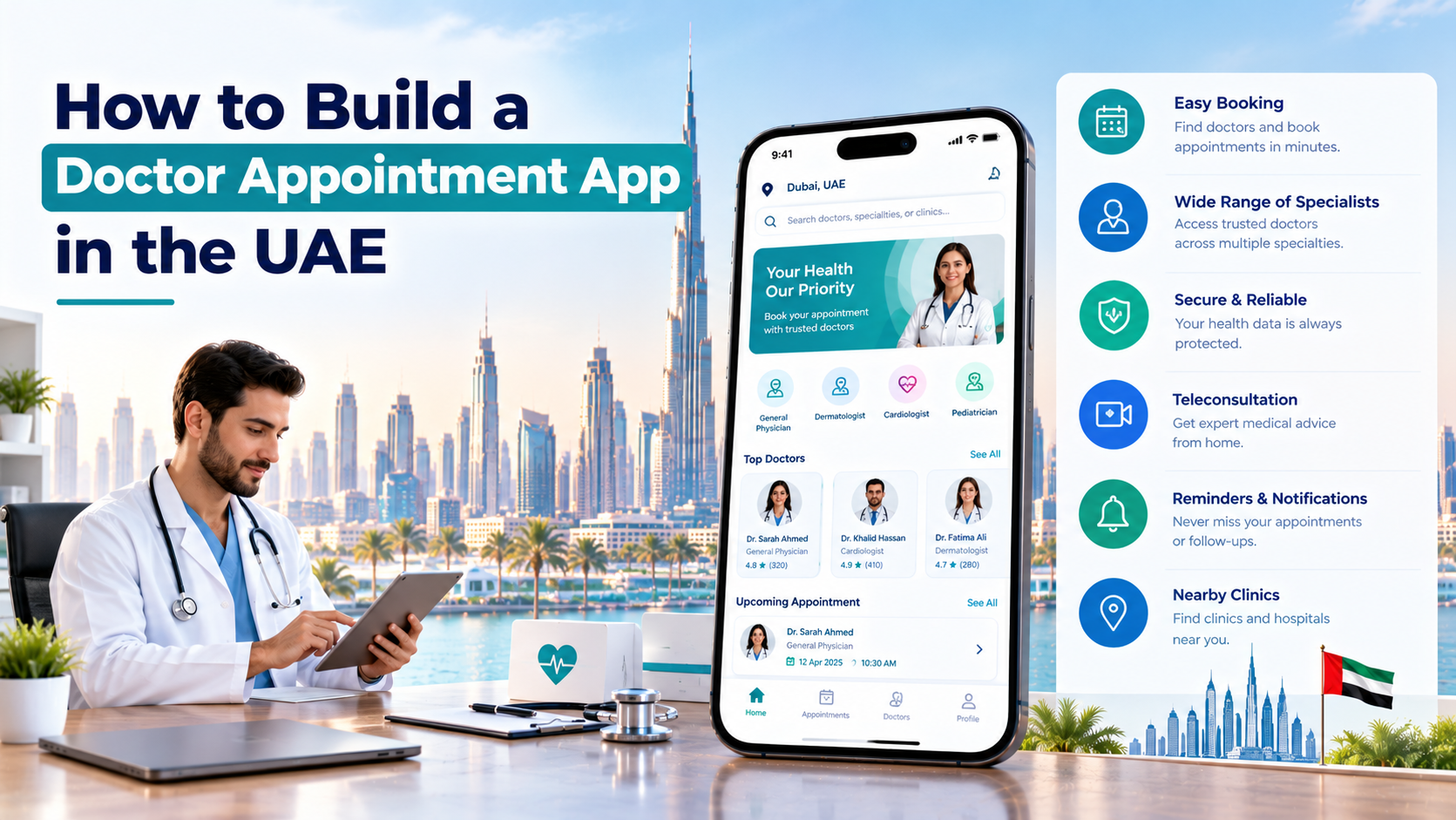
How to Build a Doctor Appointment App in the UAE
For founders, healthcare entrepreneurs, clinics, and business owners planning to launch a digital healthcare platform, choosing the right Doctor Appointment App Development Company in Dubai can be an important step toward turning a healthcare idea into a scalable digital service. A well-designed doctor appointment app can help patients discover healthcare providers, check availability, book appointments, receive reminders, make eligible payments, and communicate with healthcare providers through supported digital channels.
The UAE is an attractive market for businesses exploring digital healthcare solutions, but a successful application requires more than appointment scheduling. Businesses need to consider user experience, provider workflows, security, integrations, scalability, and applicable healthcare and data requirements.
This guide explains how to build a doctor appointment app in the UAE, including essential features, development stages, technology choices, cost factors, security considerations, monetization opportunities, and practical advice for businesses planning their own healthcare application.
What Is a Doctor Appointment App?
A doctor appointment app is a mobile or web-based platform that allows patients to find healthcare providers and manage appointments digitally.
Depending on the business model, the application may connect patients with individual doctors, clinics, hospitals, specialist centers, or multiple healthcare providers.
A typical doctor appointment platform can include:
- Patient registration and login
- Doctor and clinic profiles
- Specialty-based search
- Location-based discovery
- Appointment availability
- Online appointment booking
- Appointment cancellation and rescheduling
- Notifications and reminders
- Online payments where applicable
- Doctor-patient communication
- Teleconsultation functionality
- Digital documents or prescriptions where supported
- Ratings and reviews
- Admin dashboard
- Reports and analytics
The exact functionality depends on whether you are building an application for a single clinic, a healthcare group, or a multi-provider marketplace.
Why Should Businesses Build a Doctor Appointment App in the UAE?
A doctor appointment application can become more than a booking tool. For the right business model, it can become a digital channel connecting patients, healthcare professionals, clinics, and supporting services.
Improve Patient Convenience
Patients can search for suitable healthcare providers, view available appointment slots, and manage bookings from their smartphones.
Instead of depending entirely on telephone calls or manual scheduling, businesses can provide a more convenient digital experience.
Reduce Manual Appointment Management
A properly connected scheduling system can help healthcare organizations manage appointments, availability, cancellations, and reminders from a centralized platform.
This can reduce some repetitive administrative work and provide staff with better visibility into schedules.
Increase Digital Patient Engagement
A mobile app provides an ongoing communication channel between a healthcare business and its users.
Depending on the service, businesses can use notifications for appointment reminders, follow-ups, service updates, and other appropriate communications.
Create a Scalable Healthcare Business
Entrepreneurs can build specialized healthcare platforms around specific markets.
Examples include:
- General doctor booking
- Specialist consultations
- Dental appointments
- Dermatology appointments
- Pediatric healthcare
- Women’s healthcare
- Home healthcare
- Telemedicine
- Corporate healthcare
- Wellness services
The strongest opportunity is usually not to copy every feature of an established platform. Instead, identify a specific patient or healthcare-provider problem and build a solution around it.
Types of Doctor Appointment Apps You Can Build
Before development starts, determine which type of application you want to create.
Single-Clinic Appointment App
A clinic can build its own application where patients can:
- View doctors
- Browse services
- Check availability
- Book appointments
- Receive reminders
- Contact the clinic
- Manage their profiles
This model is suitable for clinics and healthcare organizations wanting to build a direct digital relationship with their patients.
Multi-Clinic Appointment Marketplace
A marketplace connects patients with multiple healthcare providers.
Users can search providers based on factors such as specialty, location, availability, or other relevant criteria.
The business can potentially generate revenue through booking fees, commissions, subscriptions, or provider plans depending on the operating model.
Specialist Appointment Platform
A business can focus on one healthcare category, such as dental care, dermatology, physiotherapy, mental wellness, or another specialty.
A focused platform can make it easier to build a differentiated value proposition.
Telemedicine and Appointment Platform
Businesses can combine appointment booking with remote consultations where appropriate.
Users can book a consultation and then access the supported digital consultation workflow through the application.
Essential Features of a Doctor Appointment App
A successful appointment application should prioritize the core patient journey before adding advanced functionality.
Patient Registration and Login
Users should be able to create accounts through a simple and secure registration process.
Possible options include:
- Mobile number registration
- Email registration
- Secure password authentication
- OTP verification where appropriate
- Profile management
- Password recovery
- Privacy preferences
- Notification settings
Only information required for the service should be collected.
Doctor Profiles
Doctor profiles help users make informed decisions before booking an appointment.
Depending on the platform, profiles may include:
- Doctor name
- Specialty
- Professional information
- Clinic location
- Consultation type
- Available appointment slots
- Languages supported
- Professional verification information where appropriate
- Consultation fees where applicable
Healthcare credentials and professional information should come from reliable and appropriately verified sources.
Search and Filters
A marketplace-style application should make provider discovery simple.
Users may be able to search by:
- Specialty
- Location
- Doctor
- Clinic
- Availability
- Consultation type
- Other relevant categories
The goal is to help users reach the appropriate booking option with as few unnecessary steps as possible.
Appointment Booking
Appointment booking is the core feature.
A typical booking process can be:
- Search for a doctor or specialty.
- Open the provider profile.
- Select a service.
- View available dates and times.
- Select a suitable slot.
- Confirm the appointment.
- Complete eligible payment if required.
- Receive confirmation and reminders.
The backend should keep appointment availability synchronized to minimize scheduling conflicts.
Appointment Rescheduling and Cancellation
Users should be able to manage their appointments according to the business’s policies.
The system can support:
- Rescheduling
- Cancellation
- Appointment status
- Confirmation
- No-show tracking
- Refund workflows where applicable
Notifications and Reminders
Automated notifications can help users remember upcoming appointments.
Notifications may cover:
- Booking confirmation
- Appointment reminders
- Schedule changes
- Cancellation
- Rescheduling
- Payment status
- Relevant service notifications
Sensitive healthcare information should not unnecessarily appear in notification previews.
Online Payments
If the business charges patients for eligible services, the application can integrate a suitable payment gateway.
The system may support:
- Consultation payments
- Appointment fees
- Service payments
- Refund workflows
- Payment confirmations
- Transaction records
Payment integration should follow appropriate security practices and use authorized payment providers.
Doctor or Clinic Dashboard
Healthcare providers need their own tools to manage appointments.
A provider dashboard may include:
- Appointment calendar
- Availability management
- Patient booking information
- Appointment status
- Notifications
- Profile management
- Consultation scheduling
- Reports
The interface should be designed around the actual workflow of the healthcare organization.
Admin Dashboard
The business owner or platform administrator can manage the overall system through an administrative dashboard.
Typical functions include:
- Patient management
- Doctor management
- Clinic management
- Appointment management
- Payments
- Provider verification
- Content management
- Support requests
- Reports
- Analytics
- Access permissions
Advanced Features for a Modern Doctor Appointment App
Once the core appointment system is stable, businesses can introduce advanced capabilities.
Telemedicine
Video or audio consultation functionality can allow eligible healthcare providers to conduct remote appointments.
Depending on the service, the system may include:
- Scheduled consultations
- Secure consultation sessions
- Appointment reminders
- Provider availability
- Consultation history
- Follow-up workflows
Healthcare businesses should evaluate privacy, security, consent, and applicable requirements before introducing telemedicine.
AI-Powered Appointment Assistance
AI can support administrative tasks such as helping users navigate the appointment process, finding relevant information, answering general service questions, or assisting with scheduling workflows.
AI used for health-related recommendations or clinical decisions requires significantly greater consideration around validation, oversight, safety, privacy, and applicable requirements.
Smart Appointment Recommendations
The application could use available information such as specialty, location, appointment type, and availability to make provider discovery easier.
The goal should be to improve navigation rather than make unsupported medical decisions.
Digital Waiting List
If an appointment becomes unavailable, users can potentially join a waiting list.
When an eligible slot becomes available, the system can notify users according to the platform’s rules.
Loyalty and Membership Programs
Healthcare businesses may introduce suitable membership or loyalty models where commercially and legally appropriate.
Examples could include:
- Membership plans
- Subscription packages
- Corporate healthcare programs
- Service bundles
The model should be designed around the actual healthcare business rather than added simply as an app feature.
Doctor Appointment App Development Process
Building a healthcare application requires structured planning.
Step 1: Define the Business Model
First determine what you are building.
Ask:
- Is this for one clinic?
- Will multiple doctors join?
- Will multiple clinics participate?
- Will patients pay through the platform?
- Will the platform include telemedicine?
- How will the business generate revenue?
A clear business model makes later technical decisions easier.
Step 2: Identify Your Target Users
Define the main users.
They may include:
- Patients
- Doctors
- Clinics
- Hospitals
- Reception staff
- Administrators
Each user group requires different screens, permissions, and workflows.
Step 3: Define the MVP
An MVP should contain the minimum functionality required to operate the core service.
For a doctor appointment platform, an MVP could include:
- Patient registration
- Doctor profiles
- Search
- Availability
- Appointment booking
- Notifications
- Basic payments
- Doctor dashboard
- Admin dashboard
Advanced features can be added after the core experience is validated.
Step 4: Design the UI/UX
Healthcare applications should prioritize clarity and ease of use.
Design should make important actions such as finding a provider and booking an appointment straightforward.
The design process can include:
- User-flow mapping
- Wireframes
- Interactive prototypes
- UI design
- Usability testing
Step 5: Choose the Technology
The technology stack should be selected based on:
- Number of users
- Platforms
- Backend requirements
- Security
- Integrations
- Scalability
- Budget
- Long-term maintenance
A suitable Mobile App Development Company in UAE can help evaluate these choices based on the project rather than selecting technology purely because it is popular.
Step 6: Develop the Application
Development generally includes:
- Mobile applications
- Backend
- APIs
- Database
- Admin dashboard
- Provider dashboard
- Payment integrations
- Notification systems
- Third-party integrations
Step 7: Test the Platform
Testing should cover:
- Functionality
- Appointment workflows
- Payment processes
- API security
- Authentication
- Permissions
- Performance
- Device compatibility
- Notifications
- User experience
Healthcare applications should receive appropriate security testing before launch.
Step 8: Launch and Improve
Launching the first version is not the end of development.
Businesses should monitor:
- Booking completion
- User feedback
- Appointment cancellations
- Technical errors
- Support requests
- Provider adoption
- App performance
Future features should be based on actual user and business requirements.
How Much Does It Cost to Build a Doctor Appointment App in the UAE?
The cost depends heavily on the application’s scope.
As a broad planning framework:
| App Type | Indicative Development Range |
|---|---|
| Basic appointment MVP | $20,000–$40,000 |
| Multi-doctor appointment app | $35,000–$60,000 |
| Multi-clinic platform | $50,000–$90,000+ |
| Appointment + telemedicine platform | $60,000–$100,000+ |
| Advanced healthcare marketplace | $100,000+ |
These are illustrative planning ranges, not fixed market prices or quotations.
The actual budget can change considerably based on the number of platforms, user roles, integrations, security requirements, design complexity, backend architecture, and advanced functionality.
Factors That Increase Development Cost
Multiple Applications
A platform containing patient, doctor, clinic, and admin applications will require more development and testing than a single application.
Custom Design
A highly customized UX requires additional research, prototyping, design, and testing.
Third-Party Integrations
Integrations with payment providers, video services, healthcare systems, notifications, maps, identity verification, or other services can increase development effort.
Advanced Security
Healthcare applications require appropriate controls for authentication, authorization, data protection, monitoring, and security testing.
AI Features
AI-powered functionality may introduce additional development, infrastructure, integration, testing, and ongoing operational costs.
Complex Backend
A marketplace serving many healthcare providers requires more sophisticated scheduling, availability, permissions, reporting, and administrative capabilities.
Android or iOS: Which Platform Should You Build First?
The right platform depends on your target users and business strategy.
An Android App Development Company can develop an Android version, while an iOS App Development Company can build the application for Apple’s ecosystem.
Businesses can choose:
- Android first
- iOS first
- Both platforms simultaneously
- Cross-platform development
Cross-platform development can reduce duplicated development work when the application’s requirements are suitable for a shared codebase.
However, healthcare businesses should consider more than initial development cost. Device compatibility, security, performance, notifications, integrations, accessibility, and future maintenance should also influence the decision.
Healthcare App Security and Privacy
Security should be planned from the beginning of the project.
A doctor appointment platform may process personal information and potentially sensitive healthcare-related information.
Important considerations include:
Secure Authentication
Use appropriate authentication and account-security mechanisms based on the application and risk profile.
Role-Based Access
Patients should not have access to provider or administrative information that they are not authorized to see.
Likewise, healthcare staff should only receive the access necessary for their role.
Data Encryption
Sensitive information should be protected during transmission and, where appropriate, while stored.
Secure APIs
APIs connecting the mobile application, backend, payment systems, appointment systems, and other services should use appropriate authentication, authorization, validation, and monitoring.
Audit Logging
Important actions can be logged to support accountability and operational monitoring.
Regular Security Testing
Security should be assessed before launch and maintained throughout the application’s lifecycle.
UAE Healthcare and Compliance Considerations
Healthcare applications operating in the UAE may be subject to healthcare, privacy, data protection, licensing, and other requirements depending on the business model and services provided.
The applicable requirements can differ based on factors such as:
- Healthcare service type
- Emirate
- Organization structure
- Data processed
- Healthcare providers involved
- Storage and processing arrangements
- Telemedicine functionality
- Third-party integrations
Before development begins, businesses should determine what information will be collected, who will access it, how it will be processed, and what requirements apply to the intended service.
A technology partner can help implement technical controls, but businesses should obtain qualified UAE healthcare, legal, and regulatory advice for compliance decisions.
This is particularly important when an application handles medical information, facilitates healthcare services, or introduces remote consultation functionality.
How Can a Doctor Appointment App Make Money?
A doctor appointment platform can use different revenue models depending on its target market.
Commission Model
The platform can potentially charge a commission on eligible bookings made through participating providers.
Subscription Model
Doctors or clinics can pay a recurring fee to use the platform.
Featured Listings
Providers may pay for enhanced visibility where the model is appropriate and transparent.
Corporate Healthcare Programs
Businesses can potentially offer appointment or healthcare-management services to corporate customers.
Service Fees
A platform may charge applicable service or booking fees depending on its business model and applicable requirements.
The monetization strategy should be decided before development because it can influence platform architecture, payment workflows, provider management, and reporting.
How to Choose a Doctor Appointment App Development Company in Dubai
Choosing a development partner should not be based solely on the lowest quotation.
When evaluating a Mobile App Development Company in Dubai, consider:
- Healthcare technology experience
- Mobile development capabilities
- Backend expertise
- UI/UX design
- API development
- Security practices
- Testing methodology
- Third-party integration experience
- Scalability planning
- Post-launch support
- Documentation
- Code ownership
Ask potential development partners to explain how they would approach your specific business model.
A good proposal should clearly explain:
- Project scope
- Features
- Platforms
- Development phases
- Technology stack
- Integrations
- Testing
- Deployment
- Maintenance
- Estimated investment
This makes it easier to compare proposals from different development teams.
Working With a Healthcare App Development Partner in the UAE
A reliable Healthcare App Development UAE strategy should begin with the business problem rather than the technology.
For example, if the main problem is appointment management for a clinic, the first version may not require an extensive marketplace, AI engine, or complex telemedicine system.
If the goal is to create a nationwide healthcare marketplace, the architecture will need to account for multiple providers, schedules, user roles, payments, verification, scalability, and operational management.
The scope should therefore be designed around the intended business model.
How A2Solutions Can Help Build a Doctor Appointment App
A2Solutions can work with businesses planning healthcare and appointment-based mobile applications by helping translate the business concept into a structured digital product.
Depending on the project requirements, development can cover:
- Patient mobile applications
- Doctor applications
- Clinic applications
- Appointment scheduling
- Provider profiles
- Admin dashboards
- Backend development
- API integrations
- Payment integration
- Notifications
- Telemedicine functionality
- Analytics and reporting
- Security-focused development and testing
The right feature set depends on the healthcare service, target users, operating model, and intended market.
For startups and businesses validating a new idea, beginning with a focused MVP can be a practical way to test the core concept before expanding the platform.
What Should Founders Prepare Before Building the App?
Before approaching a development company, prepare a basic project brief.
Include:
- Your healthcare business idea
- Target users
- Target UAE market
- Main services
- Revenue model
- Required platforms
- Core features
- Expected integrations
- Healthcare providers involved
- Security expectations
- Approximate budget
- Expected launch timeline
You do not need a complete technical specification before contacting a development partner.
A professional development team can help convert the initial business idea into user flows, technical requirements, development phases, and a realistic project scope.
Frequently Asked Questions
How much does it cost to build a doctor appointment app in the UAE?
A basic appointment MVP may start around $20,000–$40,000, while multi-provider platforms and telemedicine solutions can cost considerably more. The final budget depends on features, platforms, integrations, security, and complexity.
How long does it take to develop a doctor appointment app?
A focused MVP may take approximately three to six months. More complex platforms involving multiple user roles, telemedicine, advanced integrations, and extensive backend functionality can take six to twelve months or longer.
What are the most important features of a doctor appointment app?
Core features usually include patient registration, doctor profiles, search, availability, appointment booking, reminders, appointment management, payments where applicable, provider dashboards, and an admin panel.
Can I build a doctor appointment app for multiple clinics?
Yes. A multi-clinic platform can allow different healthcare providers to manage profiles, availability, appointments, and other workflows through separate accounts and permissions.
Can I add telemedicine to an appointment app?
Yes. Telemedicine functionality can be integrated where appropriate. The implementation should account for security, consent, privacy, provider workflows, technical requirements, and applicable UAE healthcare requirements.
Can AI be added to a doctor appointment app?
Yes. AI can support functions such as appointment assistance, information retrieval, administrative automation, and workflow support. Clinical or health-related AI functions require additional validation, oversight, privacy safeguards, and appropriate compliance consideration.
Should a healthcare startup build an MVP first?
For many startups, an MVP can be a practical way to validate the core business model before investing in a larger platform. However, essential security, privacy, safety, and applicable compliance requirements should not be treated as optional MVP features.
Should I build Android or iOS first?
The decision depends on your target audience, business model, budget, and product strategy. If your target users are spread across both platforms, launching on both or using an appropriate cross-platform approach may be considered.
Final Thoughts
Building a doctor appointment app in the UAE can create opportunities for clinics, healthcare startups, entrepreneurs, hospitals, specialist providers, and businesses developing new digital healthcare services.
The most successful approach is not simply to create an application with a long list of features. Start by identifying a genuine healthcare problem, understand the needs of patients and providers, define a practical business model, and build the core experience around those needs.
From appointment booking and provider discovery to payments, notifications, telemedicine, AI-assisted workflows, and analytics, features should be introduced based on genuine business and user requirements.
Security and applicable UAE healthcare considerations should also be addressed from the beginning rather than added after development.
For founders and business owners planning a healthcare platform, a focused MVP can provide a practical starting point. As the business gains users and validates its model, additional functionality can be introduced to create a broader healthcare ecosystem.
With the right strategy, technology architecture, UX, security approach, and development partner, a doctor appointment application can become a valuable digital channel for healthcare businesses serving users in Dubai and across the UAE.
Also Read:- Healthcare App Development in Dubai: Features & Development Cost
