




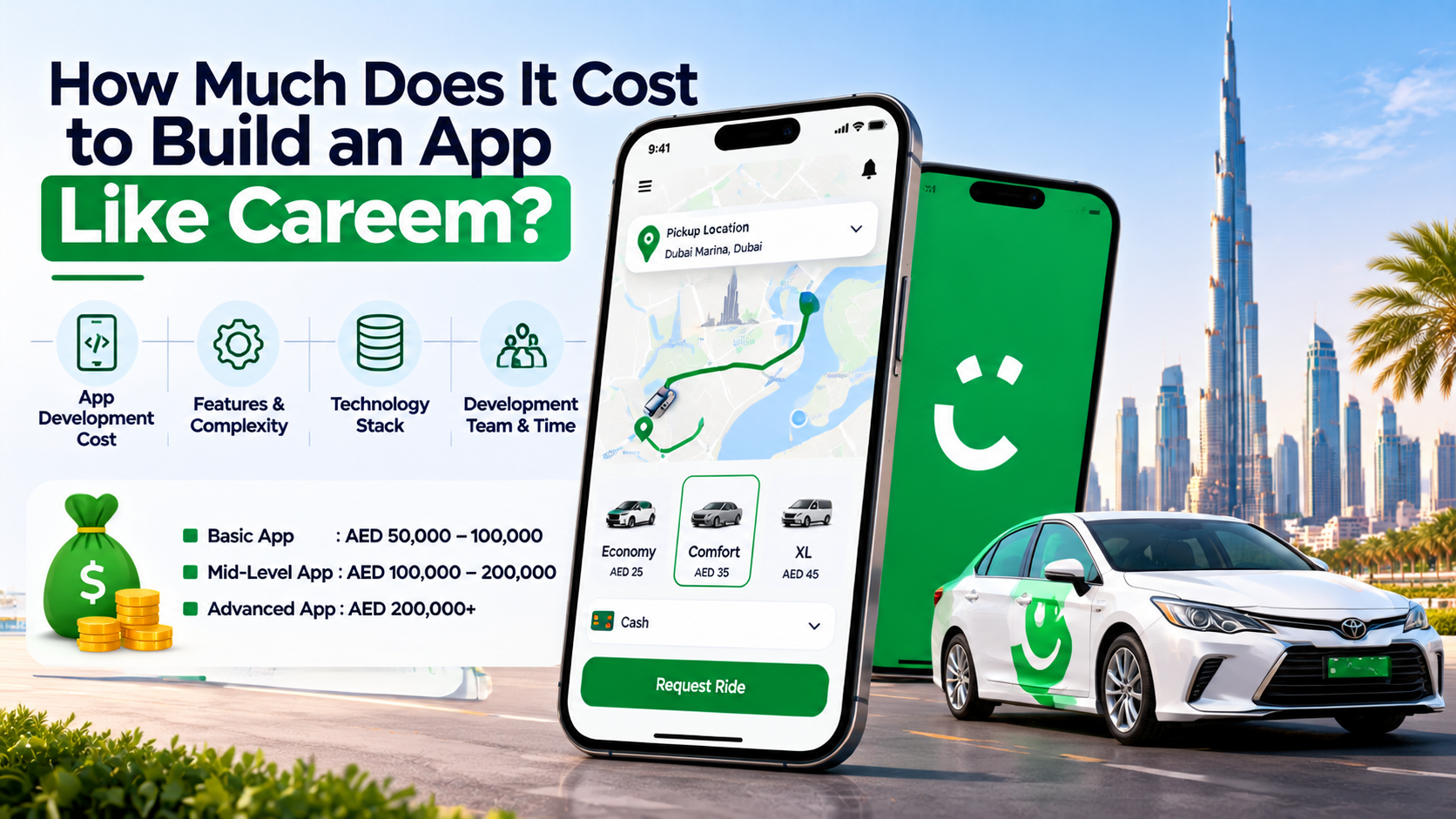
How Much Does It Cost to Build an App Like Careem?
For founders and business owners planning to enter the ride-hailing industry, understanding the App Like Careem Cost is an important first step before investing in development. The total budget depends on the features you need, the number of user applications, the technology stack, third-party integrations, and the scale of your launch. Whether you are a startup testing a new transportation concept or an established business expanding into digital mobility, building the right app begins with a clear business model and a realistic development plan.
A ride-hailing platform is more than a passenger booking application. It typically includes a passenger app, a driver app, an administration dashboard, a backend system, location tracking, fare calculation, and payment integrations. Planning these components carefully can help businesses manage development costs while creating a platform that can grow with demand.
How Much Does It Cost to Build an App Like Careem?
Building a ride-hailing app similar in concept to Careem can cost approximately $20,000 to $150,000 or more, depending on complexity, features, integrations, and development requirements. A basic MVP will generally cost less than a feature-rich platform designed for multiple cities and large numbers of users.
The following figures are indicative planning estimates, not quotations. Actual prices vary by development partner, project scope, and business requirements.
| App Type | Estimated Development Cost |
|---|---|
| Basic ride-hailing MVP | $20,000–$40,000 |
| Mid-level ride-hailing app | $40,000–$80,000 |
| Advanced ride-hailing platform | $80,000–$150,000+ |
| Large-scale, multi-city platform | $150,000+ |
These estimates refer to software development and may not include every expense associated with launching a transportation business. Driver recruitment, marketing, operational staffing, insurance, regulatory approvals, and ongoing service costs should be budgeted separately.
For businesses launching in Dubai or elsewhere in the UAE, it is especially important to define the initial service area, operating model, payment methods, and local compliance requirements before finalizing the budget.
What Features Affect the Cost of a Careem-Like App?
The features you choose have a direct effect on development time, testing requirements, and overall cost. A simple booking flow is less complex than a complete platform with automated dispatch, advanced analytics, corporate accounts, and multiple vehicle categories.
1. Passenger Application
The passenger app is the main interface customers use to request rides and manage their journeys.
Common features include:
- Registration and secure login
- Profile and contact management
- GPS-based pickup and destination selection
- Fare estimates
- Ride booking and cancellation
- Real-time driver tracking
- Multiple payment options
- Ride history and digital receipts
- Ratings, reviews, and customer support
- Promotions and referral codes
A basic version can focus on essential booking functionality. Features such as scheduled rides, loyalty programs, saved locations, and multiple ride categories can be added as the business grows.
2. Driver Application
The driver app allows drivers to receive ride requests, navigate to passengers, and manage their trips.
Typical features include:
- Driver registration and document submission
- Profile and vehicle details
- Availability status
- Incoming ride requests
- Accepting or declining bookings
- Navigation and route guidance
- Trip status updates
- Earnings and trip history
- Notifications
- Ratings and support
Driver onboarding can require additional workflows for document review, account approval, and vehicle verification. The exact requirements depend on the business model and applicable local rules.
3. Admin Dashboard
The administration dashboard gives the business control over the platform’s operations.
It may include:
- Passenger and driver management
- Booking and trip monitoring
- Fare and commission settings
- Service area management
- Promotions and discounts
- Payment and refund records
- Customer support tools
- Reports and business analytics
- Driver verification workflows
- Access permissions for staff
A well-designed dashboard helps operators oversee daily activities without manually managing every booking.
4. Backend, APIs, and Integrations
The backend connects the passenger app, driver app, dashboard, and external services. It handles accounts, ride requests, driver matching, trip status, notifications, payment workflows, and data management.
Integrations may include mapping and navigation services, payment gateways, SMS or email notifications, analytics, and customer support tools. Each integration has implementation and testing requirements, while some providers also charge recurring usage fees.
How Much Does Each Part of the App Cost?
A project budget becomes easier to manage when the main components are estimated separately. The following ranges are illustrative allocations for planning purposes and are not fixed market rates.
| Component | Indicative Cost |
|---|---|
| UI/UX design | $2,000–$8,000 |
| Passenger app | $5,000–$20,000 |
| Driver app | $5,000–$20,000 |
| Backend and APIs | $5,000–$25,000 |
| Admin dashboard | $3,000–$12,000 |
| Third-party integrations | $2,000–$10,000 |
| Testing and deployment | $2,000–$8,000 |
These ranges should not simply be added together to produce a final quotation. Some estimates overlap, and project scope, team structure, reusable components, and technical architecture can change the overall cost considerably.
Ask your development partner for a project-specific breakdown showing deliverables, assumptions, exclusions, milestones, and ongoing costs.
What Factors Increase the Cost of Building an App Like Careem?
Several decisions can significantly affect the final development budget.
Advanced Features
Features such as AI-assisted driver matching, demand forecasting, automated customer support, dynamic pricing, and personalized recommendations can require additional data, development, testing, and monitoring.
Businesses do not necessarily need all these features at launch. Starting with the core booking experience can help validate the business model before investing in advanced capabilities.
Multiple Cities and Vehicle Categories
Launching in one service area is usually simpler than supporting several cities, each with different operating rules, fare structures, and driver availability. Adding taxis, premium vehicles, delivery services, or other transport categories can also increase complexity.
Custom UI/UX Design
A distinctive brand experience requires thoughtful user research, interface design, accessibility considerations, and usability testing. Custom designs can improve the customer experience, but the number of screens and workflows affects the effort involved.
Payment and Business Integrations
Integrating payment providers, corporate billing, accounting tools, loyalty systems, or external fleet-management services can increase the development scope. Some integrations also require approval processes or additional compliance checks.
Security, Reliability, and Scalability
Ride-hailing applications handle personal information, location data, trip records, and payment-related workflows. Secure authentication, access controls, appropriate data protection, error handling, and testing are essential.
A platform intended to support substantial growth may also need stronger monitoring, infrastructure planning, and performance testing than a small pilot application.
Should You Build an MVP or a Full-Scale Ride-Hailing Platform?
For many startups and first-time app founders, an MVP—or minimum viable product—is a sensible way to enter the market.
An MVP includes the smallest practical set of features needed to test the business concept with real users. Instead of immediately developing every feature associated with a mature ride-hailing platform, you can focus on:
- Passenger registration and ride booking
- Driver registration and ride acceptance
- Basic GPS and navigation integration
- Fare estimation
- Essential payment workflows
- Trip status updates
- Admin controls
- Basic reporting and support
After launch, feedback and usage data can help determine which features deserve investment next.
A full-scale platform may be appropriate for a business with an established customer base, operational capacity, funding, and a clearly defined expansion strategy. The right choice depends on the business objectives—not simply on how many features competitors offer.
Android vs. iOS: Which Is More Cost-Effective?
Your platform strategy can influence the budget and launch timeline.
Android App Development Company
Working with an Android App Development Company can help you create an application for Android devices. Android may be an important part of your target audience strategy, but the decision should be based on your intended users, device preferences, and business requirements.
iOS App Development Company
An iOS App Development Company can build the passenger and driver experiences for Apple devices. If your target customers or drivers use iPhones, supporting iOS may be essential to your launch plan.
Native or Cross-Platform Development
Native development builds separately for each operating system. Cross-platform development can share parts of the codebase across Android and iOS, depending on the chosen framework and technical requirements.
Cross-platform development may reduce duplicated implementation work, but it does not automatically make every project cheaper. GPS tracking, background location, notifications, performance, and device-specific behaviour still require careful engineering and testing.
Discuss both approaches with your development team before deciding.
How Can a Mobile App Development Company in Dubai Help?
A capable development partner should do more than write code. It should help translate your business idea into a workable product plan.
Look for a team that can support:
- Business and technical requirement analysis
- UI/UX design and prototyping
- Passenger and driver application development
- Backend engineering and admin dashboards
- Maps, notifications, and payment integrations
- Quality assurance and device testing
- Deployment and release support
- Maintenance and future enhancements
When evaluating a Mobile App Development Company in Dubai, ask to review relevant project experience, technical recommendations, delivery milestones, and the proposed support arrangement.
Businesses comparing a Mobile App Development Company in UAE should also evaluate communication, project ownership, security practices, and whether the proposed solution can adapt as the business expands.
For companies building broader digital commerce platforms, ecommerce app development services in Dubai may be relevant when the business also needs online ordering, merchant management, digital payments, or delivery workflows. However, a ride-hailing product requires its own dispatch, location, and trip-management capabilities.
How A2Solutions Can Help You Plan Your App
A2Solutions can be considered as a development partner when you are planning a custom mobile application for your business. The first step should be to define the business model, intended users, launch geography, essential features, and budget.
Before development begins, establish what the first release must achieve. A clearly scoped project helps your team compare proposals, prioritize important features, and understand which requirements can be delivered in later phases.
Whether you are planning a local taxi-booking service, a premium chauffeur platform, an airport-transfer application, or a broader mobility marketplace, your technical solution should be designed around your specific operating model.
Contact A2Solutions to discuss your requirements and request a project-specific estimate based on your intended features, platforms, integrations, and launch plan.
What Other Costs Should You Budget for After Development?
The initial development quote is only one part of the total investment. A realistic financial plan should also account for recurring operating expenses.
These may include:
- Cloud hosting and infrastructure
- Map and location API usage
- SMS, email, and push notification services
- Payment processing fees
- App maintenance and security updates
- Bug fixes and compatibility updates
- Customer support and driver operations
- Marketing and customer acquisition
- Driver recruitment and onboarding
- Business licensing and applicable compliance costs
Some expenses grow with the number of users or trips, while others are fixed or contract-based. Ask your providers to distinguish one-time development costs from recurring service charges.
For a UAE launch, obtain appropriate professional advice about transportation licensing, insurance, privacy, payments, and other requirements that may apply to your particular business model.
Final Thoughts
The cost of building an app like Careem depends on the product you want to launch—not just the number of screens or features. A focused MVP can help a startup test its ride-hailing business model, while a more advanced platform may be appropriate for businesses preparing for a larger launch.
Start by defining your target market, service area, revenue model, essential features, and operating requirements. Then work with a development partner to turn those priorities into a realistic scope, timeline, and budget.
For founders and business owners, the goal should be to build a dependable service that solves a genuine transportation problem and can evolve with customer demand. Careful planning at the beginning can help you invest in the right capabilities at the right stage.
Frequently Asked Questions
How much does it cost to build an app like Careem?
A basic ride-hailing MVP may cost approximately $20,000–$40,000, while a more advanced platform may cost $80,000–$150,000 or more. The final amount depends on features, integrations, platforms, complexity, and project scope.
How long does it take to develop a Careem-like app?
A focused MVP may take around three to six months, while a more complex platform may require six to twelve months or longer. These are indicative planning ranges, not guaranteed timelines. Requirements, approvals, integrations, testing, and team availability can affect delivery.
Do I need separate passenger and driver apps?
Usually, yes. Passengers and drivers have different workflows and permissions. Both applications can connect to a shared backend and administration system, although the final architecture depends on the product requirements.
Can I launch a ride-hailing app with a limited budget?
Yes, if you define a focused MVP. Prioritize essential booking, driver, location, payment, and administrative workflows. Avoid investing in advanced features before validating demand and operational feasibility.
Is AI necessary for a ride-hailing app?
No. AI can support functions such as demand forecasting, customer support, and driver matching, but a new platform can begin with reliable core booking and dispatch functionality. Add AI when it addresses a clear business need and can be supported by suitable data.
Should I develop Android and iOS apps together?
It depends on your target audience, budget, and launch strategy. Launching on both platforms may broaden access, while a phased rollout can help manage initial scope. Your development partner can assess native and cross-platform options.
What should I ask a development company before signing a contract?
Ask for a detailed scope, itemized estimate, timeline, milestone plan, ownership terms, testing approach, third-party costs, maintenance arrangements, and a clear list of exclusions. Confirm who is responsible for app-store submissions, infrastructure, and post-launch support.
Also Read:- How to Build a Ride-Hailing App Like Careem in Dubai?
