




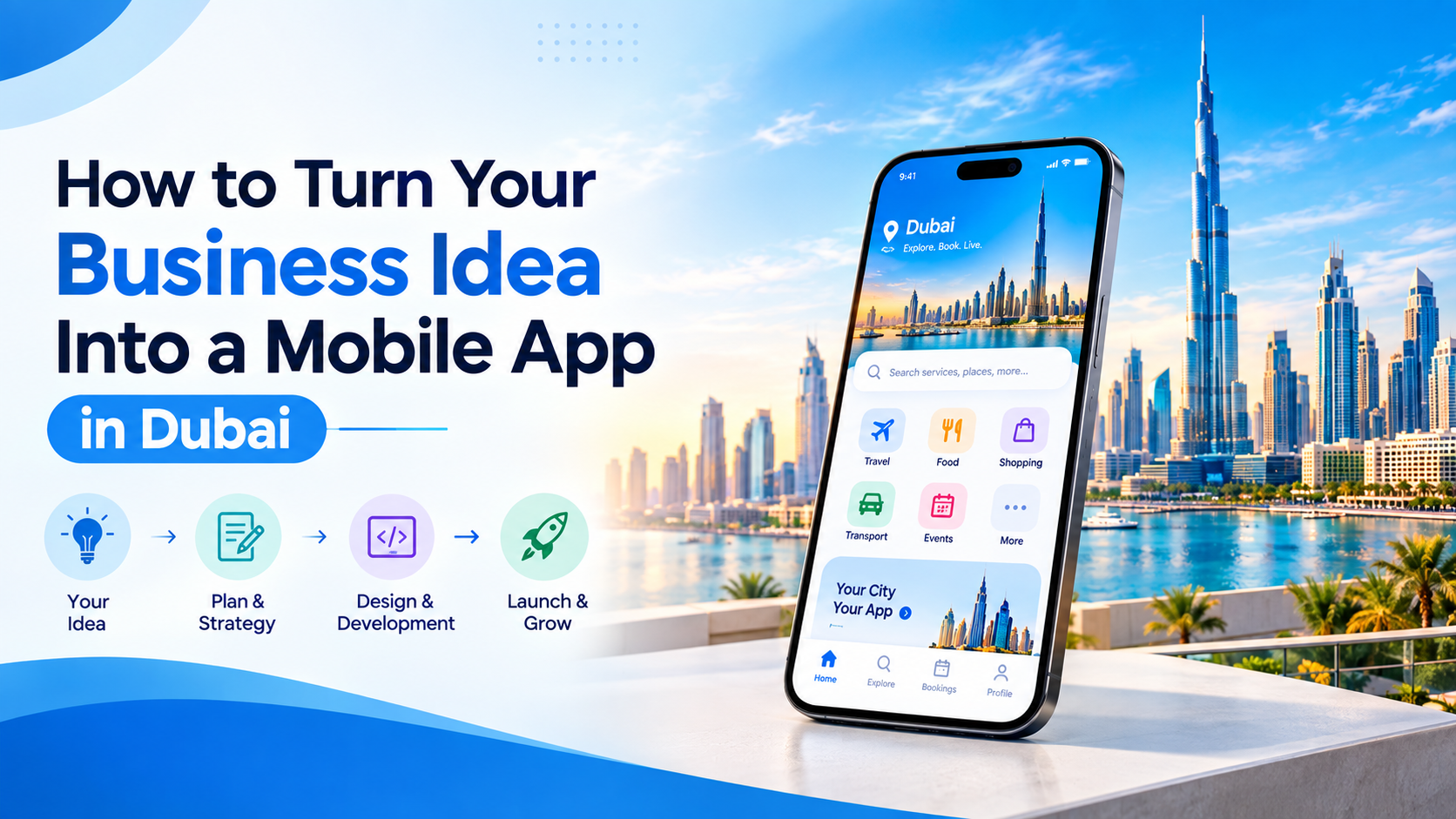
How to Turn Your Business Idea Into a Mobile App in Dubai?
Turning a business idea into a working mobile application requires more than simply hiring developers and writing code. With App Development Dubai, founders and business owners can transform an idea into a digital product by validating the concept, defining the right features, designing the user experience, selecting suitable technology, and launching a product that can grow with the business.
Whether you are starting a new venture, digitizing an existing service, or creating an app to solve a specific customer problem, a structured approach can reduce unnecessary costs and development delays.
Can Any Business Idea Become a Mobile App?
Not every business idea needs an app, but many can benefit from one when mobile technology solves a genuine customer or operational problem.
An app can help businesses provide:
- Online ordering
- Appointment and service bookings
- Customer accounts
- Digital payments
- Product marketplaces
- Delivery tracking
- Loyalty programs
- Real-time communication
- Personalized services
- Business automation
Before development begins, the most important question is not “What features should the app have?”
It is:
“What problem will the app solve, and why will customers use it?”
A clear answer helps shape the entire product.
Step 1: Validate Your Business Idea
The first stage is validating whether the idea has a genuine market opportunity.
Founders should identify:
- Who the target customers are
- What problem they experience
- How they currently solve it
- What makes the proposed app different
- Whether customers are willing to pay
- Which competitors already exist
- What the business model will be
For example, if you want to create a home-services app, research how customers currently find service providers, how bookings are managed, how payments happen, and where existing solutions create friction.
This research can prevent businesses from spending heavily on an idea before understanding the market.
Step 2: Define Your App’s Core Purpose
Once the idea is validated, define the primary purpose of the application in one clear statement.
For example:
“The app helps UAE customers discover, book, and pay for verified home services from their smartphones.”
This statement becomes a reference point for feature prioritization.
If a proposed feature does not support the core purpose, it may not need to be included in the first release.
Step 3: Identify Your Target Users
A successful mobile application is designed around users rather than assumptions.
Depending on the business model, your app could have:
- Customers
- Vendors
- Service providers
- Delivery partners
- Employees
- Administrators
Each user type may require different functionality.
A marketplace, for example, may need separate customer and vendor experiences, while an internal business application may primarily focus on employees and administrators.
Understanding user roles early makes the product architecture and development process much clearer.
Step 4: Decide Which Features You Need
This is where many app projects become unnecessarily large.
Instead of trying to build everything at once, divide features into three groups:
Essential Features
These are required for the core product to work.
Growth Features
These can improve customer engagement after launch.
Future Features
These can be introduced once the business has more users, data, and market feedback.
For example, an e-commerce MVP may require product browsing, search, cart, checkout, payment, order tracking, and notifications.
Advanced AI recommendations, loyalty programs, subscriptions, social features, and sophisticated analytics can potentially come later.
This approach can help founders launch faster while keeping the product focused.
Step 5: Build an MVP
An MVP, or Minimum Viable Product, is a functional first version containing the features necessary to test the core business idea.
For startups, an MVP can help answer important questions:
- Will people use the application?
- Which features generate the most engagement?
- Are customers willing to pay?
- Where do users abandon the process?
- What should be improved?
- Which features should be developed next?
An MVP should not mean building an unfinished or unreliable product. It should mean building a focused product with a controlled scope.
Step 6: Plan the UI/UX Design
Good UI/UX can have a major impact on how customers interact with your application.
The design process typically includes:
- User journeys
- Wireframes
- Screen layouts
- Navigation
- Visual design
- Prototypes
- Usability improvements
The objective is to make important actions easy to understand.
For example, a booking app should make it simple for users to find a service, select a date and time, confirm the booking, and complete payment.
A complicated interface can create unnecessary friction even when the underlying technology works correctly.
Step 7: Choose the Right Technology
Your technology choice should match the application’s requirements and long-term roadmap.
Depending on the project, businesses may consider:
- Native Android
- Native iOS
- Flutter
- React Native
- Cloud backend technologies
- APIs
- Database systems
- Third-party integrations
If your target audience uses both Android and iOS, cross-platform development can be considered where appropriate.
Businesses requiring specialized platform functionality may instead choose native development.
A technology decision should consider performance, security, scalability, integrations, maintenance, development resources, and future expansion—not just the initial development price.
Step 8: Develop the Mobile Application
Once the requirements and designs are finalized, development can begin.
The process may include:
Frontend Development
This is the part customers interact with on their smartphones.
Backend Development
The backend manages users, databases, authentication, business logic, APIs, payments, and other core services.
API Integration
APIs connect the application with external services such as payment gateways, maps, CRM systems, ERP platforms, analytics tools, and other software.
Admin Panel
Many business applications require an administrative dashboard for managing users, products, bookings, orders, content, reports, and other operations.
Step 9: Test Before Launch
Testing should happen throughout development rather than only at the end.
A professional testing process can include:
- Functional testing
- UI testing
- Device testing
- Performance testing
- Security testing
- API testing
- Payment testing
- Usability testing
The application should also be tested across relevant screen sizes and operating-system versions.
A smooth launch requires more than a working app—it requires a product that customers can use reliably.
Step 10: Launch and Measure Results
After testing, the application can be prepared for release through the relevant app stores.
But launch is not the finish line.
Businesses should monitor:
- Downloads
- Registrations
- Active users
- Conversion rates
- Retention
- Purchases
- Bookings
- Customer feedback
- App crashes
- Feature usage
Analytics can show what customers actually do rather than what the business assumed they would do.
These insights can guide future development.
How Much Does It Cost to Build an App in Dubai?
There is no fixed price for developing a mobile application because every project has different requirements.
The cost can depend on:
- Number of platforms
- Features
- UI/UX complexity
- Backend architecture
- Third-party integrations
- Payment functionality
- Real-time features
- Security requirements
- Development technology
- Testing
- Post-launch support
A simple business app will generally have a different scope from a marketplace, fintech platform, healthcare application, logistics platform, or on-demand service.
The best way to estimate cost is to first define the product scope and then obtain a detailed development proposal.
Choosing a Mobile App Development Partner in Dubai
The development partner you choose can influence the quality, scalability, and long-term maintainability of your application.
A Mobile App Development Company in UAE should be evaluated based on its technical expertise, portfolio, UI/UX capabilities, communication, development methodology, testing practices, security approach, and post-launch support.
Businesses searching for Mobile App Development Services in Dubai should also consider whether the team understands the intended industry and customer journey.
If the project is primarily Android-focused, an Android App Development Company in Dubai may be evaluated for relevant platform experience. Similarly, businesses targeting Apple’s ecosystem can assess an iOS App Development Company in Dubai based on its technical capabilities.
For companies operating in Abu Dhabi, a Mobile App Development Company in Abu Dhabi can be evaluated using the same factors, including experience, scalability, communication, and ongoing support.
The right Mobile App Development Agency should contribute to product strategy as well as development.
Why Businesses Should Consider Building a Mobile App
For many businesses, an application can become more than another digital channel.
It can support:
- Direct customer relationships
- Digital commerce
- Bookings and appointments
- Customer loyalty
- Payments
- Personalized experiences
- Operational efficiency
- Real-time communication
- Data-driven decision-making
For businesses considering Mobile App Development Dubai, the key is to connect the application to a measurable business objective.
If the app can solve a customer problem, improve an existing process, increase convenience, or create a new revenue channel, it may have a meaningful role in the company’s digital strategy.
How A2Solutions Can Help Turn Your Idea Into an App
A2Solutions works with businesses through the stages of mobile application development, from initial product planning and UI/UX design to development, testing, deployment, and ongoing improvements.
Whether you are a founder with a new startup concept, a business owner looking to digitize an existing service, or an established company planning a new mobile product, the development process should begin with your business objective and customer needs.
The result should not simply be an application that works. It should be a product designed around a clear business purpose and a roadmap for future growth.
Frequently Asked Questions
How do I turn my business idea into a mobile app?
Start by validating the business idea, identifying your target users, defining the core problem, prioritizing features, creating UI/UX designs, selecting suitable technology, developing an MVP, testing it, and launching it. Customer feedback and analytics can then guide future improvements.
How long does it take to build a mobile app in Dubai?
The timeline depends on the application’s complexity, number of platforms, features, design, backend requirements, and integrations. A focused MVP can be developed faster than a large application with multiple user roles, advanced functionality, and extensive integrations.
Should I build an MVP before the full app?
For many startups, an MVP can be a practical first step because it allows the business to test its core idea with real users before making a larger investment. The MVP should include enough functionality to deliver and measure the intended customer experience.
How much does app development cost in Dubai?
App development costs vary according to functionality, platforms, design complexity, backend architecture, integrations, security, testing, and maintenance. A detailed project scope is required to provide a meaningful estimate rather than relying on a generic price.
Should my business build an Android or iOS app first?
The decision depends on your target audience, market research, business objectives, and customer device preferences. Businesses targeting both audiences can also consider cross-platform development when it fits their technical requirements.
Can an existing business benefit from a mobile app?
Yes. Existing businesses can use mobile applications for e-commerce, bookings, loyalty, customer communication, payments, service delivery, internal workflows, and personalized experiences. The strongest business case comes from solving a specific customer or operational problem.
Final Thoughts
Turning a business idea into a mobile application is a process of moving from idea → validation → strategy → MVP → development → launch → improvement.
For founders and business owners, the most important step is not starting development as quickly as possible. It is making sure the product being developed solves a genuine problem and has a clear purpose.
With the right planning, technology, UI/UX strategy, and development partner, App Development Dubai can help transform a business concept into a scalable digital product that can evolve with its customers and the market.
For businesses ready to explore Mobile Application Development, starting with a clear product strategy can make the development journey more focused, measurable, and prepared for long-term growth.
