




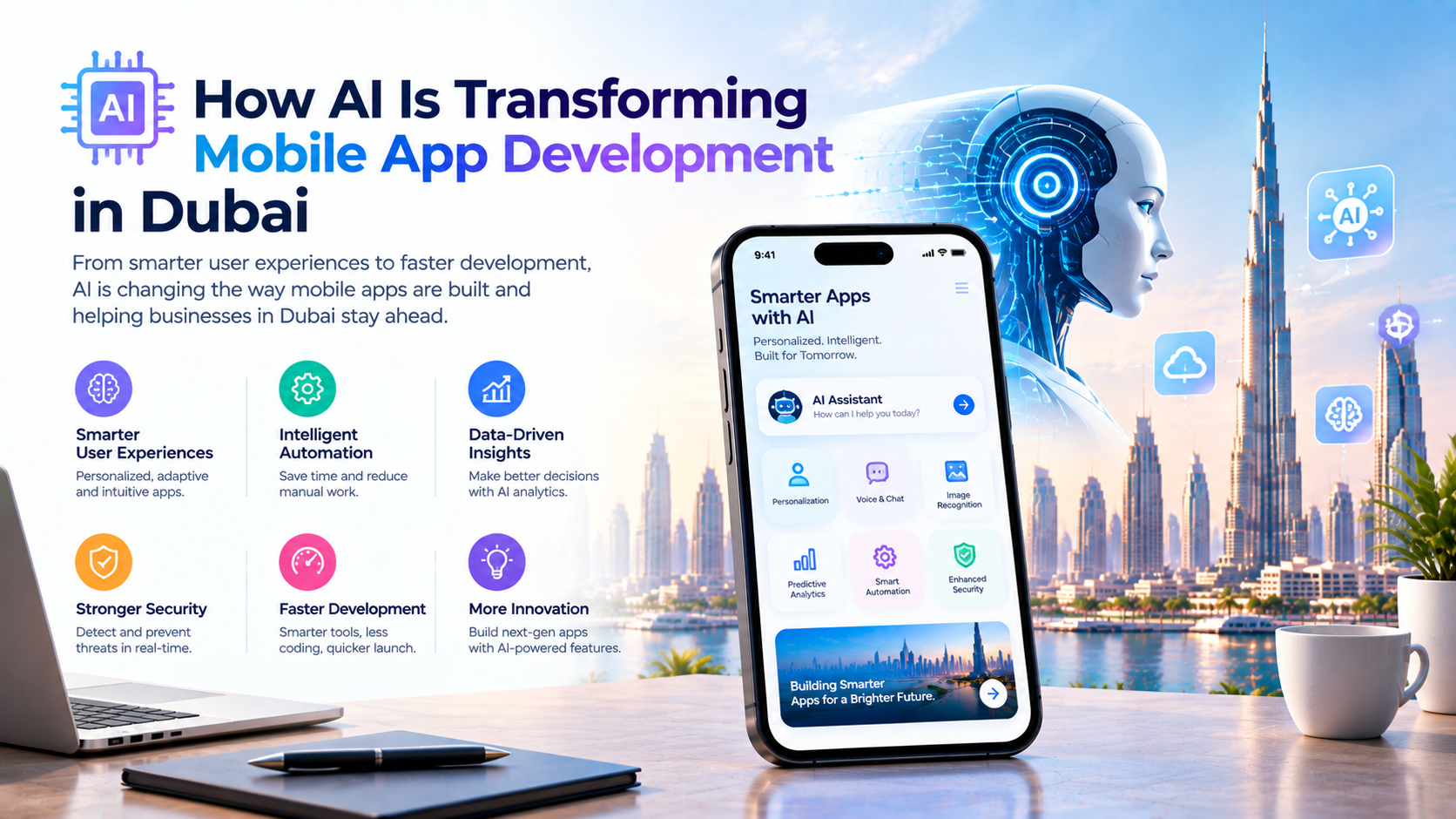
How AI Is Transforming Mobile App Development in Dubai?
Businesses across the UAE are increasingly using artificial intelligence to create smarter digital products, and Mobile App Development in Dubai is changing rapidly as a result. AI is helping businesses build applications that can personalize experiences, automate repetitive processes, analyze customer behavior, improve decision-making, and deliver more intelligent services.
For founders and business owners, AI is no longer limited to experimental technology. It can be integrated into e-commerce, healthcare, real estate, finance, logistics, education, hospitality, customer service, and many other mobile applications.
The key is understanding where AI can create genuine business value rather than adding AI simply because it is a popular technology.
What Is AI-Powered Mobile App Development?
AI-powered mobile app development involves integrating artificial intelligence and machine learning capabilities into mobile applications to make them more intelligent and responsive.
Traditional applications generally operate according to predefined rules.
AI-enabled applications can analyze data, recognize patterns, generate responses, make predictions, and adapt certain experiences based on user behavior.
Examples include:
- AI chatbots and virtual assistants
- Personalized recommendations
- Predictive analytics
- Voice recognition
- Image recognition
- Fraud detection
- Intelligent search
- Automated customer support
- Sentiment analysis
- Predictive maintenance
- AI-generated content
- Smart notifications
For businesses, these capabilities can turn a basic mobile application into a more dynamic digital platform.
Why AI Matters for Businesses in Dubai
Dubai’s business ecosystem includes startups, SMEs, enterprises, retailers, financial organizations, healthcare providers, logistics companies, real estate businesses, and technology-driven ventures.
Many of these businesses interact with large volumes of customer, transaction, operational, and behavioral data.
AI can help convert this data into actionable insights.
For example, an e-commerce application can analyze customer activity and recommend relevant products. A healthcare application can use AI-assisted features to organize information and support communication. A logistics platform can analyze routes and operational data to improve planning.
The exact application depends on the business model, available data, regulatory requirements, and desired outcomes.
7 Ways AI Is Transforming Mobile App Development
1. Personalized User Experiences
Personalization is one of the most visible applications of AI in mobile products.
Instead of showing every user the same content, AI can analyze factors such as previous activity, preferences, searches, purchases, and engagement patterns.
An e-commerce app could recommend products based on browsing and purchasing behavior.
A media application could suggest relevant content.
A learning platform could recommend courses based on a user’s progress.
This can create a more relevant experience while helping businesses understand customer preferences.
2. AI Chatbots and Virtual Assistants
AI-powered assistants can provide users with immediate answers without requiring a human employee to respond to every routine question.
For example, an application can help customers:
- Track orders
- Find products
- Schedule appointments
- Check account information
- Get answers to common questions
- Navigate services
- Submit support requests
Businesses can also connect AI assistants to approved internal knowledge sources and business systems, subject to appropriate security and access controls.
3. Predictive Analytics
Traditional analytics tells businesses what happened.
AI can also help identify patterns and estimate what may happen next.
A mobile application could analyze customer behavior to identify potential churn, predict demand, detect unusual transactions, or identify products that may become more popular.
For business owners, this can turn an application from a simple transaction channel into a source of strategic business intelligence.
4. Smarter Search
AI can improve how users find information inside an application.
Instead of requiring customers to search using exact keywords, AI-powered search can interpret intent and context.
For example, a customer searching for:
“comfortable running shoes for summer”
could potentially receive more relevant results than a traditional keyword-only search.
This is particularly useful for e-commerce, marketplaces, travel, real estate, and content-based applications.
5. Automation of Business Processes
AI can automate repetitive activities that previously required manual intervention.
Depending on the business, this could include:
- Customer query classification
- Lead qualification
- Document processing
- Product categorization
- Notification personalization
- Data analysis
- Appointment assistance
- Support ticket routing
- Report generation
Automation can allow employees to spend more time on tasks that require human judgment and customer interaction.
6. Voice and Image-Based Features
AI can make mobile applications easier to interact with by using voice and visual capabilities.
Voice functionality can allow users to search, navigate, or interact with an application through natural language.
Image recognition can be used in areas such as:
- Retail
- Healthcare
- Real estate
- Security
- Education
- Manufacturing
- Logistics
The specific implementation should depend on the application’s purpose and the quality and sensitivity of the data being processed.
7. Improved Fraud and Risk Detection
For financial and transaction-based applications, AI can help identify unusual patterns.
A system can analyze transaction behavior and flag activity that differs from established patterns for further review.
This can be relevant to fintech, banking, e-commerce, marketplaces, payment applications, and other platforms where transaction security is important.
AI should complement appropriate security controls rather than replace them.
AI Use Cases Across UAE Industries
AI-powered mobile applications can be adapted to different industries.
E-Commerce
Businesses can use AI for product recommendations, intelligent search, customer support, demand analysis, and personalization.
Healthcare
AI-enabled applications can support scheduling, communication, information organization, patient engagement, and certain decision-support workflows where appropriate.
Healthcare implementations require careful consideration of privacy, security, accuracy, and applicable regulations.
Real Estate
Property applications can use AI for personalized property recommendations, intelligent search, lead qualification, and customer communication.
Logistics
AI can support demand forecasting, route analysis, delivery optimization, and operational insights.
Finance
Financial applications can use AI for personalization, anomaly detection, customer support, risk analysis, and automated insights, subject to applicable regulatory and security requirements.
Education
Learning applications can personalize content, analyze progress, provide AI-assisted tutoring experiences, and recommend learning resources.
How AI Changes the Mobile App Development Process
AI does not simply add another feature to an application. It can influence the entire development strategy.
A typical AI-enabled development process may include:
Business and AI Strategy
First, identify the business problem that AI is expected to solve.
Data Assessment
Determine what data is available, how it can be used, and what privacy or security considerations apply.
Feature Planning
Define whether AI will power recommendations, search, automation, prediction, chat, vision, voice, or another capability.
Technology Selection
The development team selects appropriate AI models, APIs, cloud services, frameworks, and application architecture.
Development and Integration
AI capabilities are integrated with the mobile frontend, backend, databases, APIs, and business systems.
Testing and Evaluation
AI features require testing for functionality, reliability, accuracy, security, response quality, and appropriate handling of unexpected inputs.
Continuous Improvement
AI-powered applications may require monitoring, model evaluation, prompt or workflow improvements, data updates, and ongoing optimization.
Choosing the Right AI Technology
Not every application needs a complex custom AI model.
Depending on the use case, businesses may use:
- AI APIs
- Machine learning models
- Large language models
- Recommendation engines
- Computer vision
- Natural language processing
- Predictive analytics
- Speech recognition
- Generative AI
The appropriate technology depends on the problem being solved, data availability, performance requirements, security considerations, budget, and scalability.
This is where an experienced Mobile App Development Company in UAE can help translate an AI idea into a practical product architecture.
What Should Businesses Consider Before Adding AI?
AI can create significant opportunities, but businesses should approach it strategically.
Before implementation, consider:
- What business problem will AI solve?
- What data is required?
- Is the data reliable?
- What level of accuracy is acceptable?
- How will user privacy be protected?
- What happens when AI produces an incorrect result?
- How will the feature be monitored?
- What will the ongoing AI infrastructure cost?
- Can the feature scale as usage grows?
The goal should be measurable business value rather than simply adding an AI label to an application.
How a Mobile App Development Company Can Help
Developing an AI-enabled application requires expertise across mobile development, backend engineering, APIs, data, security, UI/UX, and AI integration.
Businesses looking for Mobile App Development Services in Dubai should evaluate whether a development partner can handle both the application and the AI components.
Depending on the project, companies may also need specialized expertise from an Android App Development Company in Dubai or an iOS App Development Company in Dubai.
A Mobile App Development Agency can also help businesses determine whether an AI feature should be built into the initial MVP or introduced during a later product phase.
For businesses operating in Abu Dhabi, a Mobile App Development Company in Abu Dhabi can similarly help assess product requirements, integrations, technology choices, and deployment needs.
Why Businesses Should Consider Building AI-Powered Apps
For founders and business owners, the question is not simply whether AI is available.
The more important question is whether AI can improve a specific business outcome.
A well-designed AI feature can potentially help businesses:
- Improve customer experience
- Reduce repetitive work
- Personalize services
- Understand customer behavior
- Improve operational efficiency
- Support faster decision-making
- Automate customer interactions
- Create new digital services
Businesses exploring Mobile Application Development can therefore consider AI as part of their broader product strategy rather than as a standalone technology trend.
How A2Solutions Can Help
A2Solutions helps businesses plan and develop mobile applications around practical business objectives.
From product discovery and UI/UX design to mobile development, backend integration, AI capabilities, testing, deployment, and ongoing improvements, the development process can be structured around the application’s target users and business goals.
Whether you are a startup founder with an AI app idea, a business owner looking to automate customer interactions, or an established company planning a smarter digital platform, the first step is identifying where technology can create measurable value.
Frequently Asked Questions
How is AI transforming mobile app development in Dubai?
AI is helping mobile applications become more personalized, automated, predictive, and interactive. Businesses can use AI for recommendations, chatbots, intelligent search, analytics, fraud detection, voice features, image recognition, and workflow automation across industries.
What are the most common AI features in mobile apps?
Common AI features include chatbots, virtual assistants, recommendation engines, predictive analytics, intelligent search, voice recognition, image recognition, personalization, automated content processing, and anomaly detection. The appropriate feature depends on the application’s business purpose.
Does an AI-powered mobile app cost more to develop?
AI can increase development costs because applications may require additional backend infrastructure, APIs, data processing, model integration, testing, monitoring, and ongoing optimization. The impact depends heavily on whether the business uses an existing AI service or develops more specialized AI capabilities.
Can startups use AI in an MVP?
Yes. Startups can integrate focused AI functionality into an MVP when it directly supports the core value proposition. For example, an AI assistant, recommendation feature, or intelligent search function can be included without building an entire AI ecosystem from the beginning.
Is AI useful for small businesses?
AI can be useful for small businesses when applied to specific operational or customer-facing problems. Examples include automated customer support, lead qualification, personalized recommendations, document processing, and business insights. The implementation should be proportional to the company’s actual requirements.
Should every mobile app use AI?
No. AI is most useful when it solves a genuine business or customer problem. Adding AI without a clear purpose can increase complexity, cost, privacy considerations, and maintenance requirements without creating meaningful value.
How can I build an AI-powered mobile app in Dubai?
Start by defining the business problem, target users, essential features, data requirements, AI use case, technology architecture, security requirements, and budget. A qualified development partner can then help determine the appropriate AI technology and build a scalable mobile application.
Final Thoughts
AI is changing how businesses think about mobile applications. Instead of simply providing digital access to products and services, modern applications can use AI to understand users, automate workflows, personalize experiences, and generate actionable insights.
For businesses considering Mobile App Development in Dubai, AI can become an important part of the product roadmap when it is connected to a clear business objective.
Founders and business owners do not need to build every AI capability from day one. A focused approach—starting with one valuable AI use case, measuring its impact, and expanding based on real results—can provide a practical path toward building smarter, more scalable mobile products.
The opportunity is not simply to build an app with AI. It is to build an application where AI makes the overall business experience more useful.
Also Read:- How to Turn Your Business Idea Into a Mobile App in Dubai?
