




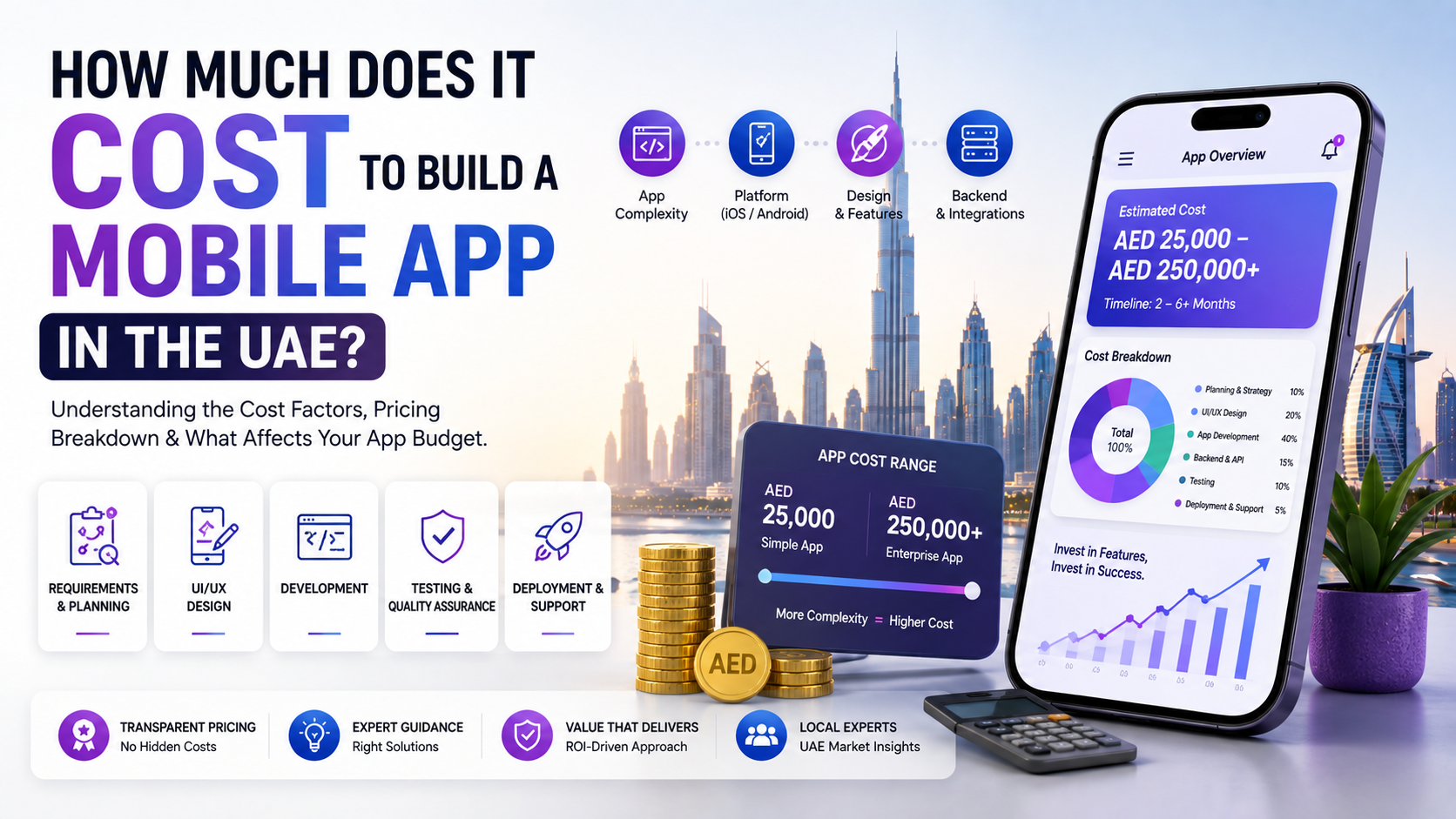
How Much Does It Cost to Build a Mobile App in the UAE in 2026?
The UAE’s digital economy is booming, and with over 99% smartphone penetration across the country, a mobile app is no longer optional for businesses — it’s the front door to your customer. That said, before founders and business owners commit budget, the first question they ask is about the Mobile App Development Cost in Dubai, and rightly so, because pricing in this market can swing from AED 20,000 for a basic app to well over AED 500,000 for a complex, enterprise-grade platform. Understanding what drives that range — and what’s often left out of initial quotes — is the key to budgeting smartly and avoiding costly surprises mid-project.
This guide breaks down everything a founder, startup, or established business owner needs to know before investing in an app in 2026: the real cost drivers, platform decisions, hidden expenses, timelines, and how to pick a development partner that won’t leave you rebuilding six months after launch.
Why App Development Costs Vary So Much in the UAE
There’s no single price tag for “building an app” because every project is shaped by different variables. Here’s what typically influences the final cost:
1. App Complexity
A simple app with basic screens, static content, and minimal backend logic costs far less than an app with real-time features, payment gateways, live chat, GPS tracking, push notifications, or AI-driven personalization. E-commerce apps, on-demand delivery platforms, and fintech apps sit at the higher end because they require secure architecture, third-party integrations, and rigorous testing across multiple devices and OS versions.
As a rule of thumb:
- Simple apps (informational, portfolio, single-feature utility) — lowest cost, fastest timeline
- Medium-complexity apps (bookings, e-commerce, social features) — moderate cost, 3–5 months
- Complex apps (fintech, on-demand, AI-powered, multi-vendor marketplaces) — highest cost, 6–12+ months
2. Platform Choice (iOS, Android, or Both)
Choosing a single platform naturally costs less than building for both simultaneously. Many businesses in the UAE start with one platform to validate the idea, then expand once they see traction. This is where working with a dedicated Android App Development Company in Dubai or an iOS App Development Company in Dubai helps — specialized teams optimize for platform-specific guidelines, performance benchmarks, and App Store/Play Store approval requirements, which reduces costly rework later.
Cross-platform frameworks like Flutter or React Native are also popular in the UAE market because they let teams build for both platforms from a single codebase, often reducing cost by 20–30% compared to fully native development — though performance-heavy apps (like gaming or AR-based apps) still benefit from native builds.
3. Design and User Experience (UI/UX)
Custom UI/UX design, branded animations, and accessibility features add development hours but significantly improve user retention. In a market as visually competitive as Dubai — where users are exposed to some of the world’s most polished apps daily — a generic, template-based design can quietly kill downloads and retention. A polished, culturally relevant design (including Arabic RTL support, where applicable) is often what separates an app that gets downloaded once from one that becomes part of a user’s daily routine.
4. Backend Infrastructure and Scalability
Apps that rely on cloud hosting, databases, admin dashboards, real-time syncing, and scalable APIs require more engineering effort upfront. If you’re planning to scale into Saudi Arabia, Qatar, or other GCC markets later, investing in solid backend architecture from day one — rather than a quick MVP hack — saves significant rebuild costs down the line. This is one of the most overlooked cost factors: businesses that skip proper backend planning often pay 2–3x more later to re-architect for scale.
5. Third-Party Integrations
Payment gateways (like Telr, PayTabs, or Stripe for UAE), maps/location services, SMS/OTP verification, CRM or ERP integrations, and analytics tools all add to development time and, in some cases, recurring licensing costs. It’s important to list every integration you anticipate needing — even ones planned for phase two — during the initial scoping conversation so your quote reflects the full picture.
6. Team Location and Expertise
Rates vary widely between freelancers, offshore teams, and established local agencies. While outsourcing overseas may look cheaper upfront, working with a reputable Mobile App Development Company in Dubai or Mobile App Development Company in Abu Dhabi often reduces communication gaps, ensures compliance with UAE data protection regulations, and provides post-launch support that offshore vendors rarely offer at the same standard.
Typical Cost Ranges in 2026
While every quote should be based on a detailed scope document, here’s a general breakdown business owners can use as a starting reference:
| App Type | Estimated Cost (AED) | Typical Timeline |
|---|---|---|
| Basic/MVP App | 20,000 – 60,000 | 6–10 weeks |
| Mid-Complexity App | 60,000 – 150,000 | 3–5 months |
| Complex/Enterprise App | 150,000 – 500,000+ | 6–12+ months |
These figures reflect typical market rates from a Mobile App Development Agency operating in the UAE, though final costs always depend on the specific scope, feature list, design ambition, and post-launch maintenance plan you choose.
Hidden Costs Founders Often Overlook
Many first-time app owners budget only for the initial build and are caught off guard by ongoing costs. Be sure to factor in:
- App Store & Play Store fees — annual developer account costs
- Cloud hosting and server costs — scales with user base
- Third-party API/licensing fees — payment gateways, maps, SMS services
- Post-launch maintenance — bug fixes, OS updates, security patches (typically 15–20% of build cost annually)
- Marketing and App Store Optimization (ASO) — getting downloads is a separate cost from building the app
- Feature updates — adding functionality after launch based on user feedback
A transparent Mobile App Development Company in UAE will walk you through these costs upfront rather than letting them surface as surprises after signing.
Why Founders and Business Owners Should Build an App in 2026
For founders validating a new idea, an app can be the fastest way to test product-market fit directly with UAE’s tech-savvy, mobile-first consumer base. For established business owners, an app strengthens customer loyalty, opens new revenue channels (in-app purchases, subscriptions, bookings), and provides valuable behavioral data that websites alone can’t capture.
The UAE government’s continued push toward a cashless, digital-first economy — through initiatives supporting fintech, smart government services, and e-commerce — means businesses with a strong mobile presence are better positioned to capture growth. Whether you run a retail brand, a clinic, a logistics company, a real estate firm, or a service-based business, Mobile Application Development is quickly becoming as fundamental as having a website was a decade ago.
Here’s why timing matters in 2026 specifically:
- Rising mobile-first commerce — more UAE consumers now complete entire purchase journeys on mobile rather than desktop.
- AI-enabled personalization has become cheaper and more accessible, letting even mid-sized businesses offer smart recommendations and chat-based support.
- Government digital initiatives (like UAE Pass integration) make it easier for apps to offer seamless, trusted user verification.
- Increased investor interest in UAE-based startups means a well-built app can double as a fundraising asset, not just a product.
Choosing the Right Development Partner
Not every Mobile App Development Company in UAE offers the same value. When evaluating partners, look beyond price and assess:
- Portfolio relevance — have they built apps in your industry or of similar complexity?
- Post-launch support policies — what happens after the app goes live?
- Technology stack — is it modern, scalable, and well-documented?
- Communication and project management — do they provide regular updates and a dedicated point of contact?
- Transparent, itemized quotes — a credible agency breaks down cost by feature and phase, not a vague lump sum.
If you’re looking for Mobile App Development Services in Dubai or Mobile App Development Dubai-based support with a proven delivery track record, working with a company that understands both the technical and regional business landscape makes a measurable difference in your app’s long-term success.
Why A2Solutions?
A2Solutions is a trusted Mobile App Development Company in Dubai, helping startups, SMEs, and enterprises across the UAE turn their app ideas into scalable, market-ready products. With hands-on experience across iOS, Android, and cross-platform development, A2Solutions offers transparent pricing, dedicated project management, and long-term technical support — making it easier for founders and business owners to plan budgets with confidence.
From MVP builds for early-stage startups to enterprise-grade platforms for established businesses, A2Solutions combines local market understanding with global development standards, ensuring every app is built to perform, scale, and deliver real ROI. As a full-service Mobile App Development Agency, the team supports clients from initial idea validation through design, development, launch, and ongoing maintenance — all under one roof.
Frequently Asked Questions
Q: What is the average Mobile App Development Cost in Dubai in 2026?
A: Most apps range between AED 20,000 for a basic MVP and AED 500,000+ for a complex, enterprise-grade platform, depending on features, platforms, and design complexity.
Q: Is it cheaper to build for one platform first?
A: Yes. Building for a single platform (iOS or Android) first typically costs 30–50% less than launching on both simultaneously, and lets you validate demand before expanding.
Q: How long does it take to build a mobile app in the UAE?
A: A basic app typically takes 6–10 weeks, mid-complexity apps take 3–5 months, and complex or enterprise apps can take 6–12 months or longer.
Q: What ongoing costs should I budget for after launch?
A: Expect annual maintenance costs of roughly 15–20% of the original build cost, plus hosting, third-party API fees, and app store developer fees.
Q: Should a small business invest in an app, or is a website enough?
A: It depends on the business model, but apps offer stronger customer retention, push notification capability, and offline access — advantages a website alone can’t replicate. Many UAE businesses now use both together.
Q: How do I choose between a freelancer and a development agency?
A: Freelancers can be cost-effective for very simple apps, but agencies typically offer better long-term reliability, structured project management, and post-launch support — especially important for apps handling payments or user data.
Final Thoughts
The Mobile App Development Cost in Dubai in 2026 isn’t a fixed number — it’s a reflection of your app’s complexity, platform choice, design ambition, integrations, and the expertise of the team building it. The smartest approach is to define your goals clearly, get a detailed, itemized quote from a credible development partner, and invest in a roadmap that supports both launch and long-term growth. Whether you’re a founder testing a new concept or a business owner scaling operations, the right app — built with the right partner — can become one of your most valuable business assets.
