




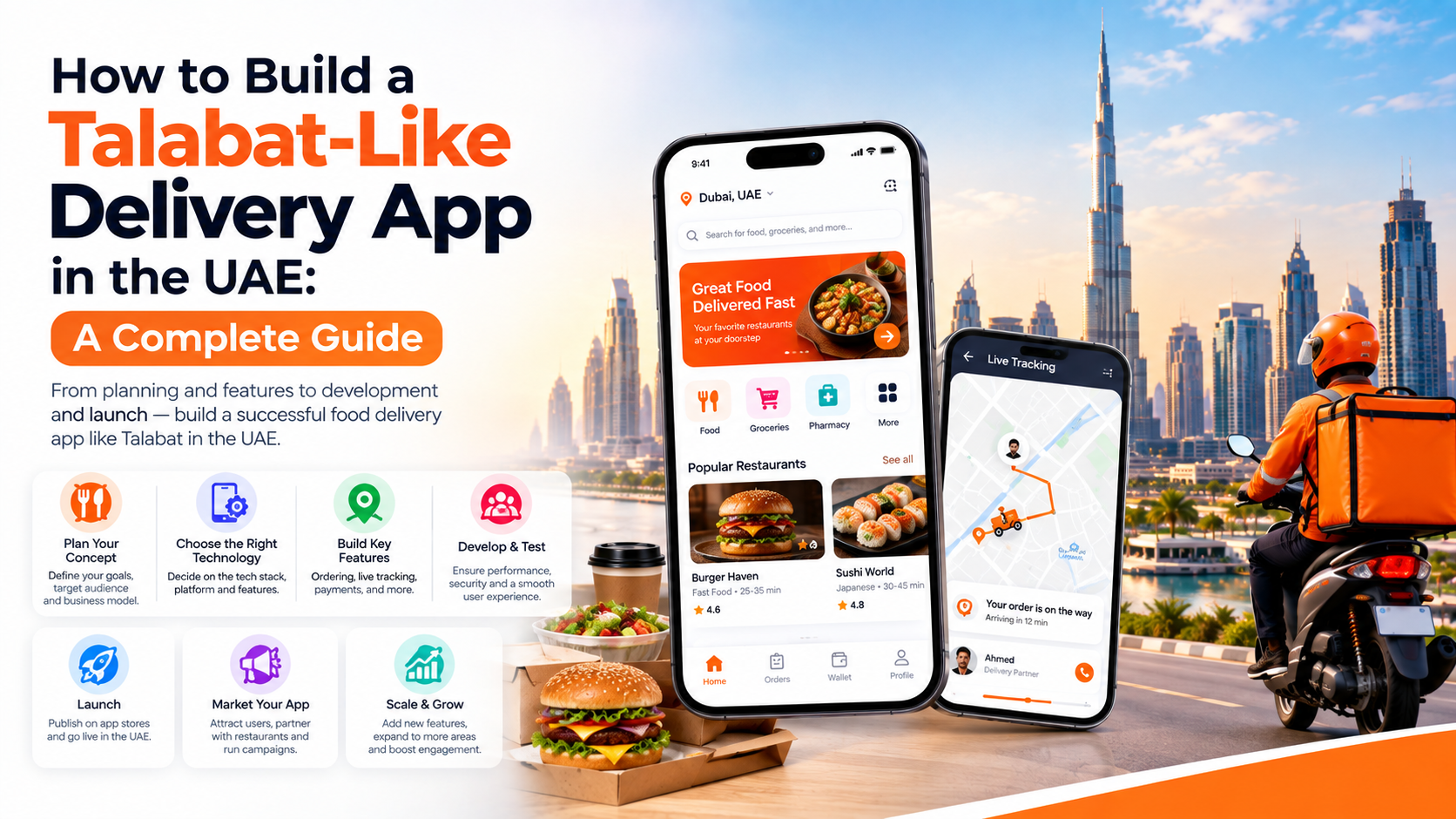
How to Build a Talabat-Like Delivery App in the UAE: A Complete Guide
The UAE has become a highly competitive market for on-demand food, grocery, pharmacy, and retail delivery services. For businesses planning to enter this space, Mobile App Development Dubai can help transform a delivery idea into a scalable digital platform that connects customers, merchants, and delivery partners through one seamless ecosystem. A Talabat-like app is more than a food-ordering application—it is a technology platform designed around convenience, logistics, payments, real-time tracking, and business growth.
For founders and business owners, the opportunity is not simply to copy an existing delivery platform. The smarter approach is to identify a specific market need, build a strong minimum viable product (MVP), and gradually expand the platform based on customer and merchant demand.
What Is a Talabat-Like Delivery App?
A Talabat-like delivery app is a multi-sided marketplace that connects customers with restaurants, stores, delivery partners, and administrators.
The platform typically allows customers to discover businesses, browse products or menus, place orders, make payments, track deliveries, and provide reviews. Merchants manage products, orders, pricing, and promotions, while delivery partners receive and complete delivery requests.
A successful platform therefore usually consists of four connected components:
- Customer mobile application
- Merchant or restaurant application/panel
- Delivery partner application
- Admin dashboard
This structure gives the business complete control over ordering, operations, payments, customer service, and marketplace management.
Why Build a Delivery App in the UAE?
The UAE offers a strong environment for digital businesses because consumers are accustomed to mobile-first services and convenient on-demand experiences.
A delivery platform can serve several industries, including:
- Food and restaurant delivery
- Grocery delivery
- Pharmacy delivery
- Flower and gift delivery
- Retail and e-commerce delivery
- Laundry and home-service delivery
- Courier and local delivery
- Multi-category marketplace delivery
Instead of building another general-purpose marketplace, businesses can focus on a particular customer segment, location, product category, or delivery model.
For example, a startup could create a specialized grocery delivery platform for a particular community or develop a same-day delivery marketplace for local retailers.
Essential Features of a Talabat-Like Delivery App
The features you select should depend on your business model and MVP strategy. However, several functions are fundamental to a modern delivery platform.
Customer App
The customer application should make ordering fast and intuitive.
Important features include:
- User registration and login
- Location and address management
- Restaurant or store discovery
- Search and filters
- Categories
- Product or menu listings
- Product customization
- Shopping cart
- Coupon and promotional codes
- Multiple payment options
- Order confirmation
- Real-time order tracking
- Push notifications
- Order history
- Ratings and reviews
- Customer support
- Favorites and saved addresses
The objective is to minimize the number of steps between opening the app and completing an order.
Merchant App or Dashboard
Merchants need an efficient way to manage their operations.
Key functions can include:
- Merchant registration
- Business profile management
- Menu/product management
- Pricing management
- Inventory availability
- Order acceptance and rejection
- Order status updates
- Promotions
- Sales reports
- Customer information
- Notifications
- Business analytics
A simple merchant experience is important because complicated dashboards can negatively affect marketplace participation.
Delivery Partner App
The delivery application connects drivers or riders with active orders.
It can include:
- Delivery partner registration
- Profile and document management
- Online/offline status
- New delivery requests
- Order details
- Navigation
- Pickup confirmation
- Delivery confirmation
- Real-time location sharing
- Earnings information
- Delivery history
- Notifications
- Support
GPS and mapping integration can help improve route visibility and delivery coordination.
Admin Dashboard
The admin panel is the operational control center of the platform.
Administrators should be able to manage:
- Customers
- Merchants
- Delivery partners
- Orders
- Payments
- Commissions
- Promotions
- Locations
- Categories
- Reviews
- Complaints
- Reports
- Notifications
- Platform settings
Analytics can also help business owners understand order volumes, popular categories, customer behavior, merchant performance, and delivery activity.
How to Build a Talabat-Like App Step by Step
Building a large delivery marketplace should be approached in stages.
1. Define the Business Model
Before development begins, determine how the platform will generate revenue.
Common models include:
- Commission from merchants
- Delivery charges
- Customer service or platform fees
- Subscription plans
- Featured listings
- Advertising
- Merchant membership plans
The business model should influence the product architecture and features from the beginning.
2. Research the UAE Market
Study your target customers, competitors, merchants, delivery expectations, and preferred locations.
Rather than trying to serve the entire UAE immediately, consider launching in a defined market area and expanding after validating demand.
Research should answer questions such as:
- Who are the target customers?
- Which category will the app focus on?
- What problem does the platform solve?
- How will merchants benefit?
- How will delivery partners benefit?
- What makes the platform different?
3. Design the User Experience
UX/UI design should prioritize speed, simplicity, and trust.
Customers should be able to search, select, order, pay, and track deliveries without unnecessary complexity.
A well-designed interface is particularly important for marketplaces because users may compare several businesses before placing an order.
4. Build the MVP
An MVP allows a business to launch the core concept without investing in every possible feature from day one.
The first version can focus on:
- Customer registration
- Business listings
- Product/menu browsing
- Cart
- Checkout
- Online payment
- Order management
- Delivery assignment
- GPS tracking
- Push notifications
- Admin management
Advanced loyalty systems, AI recommendations, sophisticated analytics, subscriptions, and other features can be introduced later.
Choosing the Right Technology
The technology stack depends on the expected scale, budget, performance requirements, integrations, and development strategy.
For mobile platforms, businesses may choose native development or cross-platform frameworks.
A business may work with an iOS App Development Company in Dubai when it requires a dedicated iOS application, while an Android App Development Company in Dubai can develop an Android-focused experience.
Cross-platform development can also be considered when the goal is to launch on both platforms efficiently from a shared codebase.
The backend should be designed to handle users, merchants, products, orders, payments, notifications, locations, and delivery operations securely and reliably.
Integrations a Delivery App May Need
A delivery platform often requires several third-party integrations.
Depending on the business model, these may include:
- Payment gateways
- Maps and GPS
- Push notification services
- SMS or OTP verification
- Analytics
- Customer support
- Cloud infrastructure
- Accounting or business systems
Payment and location functionality should be selected according to the platform’s target market and operational requirements.
How Much Does It Cost to Build a Talabat-Like App in the UAE?
The cost depends heavily on the complexity of the platform.
A basic MVP will generally cost less than a mature multi-vendor marketplace containing advanced logistics, AI, analytics, loyalty programs, subscriptions, and complex integrations.
The major cost factors include:
- Number of applications
- UI/UX complexity
- Number of features
- Backend architecture
- Payment integrations
- GPS and real-time tracking
- Admin dashboard
- Third-party integrations
- Security requirements
- Testing
- Maintenance
- Post-launch support
For an accurate estimate, businesses should first prepare a feature list and product roadmap rather than relying on a generic app-development price.
How Long Does It Take to Build a Delivery App?
A basic delivery MVP can potentially be developed within a few months, while a feature-rich marketplace may require considerably more time.
The timeline depends on:
- Business and technical planning
- UI/UX design
- Mobile application development
- Backend development
- Admin dashboard development
- API and third-party integrations
- Testing and quality assurance
- Deployment
- Post-launch improvements
A phased approach can help businesses launch sooner and use real customer feedback to determine which features should be developed next.
How A2Solutions Can Help Build a Delivery App
Choosing the right technology partner is one of the most important decisions when developing a marketplace platform.
A2Solutions is one of the leading app development companies in the UAE, helping businesses turn digital product ideas into scalable mobile applications and software solutions.
As a Mobile App Development Company in UAE, A2Solutions can support businesses across planning, UX/UI design, development, integrations, testing, deployment, and ongoing improvements.
Businesses looking for a Mobile App Development Company in Abu Dhabi, Dubai, or other UAE markets can use a structured development process to transform their delivery concept into an MVP and eventually a full-scale platform.
A2Solutions can also provide Mobile App Development Services in Dubai for businesses that need customer applications, merchant systems, delivery applications, backend infrastructure, and administrative dashboards under one development strategy.
How to Make Your Delivery App Different
Building a platform similar to an established marketplace does not mean copying every feature.
Your competitive advantage could come from:
- Faster delivery
- Better merchant economics
- A niche product category
- Better customer support
- Subscription-based benefits
- Personalized recommendations
- Hyperlocal delivery
- Better merchant tools
- Loyalty programs
- AI-powered personalization
- Transparent pricing
The strongest delivery platforms solve a specific customer or merchant problem better than existing alternatives.
Why Scalability Matters
A delivery application may start with a small number of customers and merchants but can grow rapidly if the business model succeeds.
The architecture should therefore be designed with future growth in mind.
Scalable Mobile Application Development can help accommodate increasing users, orders, merchants, delivery partners, transactions, and locations without requiring the entire platform to be rebuilt.
Security, performance monitoring, database architecture, cloud infrastructure, API design, and backup strategies should all be considered early in the project.
Frequently Asked Questions
How do I build a Talabat-like app in the UAE?
To build a Talabat-like app, define the business model, research the UAE market, design the customer experience, develop customer and merchant applications, create a delivery partner app and admin dashboard, integrate payments and maps, test the platform, and launch an MVP.
How many apps are required for a delivery platform?
A full delivery marketplace commonly requires a customer app, merchant application or dashboard, delivery partner app, and admin dashboard. The exact structure depends on the business model and operational requirements.
How much does it cost to build a Talabat-like app?
The cost depends on features, platforms, design complexity, integrations, backend architecture, and development requirements. An MVP costs less than a full-scale marketplace with advanced logistics, analytics, loyalty, and AI functionality.
How long does it take to develop a delivery app?
Development time varies according to the scope. A focused MVP can be launched faster than a comprehensive marketplace. Planning, design, development, integrations, testing, deployment, and revisions all contribute to the timeline.
Can I launch a delivery app as an MVP?
Yes. An MVP is often a practical way to validate the business idea before investing in advanced functionality. Start with essential ordering, payment, merchant, delivery, and administrative features and expand based on real market feedback.
Should I build separate iOS and Android apps?
Businesses can choose native iOS and Android development or a cross-platform approach. The right choice depends on the target audience, required performance, budget, development strategy, and long-term roadmap.
What businesses can use a Talabat-like delivery model?
The model can be adapted for restaurants, groceries, pharmacies, retail stores, flowers, gifts, courier services, laundry, and other on-demand businesses.
Final Thoughts
A Talabat-like delivery platform can become a powerful digital business when it is built around a clear market opportunity rather than simply replicating an existing application.
For founders and business owners, the best starting point is to define the target audience, select a focused business model, build an MVP, validate demand, and then scale the platform with advanced features.
With the right Mobile App Development Agency, technology strategy, UX, integrations, and scalable architecture, a delivery idea can evolve into a complete marketplace serving customers and businesses across the UAE.
If you are planning to build a food delivery, grocery delivery, pharmacy delivery, retail delivery, or multi-vendor marketplace app, A2Solutions can help turn your concept into a development roadmap and scalable mobile solution.
Also Read:- Why Businesses in Dubai Need a Mobile App
