




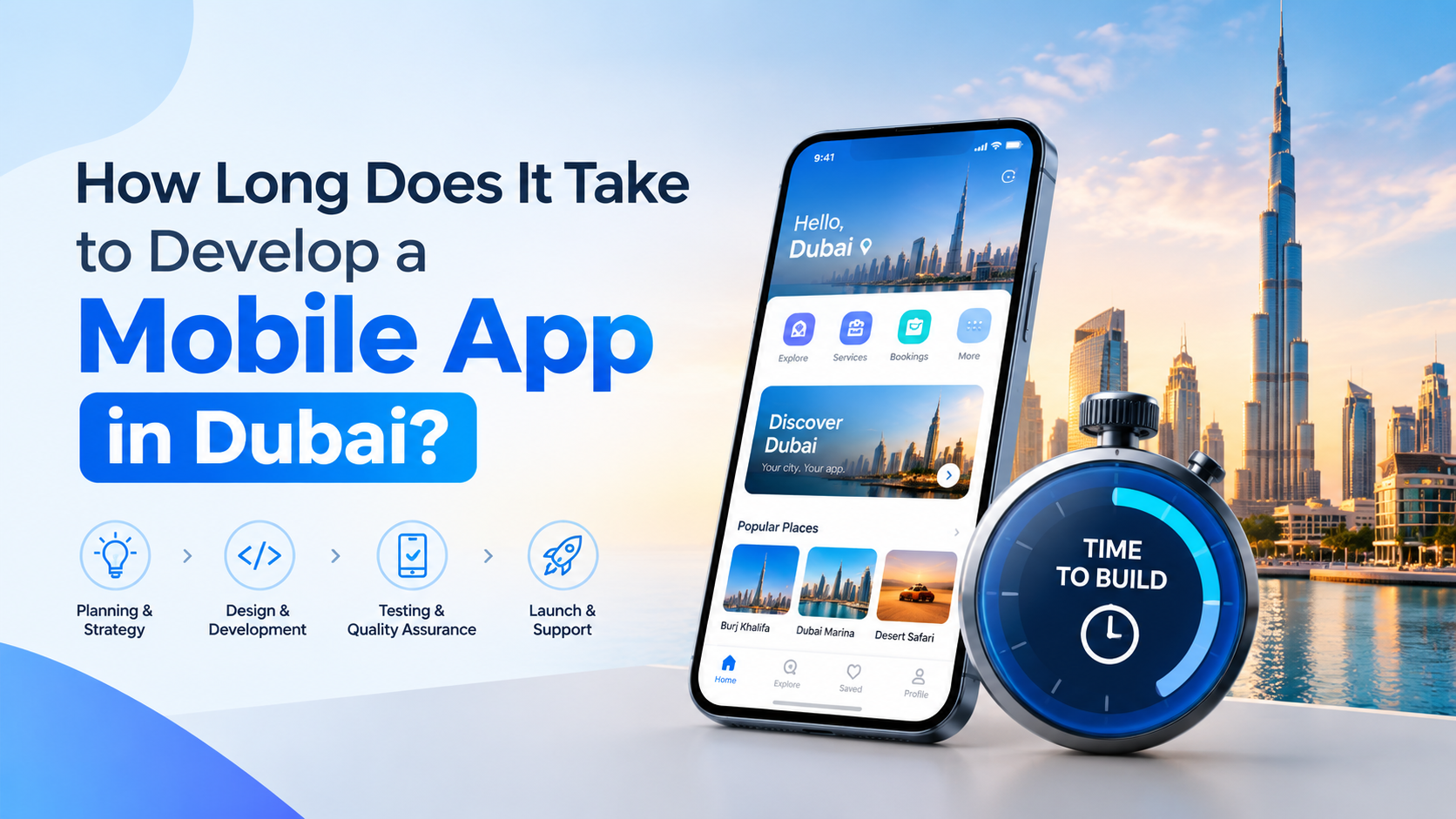
How Long Does It Take to Develop a Mobile App in Dubai?
For founders and business owners planning a mobile product, understanding the Mobile App Development Timeline is essential before committing resources to a project. A simple mobile application may take a few months, while a complex marketplace, fintech, healthcare, or enterprise platform can require considerably more time.
The exact duration depends on the number of features, UI/UX complexity, backend requirements, integrations, security, testing, and whether the business is building an MVP or a complete product.
How Long Does It Take to Build a Mobile App in Dubai?
A typical mobile app development project can take approximately 3 to 9 months, depending on complexity and scope.
A simplified breakdown is:
- Simple app: Around 2–4 months
- Medium-complexity app: Around 4–6 months
- Complex app: Around 6–9+ months
- Large enterprise platform: Potentially 9–12+ months
These are general planning ranges rather than fixed deadlines. A detailed requirements analysis is necessary to establish a realistic schedule for a specific application.
What Determines the Mobile App Development Timeline?
The development timeline is influenced by several factors. Understanding these before starting can help businesses avoid unexpected delays.
1. App Complexity
The number and complexity of features have a direct impact on development time.
A basic company application with informational content, contact forms, authentication, and notifications is relatively straightforward.
A marketplace with customers, vendors, product management, payments, order tracking, reviews, notifications, and an admin dashboard requires considerably more development and testing.
2. Number of Platforms
Businesses need to decide whether they are launching on Android, iOS, or both.
Developing for both platforms can increase the overall project scope. Cross-platform technologies such as Flutter or React Native can allow teams to share substantial development work, while native development may be appropriate for applications requiring extensive platform-specific functionality.
3. UI/UX Design
Design is more than creating attractive screens.
The team needs to plan user journeys, wireframes, navigation, interactive prototypes, visual design, responsive layouts, and usability.
An application with 10–15 straightforward screens will generally require less design work than a large application containing dozens of user flows.
4. Backend Development
Mobile applications frequently depend on backend systems for user accounts, databases, APIs, payments, notifications, analytics, content management, and business logic.
If a business already has suitable APIs and backend infrastructure, development may move faster. Building a complete backend from scratch can add significant time.
5. Third-Party Integrations
Payment gateways, maps, SMS services, social login, analytics, CRM systems, ERP platforms, cloud services, and other integrations can affect the schedule.
Each integration needs implementation, configuration, security checks, and testing.
Mobile App Development Stages and Their Timeline
A professional Mobile App Development Company in Dubai typically follows several stages.
Discovery and Planning: 1–3 Weeks
The first stage establishes the business objectives, target audience, core features, technical requirements, monetization strategy, and project scope.
For startups, this stage is particularly important because it helps distinguish essential MVP features from features that can be introduced later.
UI/UX Design: 2–6 Weeks
Designers create user flows, wireframes, prototypes, and final interfaces.
The duration depends on the number of screens, user roles, design complexity, revisions, and approval cycles.
Development: 6–16+ Weeks
This is usually the largest phase.
Developers build the mobile application, backend, APIs, database, authentication, integrations, dashboards, and other required functionality.
The timeline varies significantly depending on the product.
Testing and Quality Assurance: 2–5 Weeks
Testing can include functional testing, usability testing, device testing, performance testing, security checks, API testing, and regression testing.
Testing should not be treated as an optional final step. Identifying issues early can help reduce costly fixes later.
Deployment: 1–2 Weeks
After final testing and approval, the application is prepared for release through the relevant app stores.
The team may also need to configure production infrastructure, analytics, certificates, app-store information, and release settings.
Post-Launch Support
Development does not necessarily end when the application goes live.
Businesses may need ongoing bug fixes, security updates, performance optimization, operating-system compatibility updates, analytics, and new features.
How Long Does It Take to Build an MVP?
An MVP can often be developed faster than a complete application because it focuses on the essential functionality required to test a business idea.
Depending on complexity, an MVP may take approximately 8–16 weeks.
For example, a startup developing a booking application might initially focus on:
- User registration
- Service discovery
- Booking
- Payments
- Notifications
- Basic profiles
- Admin management
Advanced analytics, loyalty programs, AI features, complex automation, and other enhancements can be introduced after validating the product.
For founders, this approach can reduce initial scope and allow the business to collect real-world feedback before expanding the application.
Timeline for Different Types of Mobile Apps
Different business models naturally require different development efforts.
E-Commerce App
An e-commerce application may require product catalogs, search, filters, customer accounts, cart management, payments, order tracking, notifications, and administration.
On-Demand App
Delivery, transportation, home services, and similar applications may require real-time tracking, customer and provider apps, location services, booking, payments, notifications, and operational dashboards.
Marketplace App
A marketplace can require multiple user roles, vendor onboarding, product or service management, commissions, payments, reviews, orders, messaging, and administrative controls.
Healthcare App
Healthcare applications may include appointments, provider profiles, patient communication, reminders, records, and integrations. Security and applicable regulatory requirements can add complexity.
Enterprise App
Enterprise applications can involve employee management, field operations, inventory, reporting, CRM/ERP integration, workflows, and role-based access.
How Businesses Can Reduce Development Delays
Businesses cannot eliminate every development challenge, but several practices can help keep projects on schedule.
Define Requirements Early
A clear feature list reduces uncertainty and prevents repeated changes during development.
Prioritize MVP Features
Not every desired feature needs to be included in version one. Focus on functionality that directly supports the primary business objective.
Prepare Content and Assets
Delays can occur when designs, text, images, product information, branding materials, or business rules are not ready when needed.
Establish a Clear Approval Process
Fast feedback from decision-makers can prevent development teams from waiting for design or feature approvals.
Use the Right Technology
The technology stack should match the product. Depending on requirements, businesses may consider native Android/iOS development, Flutter, React Native, or other approaches.
Choosing a Mobile App Development Company in Dubai
Selecting the right development partner can influence both timeline and product quality.
Before hiring a Mobile App Development Agency, business owners should evaluate its experience with similar applications, development methodology, UI/UX capabilities, backend expertise, testing process, communication practices, and post-launch support.
Companies can also compare specialized expertise from an Android App Development Company in Dubai or an iOS App Development Company in Dubai when platform-specific development is required.
Businesses searching for a Mobile App Development Company in UAE should also consider whether the team understands their target market, industry requirements, integrations, and business objectives.
How A2Solutions Helps Businesses Build Mobile Apps
A2Solutions can support businesses throughout the application lifecycle, including discovery, strategy, UI/UX design, development, testing, deployment, and ongoing maintenance.
Whether you are a founder validating an MVP, a business owner digitizing an existing service, or an established company creating a new customer platform, the development process should be structured around your business goals.
For companies exploring Mobile App Development Services in Dubai, establishing the scope and priorities before development begins can make the timeline more predictable.
Frequently Asked Questions
How long does it take to develop a mobile app in Dubai?
A mobile app can take around 3–9 months depending on complexity. Simple applications may take 2–4 months, while complex marketplaces, fintech products, healthcare platforms, and enterprise applications can require 6–9 months or longer.
What is the fastest way to build a mobile app?
The fastest approach is usually to define a focused MVP, prioritize essential features, finalize requirements early, and use a suitable development technology. Cross-platform frameworks can also reduce duplicated development work when both Android and iOS are required.
Does building an Android and iOS app take longer?
Building for both platforms can increase project scope. However, cross-platform technologies such as Flutter and React Native can allow substantial code sharing, potentially making multi-platform development more efficient.
How long does an MVP mobile app take?
An MVP can often take approximately 8–16 weeks, depending on features and complexity. A focused MVP includes only the functionality required to test the core business proposition and gather initial user feedback.
What causes mobile app development delays?
Common causes include unclear requirements, frequent scope changes, delayed approvals, complex integrations, unavailable content, technical issues, inadequate testing, and changing business requirements during development.
Can AI features increase app development time?
Yes. AI functionality can add development complexity depending on the feature. AI chatbots, recommendations, computer vision, predictive analytics, voice capabilities, and intelligent automation may require additional APIs, data preparation, testing, security, and infrastructure.
How can I get an accurate mobile app development timeline?
An accurate timeline requires a detailed understanding of the application’s features, platforms, user roles, integrations, design requirements, backend architecture, and testing needs. A discovery and requirements phase is usually the best starting point.
Final Thoughts
There is no universal timeline for building a mobile application. A simple business app can potentially be launched within a few months, while a complex digital platform may require considerably longer.
For founders and business owners considering Mobile App Development Dubai, the most effective approach is to define the business objective first, prioritize the essential features, establish a realistic MVP, and select a development partner capable of managing design, development, testing, deployment, and future growth.
A clear scope at the beginning does more than estimate the launch date—it helps businesses manage investment, expectations, and product quality throughout the development journey.
