




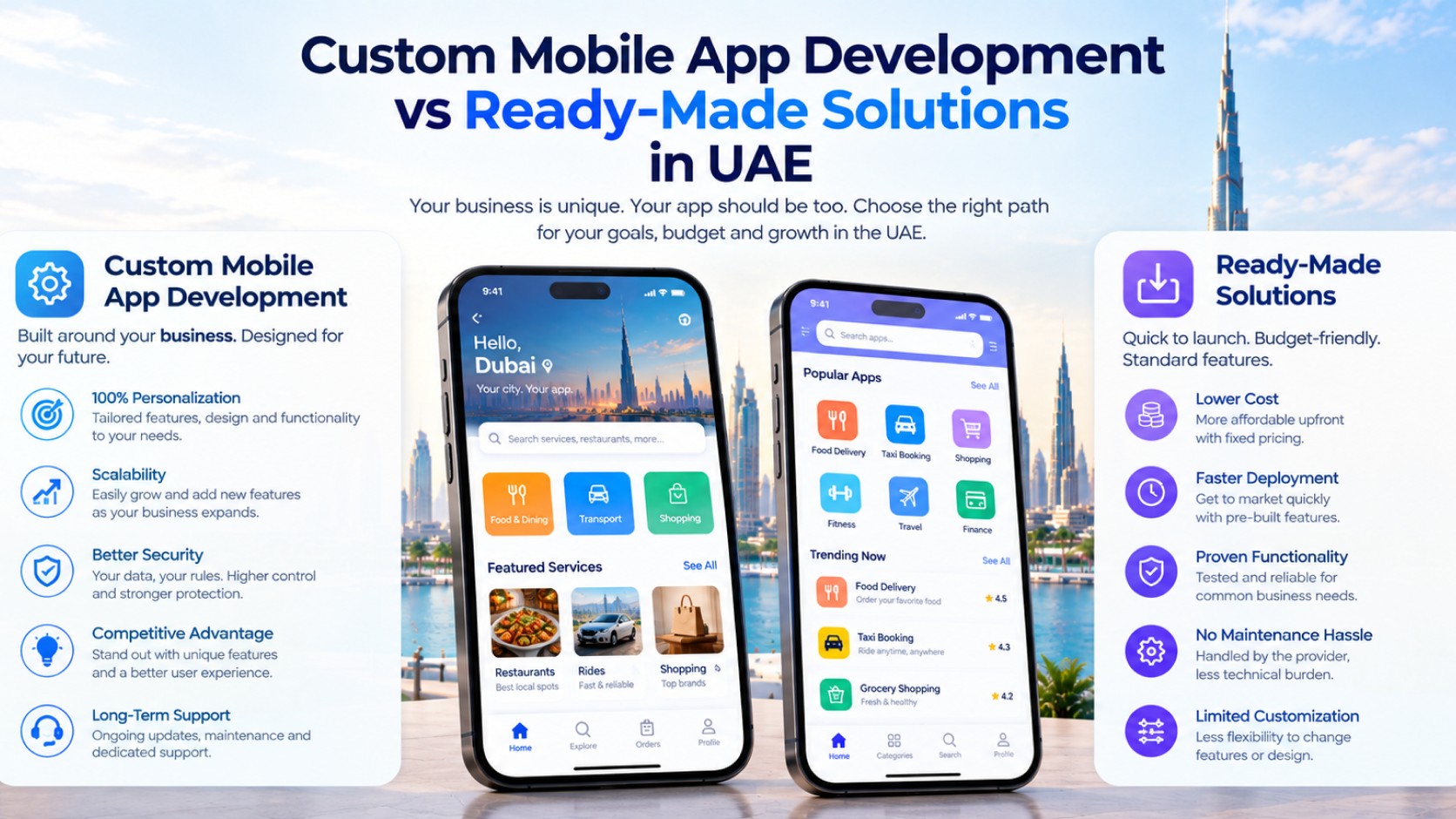
Custom Mobile App Development vs Ready-Made Solutions in UAE
For businesses planning to launch a mobile application, choosing between custom development and a ready-made solution can have a major impact on cost, flexibility, scalability, and long-term growth. A Mobile App Development Company in UAE can help businesses evaluate both approaches based on their objectives, target customers, required features, and budget.
Ready-made solutions can provide businesses with faster access to existing functionality, while custom mobile applications are designed around specific business requirements. The right choice depends on what the business needs today and where it expects to go in the future.
What Is Custom Mobile App Development?
Custom mobile app development involves creating an application specifically for a business, its customers, and its operational requirements.
Instead of adapting an existing product to fit the business, developers build the application’s functionality, user experience, backend, integrations, and workflows around the company’s requirements.
Custom development can be suitable for:
- Startups launching unique products
- Businesses with specialized workflows
- Marketplaces
- On-demand platforms
- Enterprise applications
- Fintech products
- Healthcare platforms
- E-commerce businesses
- Businesses requiring custom integrations
The biggest advantage is flexibility. The application can evolve as the business model and customer requirements change.
What Are Ready-Made Mobile App Solutions?
Ready-made solutions are pre-built applications or software platforms that offer existing features and workflows.
Businesses can often configure branding, content, products, users, and other settings without developing the entire application from scratch.
Ready-made solutions can be useful for businesses that need a straightforward application and want to launch quickly.
For example, a small business may need basic booking, customer management, notifications, or e-commerce functionality that is already supported by an existing platform.
However, businesses need to understand the platform’s limitations before committing to it.
Custom vs Ready-Made: What Is the Difference?
The main difference is flexibility versus speed and standardization.
Custom development gives businesses greater control over functionality, design, integrations, data architecture, and future development.
Ready-made solutions can reduce initial development effort because much of the underlying product already exists.
Neither approach is automatically suitable for every business. The decision should be based on the complexity of the business model and the level of customization required.
Custom Mobile App Development: Key Benefits
Complete Feature Flexibility
With custom development, businesses can build features around their actual customer journey instead of adjusting the business process to match a pre-existing platform.
Unique User Experience
The interface can be designed specifically for the brand and its target users.
This can be important for businesses competing in crowded markets where customer experience is a major differentiator.
Custom Integrations
A custom application can be designed to connect with CRM, ERP, payment, logistics, inventory, analytics, AI, and other business systems according to specific requirements.
Scalability
The architecture can be planned around expected growth.
A startup may initially require a small MVP, while an established business may need multiple user roles, advanced analytics, automation, and enterprise integrations later.
Greater Product Ownership
Custom development can provide businesses with greater control over the product’s functionality and future roadmap, depending on the contractual and technical arrangements.
Ready-Made Solutions: Key Benefits
Faster Launch
Since much of the software is already developed, businesses can potentially launch faster than building a completely new application.
Lower Initial Investment
A ready-made solution can require less initial development work, particularly when the business only needs standard functionality.
Existing Features
Many ready-made platforms already provide common features such as user accounts, notifications, content management, bookings, product catalogs, and basic administration.
Easier Initial Setup
Businesses with straightforward requirements may be able to configure an existing solution without managing a large custom development project.
Limitations of Ready-Made Solutions
The lower initial cost and faster deployment can come with trade-offs.
Limited Customization
Businesses may have to work within the platform’s existing functionality.
If a company requires unique workflows, highly customized features, or specialized integrations, modifications may become difficult or expensive.
Scalability Constraints
A platform that works well for a small operation may not necessarily support a business’s future requirements.
Businesses should investigate user limits, API availability, performance, integrations, and upgrade options before making a decision.
Vendor Dependency
Depending on the solution, businesses may become dependent on the provider for updates, technical changes, pricing, support, or feature availability.
Differentiation Challenges
When multiple businesses use similar platforms, creating a highly differentiated customer experience can be more difficult.
Custom vs Ready-Made: Cost Considerations
Custom development generally requires a larger initial investment because the product is designed and built specifically for the business.
Ready-made solutions may have a lower initial cost, but businesses should consider the total cost of ownership, not only the launch price.
Costs can include:
- Subscription or licensing fees
- Customization
- Additional integrations
- Transaction fees
- Hosting
- Maintenance
- Support
- Upgrades
- Data migration
- Future development
A ready-made product can be financially sensible when its features closely match the business requirements.
However, if extensive customization is required, the cost difference between a ready-made platform and custom development may become smaller over time.
Which Option Is Better for Startups?
For founders, the decision often depends on how unique the business idea is and how quickly the market needs to be tested.
A startup with a straightforward business model may begin with a ready-made solution to validate demand.
However, if the application itself is the core of the business—for example, a unique marketplace, fintech platform, logistics product, or customer experience—custom development may provide greater flexibility.
An MVP can also provide a middle path.
Instead of building every planned feature, founders can create a focused custom product containing only the functionality required to validate the concept.
Which Option Is Better for Established Businesses?
Established businesses often have existing processes, systems, customer databases, and operational requirements.
If the application needs to connect with existing CRM, ERP, inventory, payment, or enterprise systems, custom development may provide more control.
For businesses with straightforward requirements, however, a ready-made platform may still be sufficient.
The key question is whether the solution can support the business’s current workflow without creating unnecessary operational limitations.
When Should You Choose Custom Development?
Custom development may be worth considering when:
- Your business model is unique
- You need specialized functionality
- Your application is a core business product
- You require complex integrations
- You expect significant future growth
- Customer experience is a major competitive factor
- You need greater control over the product roadmap
- Existing solutions cannot meet your requirements
When Should You Choose a Ready-Made Solution?
A ready-made solution may make sense when:
- Your requirements are relatively standard
- You need to launch quickly
- Your initial budget is limited
- You do not require extensive customization
- The platform already supports your essential workflows
- You are testing a simple business concept
- You are comfortable with the provider’s pricing and limitations
How a Mobile App Development Company Can Help
Choosing between custom and ready-made development does not have to be based solely on price.
A professional Mobile App Development Agency can assess the business model, customer journey, technical requirements, integrations, scalability needs, and long-term roadmap before recommending an approach.
Businesses searching for Mobile App Development Services in Dubai can also evaluate whether their potential development partner has experience with similar industries and application types.
If platform-specific development is required, businesses may also consider specialized expertise from an Android App Development Company in Dubai or an iOS App Development Company in Dubai.
For companies operating in Abu Dhabi, evaluating a Mobile App Development Company in Abu Dhabi can involve the same considerations: technical capability, relevant experience, scalability, communication, and ongoing support.
Why Businesses in the UAE Should Think Beyond Initial Cost
For UAE businesses, the cheapest way to launch an application may not always be the most suitable long-term strategy.
An application can become a central part of customer acquisition, sales, bookings, service delivery, payments, or internal operations.
If the platform becomes difficult to customize or scale, replacing it later can involve migration, redevelopment, data handling, and additional operational costs.
Businesses exploring Mobile App Development Dubai should therefore evaluate the total product lifecycle rather than only the initial quotation.
How A2Solutions Can Help
A2Solutions can help businesses evaluate their application requirements and determine an appropriate development strategy.
From product discovery and UI/UX design to development, backend integration, testing, deployment, and maintenance, the focus should be on creating a mobile product aligned with business objectives.
Whether you need a custom application, an MVP, or are evaluating a ready-made solution, understanding the long-term requirements before investing can help reduce unnecessary costs and technical limitations.
Frequently Asked Questions
Is custom mobile app development better than a ready-made solution?
Neither option is universally better. Custom development provides greater flexibility and control, while ready-made solutions can offer faster deployment and lower initial development effort. The appropriate choice depends on the business model, features, budget, and long-term requirements.
Is custom app development more expensive?
Custom development usually requires a larger initial investment because the application is designed specifically for the business. However, the long-term value depends on functionality, scalability, integrations, maintenance, and the total cost of operating the product.
Are ready-made mobile apps suitable for startups?
Yes. Ready-made solutions can be useful for startups with straightforward requirements that want to test a business idea quickly. If the application requires unique functionality or is central to the startup’s competitive advantage, custom development may provide more flexibility.
Can a ready-made app be customized?
Many ready-made platforms offer some customization, such as branding, content, layouts, and configuration. The extent of customization varies by provider, so businesses should verify technical limitations before selecting a platform.
Which option is easier to scale?
Custom applications can be architected around the business’s expected growth and future requirements. Ready-made solutions can also scale if the provider supports increased users, transactions, integrations, and functionality, but businesses remain subject to the platform’s capabilities.
Should I build a custom app or start with an MVP?
An MVP can be a practical starting point when the goal is to validate a business idea. A custom MVP can focus on essential features while providing a foundation for future development without requiring the full product to be built immediately.
How do I choose between custom and ready-made development?
Start by identifying your business objectives, essential features, integrations, target users, expected growth, budget, and timeline. Then compare those requirements against the capabilities and limitations of available ready-made solutions.
Final Thoughts
The decision between custom mobile app development and a ready-made solution should begin with the business requirement, not the technology or initial price.
Ready-made solutions can provide speed and standard functionality, making them useful for businesses with straightforward needs. Custom development provides greater flexibility, control, and opportunities for differentiation when a business requires specialized functionality or long-term scalability.
For founders, business owners, and companies considering Mobile Application Development, the best approach is to evaluate the entire product lifecycle—from launch and customer experience to integrations, maintenance, scalability, and future growth.
Whether you work with a Mobile App Development Company in UAE or choose a ready-made platform, a clear understanding of your business objectives will help you make a more informed technology decision.
