




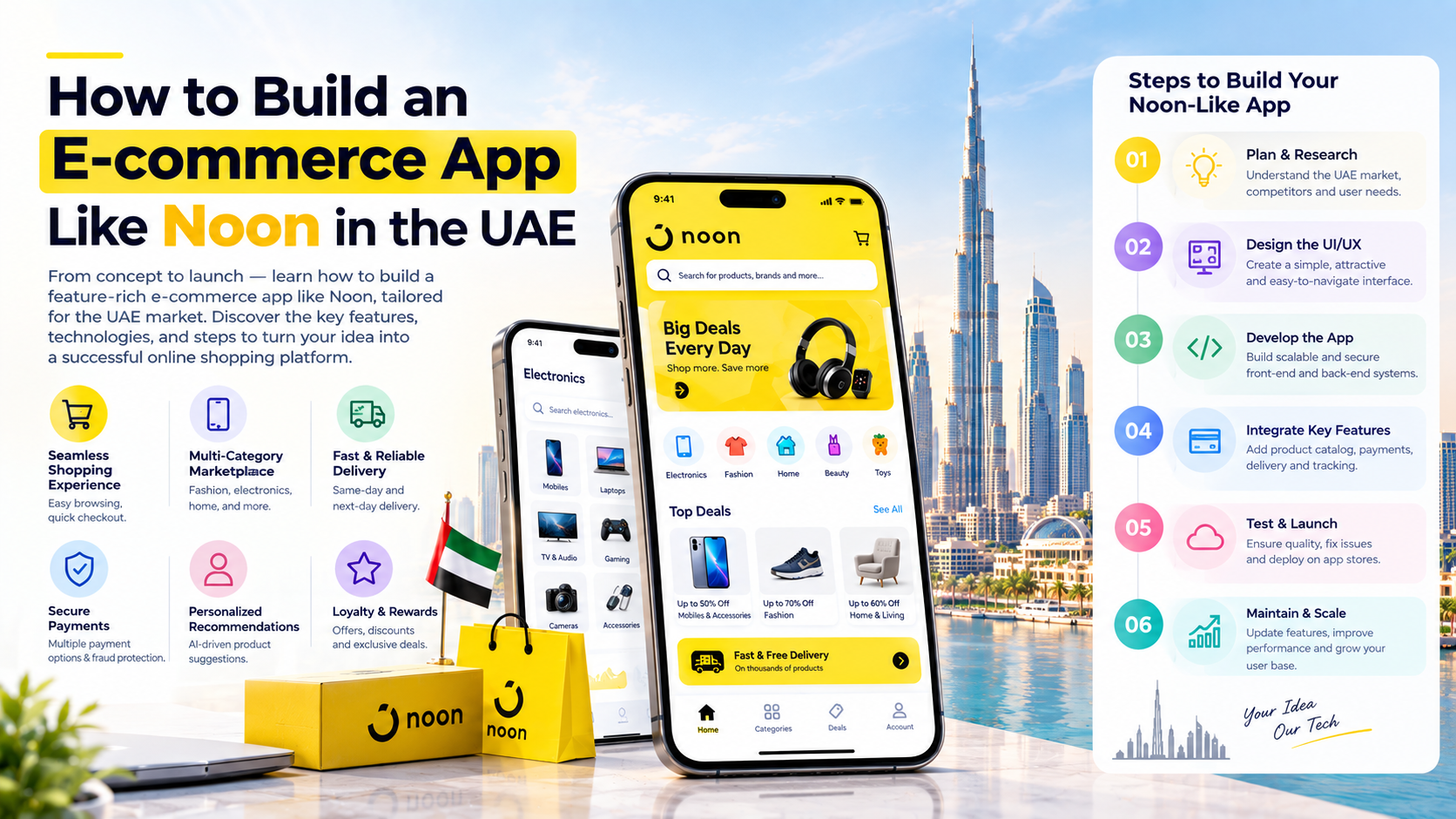
How to Build an E-commerce App Like Noon in the UAE?
The UAE has become a highly competitive market for digital commerce, making ecommerce App Development Dubai an important consideration for founders and business owners planning to launch an online marketplace. However, building an application similar to Noon is not simply about creating product pages and adding a shopping cart. A successful e-commerce marketplace requires a clear business model, customer-focused experience, seller management, secure payments, inventory systems, delivery operations, scalable technology, and a well-planned mobile product.
For a startup or established business, the better approach is to study what makes large marketplaces useful and then build a platform around a specific target audience, product category, or business opportunity.
This guide explains how to approach the development of a Noon-like e-commerce marketplace in the UAE, including essential features, technology, development stages, costs, monetization, security, and strategies for launching an MVP.
What Is a Noon-Like E-commerce App?
A Noon-like application is generally more than a conventional online store.
A traditional e-commerce app may allow one business to list and sell its own products. A marketplace platform can connect multiple sellers with customers through one digital ecosystem.
A large marketplace may therefore require several connected components:
- Customer mobile application
- Seller portal or seller application
- Administrator dashboard
- Product and catalogue management
- Inventory management
- Order management
- Payment processing
- Delivery and logistics integration
- Customer support
- Notifications
- Analytics and reporting
The exact functionality should depend on the business model. A startup does not necessarily need to reproduce every feature of a mature marketplace at launch.
Why Build an E-commerce Marketplace in the UAE?
The UAE provides an attractive environment for businesses exploring digital commerce because consumers are accustomed to using smartphones, online services, digital payments, and delivery platforms.
For founders, the opportunity is not necessarily to build another general marketplace with thousands of unrelated products.
A more focused strategy can be easier to validate.
For example, a business could develop a marketplace focused on:
- Fashion and accessories
- Beauty products
- Electronics
- Grocery
- Home and furniture
- Automotive products
- Luxury products
- Sports equipment
- Baby products
- Local brands
- B2B supplies
- Specialized niche products
The objective should be to identify a customer problem or underserved market and then build an application that solves it efficiently.
How Does a Noon-Like Marketplace Work?
A multi-vendor e-commerce platform typically involves four major participants: customers, sellers, administrators, and delivery partners.
Customer Side
Customers use the mobile application to:
- Create an account
- Browse products
- Search and filter items
- View product details
- Add products to the cart
- Select delivery information
- Complete payment
- Track orders
- Receive notifications
- Review products or sellers
The customer experience should be simple enough that users can discover a product and complete a purchase without unnecessary steps.
Seller Side
Sellers require tools to manage their marketplace operations.
A seller portal can allow merchants to:
- Register their business
- Add products
- Upload images
- Set prices
- Manage stock
- Process orders
- Update shipping information
- View sales
- Manage promotions
- Respond to customer queries
- Monitor marketplace performance
Seller experience is particularly important because a marketplace depends on the quality and activity of its merchants.
Admin Side
The administrator controls the wider ecosystem.
The admin panel can include:
- Seller approval
- Customer management
- Product approval
- Category management
- Order monitoring
- Commission management
- Promotions
- Refund management
- Payment monitoring
- Reports
- Notifications
- Content management
- User permissions
A well-designed administration system can significantly reduce operational complexity as the marketplace grows.
Delivery and Logistics
Delivery can become one of the most complicated parts of marketplace development.
Depending on the business model, the platform may need:
- Delivery partner integrations
- Address management
- Delivery status updates
- Driver assignment
- Order tracking
- Delivery charges
- Estimated delivery times
- Proof of delivery
- Customer notifications
The exact logistics architecture should be determined during product planning rather than added after the application is built.
Essential Features for an E-commerce App
A successful e-commerce application does not need hundreds of features on day one. It needs the right features in the right order.
User Registration and Profiles
Customers should be able to register and manage their accounts conveniently.
Depending on the application, registration may include email, mobile number, passwordless authentication, or other supported authentication methods.
Customer profiles can include:
- Personal information
- Saved addresses
- Order history
- Wishlist
- Payment preferences
- Notifications
- Account settings
Product Catalogue
The catalogue is the foundation of the marketplace.
Products should contain relevant information such as:
- Product name
- Images
- Description
- Price
- Discounts
- Variants
- Availability
- Seller information
- Specifications
- Ratings and reviews
A structured catalogue also makes search, filtering, recommendations, and administration easier.
Search and Filtering
Customers should be able to quickly find what they need.
Useful options can include:
- Keyword search
- Categories
- Price range
- Brand
- Ratings
- Availability
- Location
- Product attributes
For larger catalogues, intelligent search can eventually help users find products using natural-language queries.
Shopping Cart and Checkout
The checkout experience directly affects the purchasing journey.
A well-planned checkout should make it easy to:
- Review products
- Change quantities
- Apply promotions
- Select an address
- Choose delivery options
- Select a payment method
- Confirm the order
Avoid unnecessary checkout steps wherever possible.
Payment Integration
An e-commerce marketplace needs secure payment processing appropriate to its business model and target market.
Depending on requirements, the application may support:
- Credit and debit cards
- Digital payment methods
- Wallets
- Cash on delivery
- Other supported payment options
Payment information should be handled through appropriate payment infrastructure rather than unnecessarily storing sensitive card data within the application.
Order Tracking
Customers expect visibility after making a purchase.
Order tracking can show stages such as:
Order placed → Confirmed → Processing → Shipped → Out for delivery → Delivered
The exact workflow will depend on the marketplace’s logistics model.
Reviews and Ratings
Reviews can help customers make purchasing decisions and provide businesses with valuable feedback.
The platform can allow customers to review:
- Products
- Sellers
- Delivery experience
Businesses should also establish appropriate moderation processes to manage fraudulent or inappropriate reviews.
Advanced Features to Consider
Once the core marketplace has been validated, advanced capabilities can be introduced.
AI-Powered Product Recommendations
AI can analyze relevant user activity to recommend products that may be useful to individual customers.
Recommendations can be based on signals such as:
- Browsing activity
- Previous purchases
- Search behavior
- Product interactions
- Categories of interest
The objective should be improving product discovery rather than simply adding an AI label to the application.
Intelligent Search
AI-powered search can allow customers to describe what they want in natural language.
For example, a customer might search:
“Show me lightweight running shoes under AED 400.”
The application can interpret the request and return relevant products if the underlying catalogue and search infrastructure support that functionality.
Personalized Offers
A marketplace can use customer data and business rules to present more relevant offers.
Possible applications include:
- Product recommendations
- Category-based promotions
- Personalized discounts
- Re-engagement campaigns
- Cross-selling
Personalization should be implemented responsibly and with appropriate privacy controls.
AI Customer Assistance
An AI assistant can help answer common questions, explain product information, provide order guidance, or direct customers to relevant services.
Human support should remain available for situations requiring judgment or intervention.
Analytics and Business Intelligence
Marketplace owners need to understand what is happening across the platform.
Analytics can help monitor:
- Sales
- Orders
- Conversion
- Product performance
- Customer behavior
- Seller performance
- Repeat purchases
- Cart activity
- Revenue
- Operational trends
These insights can help management make informed product and business decisions.
How to Build the MVP First
One of the biggest mistakes founders can make is trying to build a complete marketplace before validating the business model.
A better strategy is to develop an MVP — Minimum Viable Product.
The initial version could include:
- Customer registration
- Product catalogue
- Search
- Product details
- Cart
- Checkout
- Payment
- Orders
- Basic notifications
- Seller management
- Admin dashboard
Advanced AI, complex loyalty systems, extensive automation, and other sophisticated capabilities can be introduced after the core product has been validated.
Phase 1: Product Discovery
Define:
- Target customers
- Product categories
- Business model
- Marketplace structure
- Revenue model
- Competitors
- Core customer problem
- MVP scope
Phase 2: UI/UX Design
Create the customer journey and marketplace workflows before development.
Design should focus on:
- Easy navigation
- Product discovery
- Fast checkout
- Clear information
- Mobile usability
- Consistent branding
Phase 3: Application Development
The development team builds the mobile applications, backend systems, APIs, databases, dashboards, and integrations.
Depending on the requirements, the business may choose native Android and iOS development or a suitable cross-platform approach.
Phase 4: Testing
Testing should cover:
- Functional behaviour
- Device compatibility
- Performance
- Security
- Payment workflows
- API integrations
- Checkout
- Notifications
- Order processing
Real-device testing is particularly important for mobile commerce applications.
Phase 5: Deployment
After testing, the application can be prepared for the relevant app stores and production infrastructure.
The launch should also include monitoring so that technical and customer issues can be identified quickly.
Phase 6: Continuous Improvement
Launching the application is not the end of development.
Customer feedback, analytics, support requests, and business performance should guide subsequent releases.
Technology Stack for a Marketplace App
The technology stack should be selected according to the expected scale, functionality, integrations, budget, and development strategy.
A typical architecture may include:
Mobile Application
Depending on requirements:
- Native Android
- Native iOS
- Flutter
- React Native
Backend
The backend manages:
- Users
- Products
- Sellers
- Orders
- Payments
- Inventory
- Notifications
- Business rules
Database
The database should be designed to support the marketplace’s expected data volume and transaction requirements.
APIs
APIs connect the mobile application with backend systems and external services such as:
- Payment gateways
- Maps
- Delivery providers
- Notifications
- Analytics
- Third-party business systems
Cloud Infrastructure
A scalable cloud architecture can help businesses increase infrastructure capacity as demand grows.
The final architecture should be designed around actual usage requirements rather than assuming that every startup needs enterprise-level infrastructure from day one.
How Much Does It Cost to Build an E-commerce App Like Noon in the UAE?
There is no single development price for a Noon-like application because the scope can vary dramatically.
The cost can be influenced by:
- Number of applications
- UI/UX complexity
- Customer features
- Seller functionality
- Admin dashboard
- Backend architecture
- Payment integrations
- Logistics integrations
- Product catalogue size
- AI functionality
- Security requirements
- Third-party integrations
- Testing requirements
- Cloud infrastructure
- Post-launch support
A basic marketplace MVP and a large multi-vendor platform are fundamentally different projects.
For this reason, founders should define the MVP before requesting a development estimate. A detailed scope produces a much more useful estimate than asking for a generic “Noon clone.”
How Can an E-commerce Marketplace Make Money?
A marketplace can use one or several revenue models.
Seller Commission
The platform can charge sellers a percentage of each completed transaction.
Seller Subscription
Merchants can pay a recurring fee for marketplace access or additional tools.
Featured Listings
Sellers may pay to promote selected products, where the business model and marketplace rules support it.
Advertising
The marketplace can offer advertising opportunities to eligible sellers and brands.
Delivery Fees
Customers may pay delivery charges depending on location, order value, or delivery method.
Premium Services
Additional services can be offered to sellers or customers depending on the marketplace strategy.
The most suitable monetization model should be established before development because it can affect marketplace architecture and workflows.
Security Considerations for an E-commerce App
Security should be considered from the beginning rather than treated as a final development step.
A marketplace may handle personal information, account credentials, orders, addresses, payments, seller data, and business information.
Important areas include:
- Secure authentication
- Authorization and role management
- Encrypted data transmission
- Secure API design
- Payment security
- Access controls
- Monitoring
- Regular security testing
- Secure cloud configuration
- Appropriate data retention practices
Businesses should also evaluate applicable UAE requirements and the requirements of their payment providers, partners, and specific industry.
How to Make Your Marketplace Different From Noon
The objective should not be to copy an established marketplace.
Large platforms already have significant scale, brand recognition, logistics networks, sellers, and customer bases.
A new business can instead compete through specialization.
For example, you could focus on:
- A specific product category
- Premium customer service
- Faster niche fulfilment
- Local sellers
- B2B commerce
- Curated products
- Subscription commerce
- Specialized communities
- A specific geographic market
- Better product discovery
- Industry-specific marketplace services
A clear positioning strategy gives founders a stronger foundation than attempting to duplicate every feature of a major platform.
Choosing an E-commerce App Development Company in Dubai
Selecting the right technology partner can have a significant impact on the development process.
An ecommerce app development company in Dubai should be able to understand both the technical and commercial sides of the marketplace.
Before selecting a partner, evaluate:
- Relevant e-commerce experience
- Mobile development capabilities
- UI/UX expertise
- Backend development
- API integration
- Payment integration experience
- Cloud architecture
- Security practices
- Testing processes
- Post-launch support
- Communication and project management
Businesses may also work with a Mobile App Development Company in UAE when they require broader regional expertise.
For Android-focused products, an Android App Development Company can handle platform-specific requirements, while an iOS App Development Company can develop the Apple ecosystem experience.
The right partner should also be able to explain what belongs in the MVP and what should be postponed until the product gains traction.
Why A2Solutions for E-commerce App Development?
A2Solutions can work with businesses from the initial product idea through design, development, testing, deployment, and ongoing product improvement.
The development process can include:
- Product discovery
- Business requirement analysis
- UI/UX design
- Android development
- iOS development
- Cross-platform development
- Backend development
- API integrations
- Payment integration
- E-commerce functionality
- AI integration
- Testing
- Deployment
- Maintenance and improvements
Whether you are a founder validating a new marketplace concept or an established business expanding into mobile commerce, the focus should be on developing a product that supports your business model and provides a useful customer experience.
Frequently Asked Questions
How much does it cost to build an app like Noon in the UAE?
The cost depends on the scope, number of platforms, marketplace features, seller tools, admin functionality, payments, logistics, integrations, security, AI capabilities, and ongoing infrastructure. A focused MVP will generally require a very different budget from a large multi-vendor marketplace.
How long does it take to develop a Noon-like e-commerce app?
Development time depends on the scope and technical complexity. A focused MVP can be planned and developed faster than a large marketplace with advanced seller management, logistics, personalization, analytics, and automation. Product discovery and requirements definition should happen before establishing a reliable timeline.
What features are essential for an e-commerce marketplace MVP?
A practical MVP can include customer registration, product browsing, search, product details, cart, checkout, payments, orders, notifications, seller management, and an admin dashboard. The exact MVP should be based on the business model and customer problem being validated.
Should I build Android and iOS apps at the same time?
It depends on the target audience, budget, launch strategy, and product requirements. Businesses can develop both platforms when reaching a broad customer base is important. Cross-platform technologies may also be considered when they fit the application’s technical requirements and long-term roadmap.
Can AI be added to an e-commerce marketplace?
Yes. AI can support product recommendations, intelligent search, customer assistance, personalization, product categorization, analytics, and other workflows. However, AI should be introduced where it provides measurable value rather than being added simply as a technology feature.
How does a multi-vendor marketplace make money?
Common models include seller commissions, subscriptions, featured listings, advertising, delivery fees, and premium services. A marketplace can use one model or combine several depending on its target sellers, customers, category, and operating structure.
Can I start with an MVP and expand later?
Yes. Starting with an MVP can help a business validate its marketplace concept before investing in a much larger platform. After launch, customer feedback, sales data, seller activity, and operational requirements can guide future features and technology investments.
What should I look for in a mobile app development company?
Look for experience relevant to your business model, strong mobile and backend capabilities, UI/UX expertise, integration experience, security practices, testing processes, communication, and post-launch support. A good development partner should also challenge unnecessary requirements and help prioritize the MVP.
Final Thoughts
Building an e-commerce app like Noon in the UAE is a substantial product development project. The challenge is not simply creating a shopping application; it is building an ecosystem that connects customers, sellers, administrators, payments, inventory, orders, and delivery operations.
For founders and business owners, the smartest starting point is usually a clearly defined market opportunity and a focused MVP.
Instead of attempting to copy every capability of an established marketplace, identify who your customers are, what they need, why they would choose your platform, and how the business will generate revenue.
From there, technology can support the strategy.
A well-planned e-commerce marketplace can start with essential commerce functionality and gradually introduce advanced capabilities such as AI recommendations, intelligent search, personalization, analytics, automation, and sophisticated logistics.
If you are planning to develop an e-commerce marketplace in the UAE, A2Solutions can help turn the concept into a structured mobile product—from product discovery and UI/UX through development, integrations, testing, deployment, and continuous improvement.
Also Read:- How AI Is Changing Mobile App Development in the UAE?
