




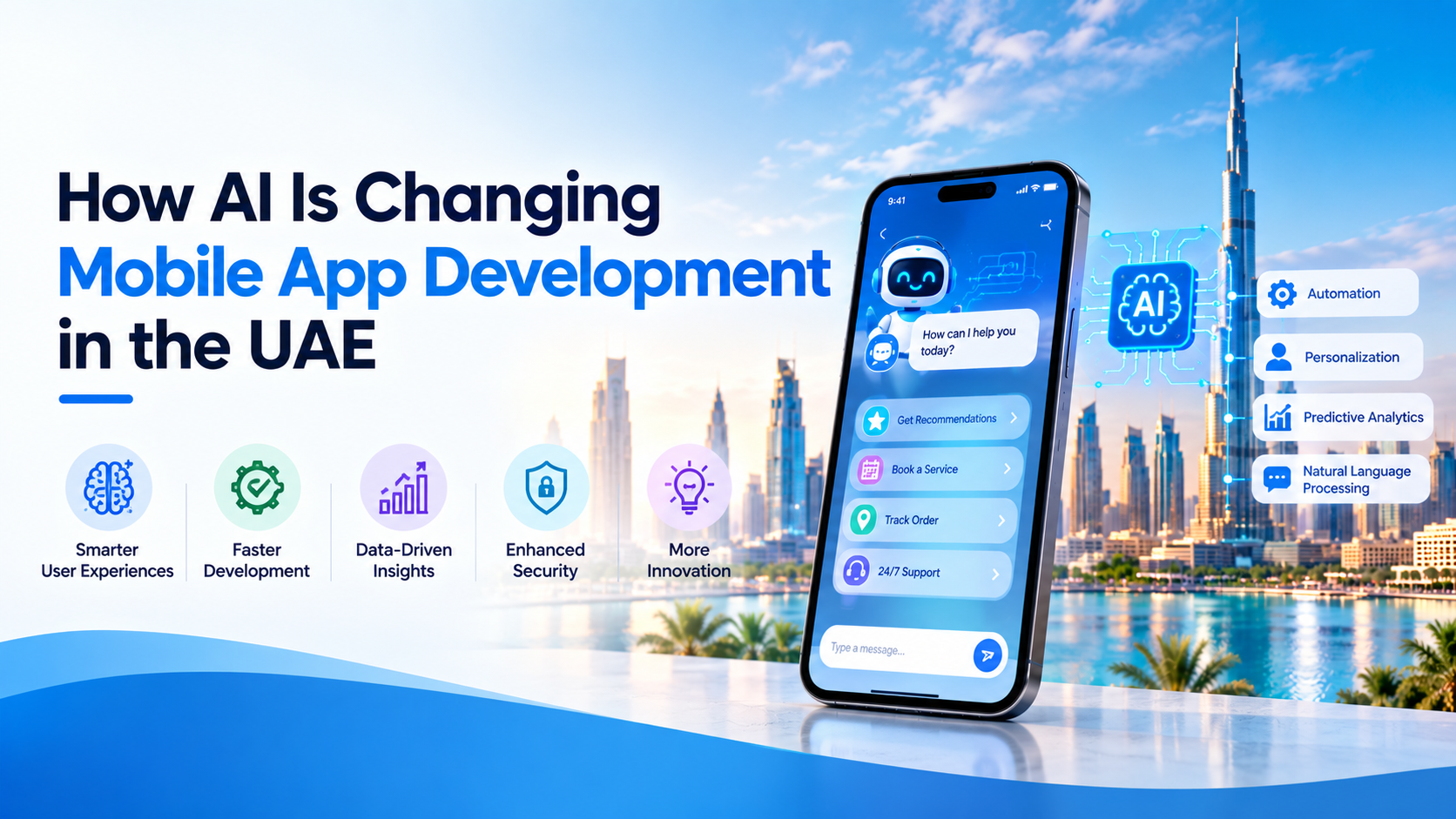
How AI Is Changing Mobile App Development in the UAE?
As businesses across the UAE become more digital, Mobile App Development Dubai is evolving from traditional app building into a more intelligent, automated, and personalized process. Artificial intelligence is changing how businesses design mobile products, interact with customers, analyze data, automate operations, and make decisions. For founders and business owners planning to build an app, AI is no longer simply a futuristic technology—it can be a practical part of a modern mobile app strategy.
From AI-powered chatbots and personalized recommendations to predictive analytics, intelligent search, voice assistants, and automated workflows, businesses can use AI to make mobile applications more useful and competitive. However, the goal should not be to add AI to an application simply because it is popular. The right AI capability should solve a genuine customer or business problem.
Why AI Is Becoming Important for Mobile Apps in the UAE
The UAE has a highly digital business environment, with companies across retail, real estate, healthcare, finance, logistics, hospitality, education, and professional services increasingly investing in digital experiences.
Mobile applications have become an important customer touchpoint for many businesses. Customers expect apps to be fast, convenient, personalized, and available whenever they need them.
AI can help businesses meet these expectations by enabling applications to:
- Understand user behavior
- Personalize experiences
- Automate repetitive tasks
- Provide instant customer assistance
- Analyze large amounts of data
- Predict customer needs
- Improve search and discovery
- Generate useful insights
- Support business decision-making
This makes AI particularly relevant for companies planning new mobile products or upgrading existing applications.
How AI Is Changing Mobile App Development
AI is influencing almost every stage of the mobile application lifecycle—from product planning and user experience to development, testing, customer engagement, and post-launch optimization.
1. AI Is Creating More Personalized User Experiences
Traditional applications often provide the same experience to every user.
AI allows applications to understand individual behavior and provide more relevant experiences.
For example, an e-commerce application can analyze browsing activity, previous purchases, searches, and preferences to recommend products that are more likely to interest a customer.
A real estate application could recommend properties based on location, budget, property preferences, and previous searches.
This level of personalization can make applications feel more relevant while helping businesses improve engagement and conversion opportunities.
2. AI-Powered Chatbots Are Improving Customer Support
AI chatbots are becoming one of the most practical AI features for business applications.
Instead of requiring customers to call support or search through multiple pages, businesses can provide an AI assistant directly inside the application.
A chatbot can potentially help users:
- Find products
- Track orders
- Answer common questions
- Book appointments
- Explain services
- Provide account information
- Recommend relevant products
- Guide users through app features
For businesses serving customers outside traditional working hours, AI can also provide automated assistance around the clock.
The chatbot should be connected only to appropriate business information and systems, with security and access controls designed around the use case.
3. Intelligent Search Is Changing How Users Find Information
Traditional search generally depends on exact keywords.
AI-powered search can understand the intent behind a user’s request.
For example, instead of searching:
“Office shoes”
a customer could ask:
“Show me comfortable formal shoes suitable for everyday office use.”
The application can interpret the request and provide more relevant results.
This can be particularly valuable for:
- E-commerce
- Real estate
- Travel
- Food delivery
- Marketplaces
- Service platforms
- Education applications
For businesses with large amounts of content, products, listings, or services, intelligent search can significantly improve the user journey.
4. Predictive Analytics Can Help Businesses Make Better Decisions
Mobile applications generate valuable data through user interactions, purchases, searches, bookings, and other activities.
AI can analyze these patterns to identify trends and potential outcomes.
Businesses can use predictive capabilities for:
- Customer churn analysis
- Demand forecasting
- Sales predictions
- Inventory planning
- Customer segmentation
- Engagement analysis
- Operational forecasting
Instead of simply showing what happened in the past, an intelligent application can help businesses understand what may happen next.
For business owners, this can turn a mobile application from a customer-facing tool into a valuable decision-support platform.
5. AI Is Automating Repetitive Business Processes
One of the biggest opportunities AI provides is automation.
Many businesses still rely on employees to perform repetitive digital tasks such as sorting customer inquiries, processing documents, categorizing information, qualifying leads, or generating reports.
AI can automate parts of these workflows.
For example, a business application could automatically:
- Classify customer requests
- Qualify incoming leads
- Extract information from documents
- Generate summaries
- Categorize products
- Route support requests
- Create basic reports
- Send personalized notifications
Automation does not necessarily eliminate human involvement. Instead, it can allow employees to spend more time on activities that require judgment, creativity, relationship-building, and decision-making.
6. Generative AI Is Creating New App Experiences
Generative AI is opening another category of possibilities for mobile applications.
Depending on the business use case, applications can use generative AI for:
- Content generation
- Summarization
- AI assistants
- Personalized recommendations
- Document assistance
- Business insights
- Customer communication
- Natural-language interfaces
For example, a business application could allow a manager to ask:
“Summarize this month’s sales performance and highlight the biggest changes.”
The application could process the available business information and provide a concise response.
However, businesses should implement generative AI carefully, particularly when applications handle confidential, financial, healthcare, or other sensitive information.
7. Voice Interaction Is Making Apps More Convenient
AI-powered voice capabilities can make mobile applications easier to use in certain situations.
Users may be able to:
- Search using voice
- Ask questions
- Navigate application features
- Book appointments
- Track orders
- Request information
- Interact with an AI assistant
Voice interaction can be particularly useful when convenience, accessibility, or hands-free operation is important.
Businesses should determine whether voice genuinely improves the customer journey before making it part of the initial product scope.
8. AI Is Improving Fraud and Anomaly Detection
Applications involving payments, transactions, accounts, or financial activity can potentially use AI to identify unusual patterns.
An AI system can analyze transaction behavior and flag activity that differs from expected patterns.
Possible applications include:
- Fintech platforms
- E-commerce
- Payment applications
- Subscription businesses
- Marketplaces
- Financial services
AI-based detection should complement established security controls rather than replace authentication, encryption, monitoring, and other cybersecurity practices.
AI Is Changing the Way Apps Are Developed
The impact of AI is not limited to the final application. It is also changing the development process.
Development teams can use AI-assisted tools for certain activities such as:
- Code assistance
- Documentation
- Testing support
- Error analysis
- Data processing
- Prototyping
- Content generation
- Development workflow automation
However, human expertise remains important for architecture, product decisions, security, code quality, testing, deployment, and business requirements.
AI can accelerate parts of development, but it does not remove the need for experienced engineers and product teams.
What This Means for Businesses Planning to Build an App
For founders and business owners, AI creates both opportunities and decisions.
Before starting development, businesses should ask:
- What customer problem will the application solve?
- Which processes can AI improve?
- Which AI features are genuinely necessary?
- What data will the application use?
- How will customer information be protected?
- Which platforms should be supported?
- What should be included in the MVP?
- What will the ongoing infrastructure cost?
- How will the application scale as users increase?
Answering these questions early can prevent businesses from spending money on unnecessary technology.
How AI Can Affect Mobile App Development Cost
AI can influence Mobile App Development Cost depending on the complexity of the required functionality.
A simple application using an existing AI API may require significantly less development work than a platform involving custom machine learning models, extensive data processing, computer vision, predictive analytics, or advanced automation.
Businesses should consider:
- AI model or API requirements
- Data requirements
- Cloud infrastructure
- Backend architecture
- Number of users
- API usage
- Security
- Testing
- Monitoring
- Ongoing maintenance
For many businesses, starting with an MVP and one or two high-value AI features can be more practical than attempting to build a fully AI-driven platform from day one.
Which UAE Businesses Can Benefit From AI Mobile Apps?
AI can be applied across a wide range of industries.
E-Commerce
AI can support product recommendations, intelligent search, customer assistance, personalization, and demand forecasting.
Real Estate
Property recommendations, AI search, lead qualification, virtual assistants, and customer communication can improve the property discovery experience.
Healthcare
AI can support appointment workflows, information assistance, patient engagement, document processing, and administrative tasks, subject to applicable privacy and regulatory requirements.
Logistics
Businesses can explore AI for demand forecasting, delivery optimization, operational insights, and customer support.
Hospitality and Travel
AI can assist with personalized recommendations, itinerary support, customer service, bookings, and travel information.
Education
AI can support personalized learning, tutoring, content recommendations, assessments, and student engagement.
Fintech
Financial applications can explore AI for anomaly detection, personalization, customer support, risk analysis, and data-driven insights, with appropriate security and regulatory controls.
Choosing the Right Mobile App Development Partner
Building an AI-enabled mobile application requires more than creating attractive screens.
A Mobile App Development Company in UAE should understand mobile engineering, backend architecture, APIs, cloud infrastructure, AI integration, security, testing, and scalability.
Businesses looking for Mobile App Development Services in Dubai should evaluate a development partner based on:
- Relevant industry experience
- Mobile development expertise
- AI integration capabilities
- UI/UX design
- Backend engineering
- API and third-party integrations
- Security practices
- Testing methodology
- Scalability
- Post-launch support
Depending on the target market, businesses may work with an Android App Development Company for Android applications or an iOS App Development Company for Apple platforms.
Companies operating in Abu Dhabi can also evaluate a Mobile App Development Company in Abu Dhabi based on similar technical and business requirements.
For businesses specifically looking for a Mobile App Development Company in Dubai, the most important consideration should be whether the development partner understands the business objective—not simply whether it can build an application.
A capable Mobile App Development Agency should be able to explain which AI features are worth implementing, which can wait, and how the product can evolve over time.
How A2Solutions Can Help Businesses Build AI-Powered Apps
A2Solutions can help businesses turn mobile app concepts into practical digital products based on their specific business requirements.
The development process can include product discovery, UI/UX design, mobile development, backend engineering, API integrations, AI implementation, testing, deployment, and ongoing improvements.
Whether you are a startup founder validating a new idea, a business owner looking to improve customer experience, or an established company planning a new digital platform, AI can be introduced according to your actual business objectives.
The focus should be on building a useful product—not simply filling an application with AI features.
Final Thoughts
AI is changing Mobile App Development Dubai and the wider UAE market by making applications more intelligent, personalized, automated, and data-driven.
For founders and business owners, the opportunity is not simply to build an app with AI. It is to build an application where AI creates measurable value for customers or the business.
Whether the goal is improving customer support, automating operations, increasing personalization, generating insights, or creating an entirely new digital service, AI can become an important part of the product strategy.
The businesses that benefit most will be those that start with a clear problem, choose the right technology, prioritize valuable features, and build an application that can evolve as customer expectations and business requirements change.
For anyone planning to develop an app in the UAE, the key question is no longer only “Can we add AI?” but “Where can AI make our app genuinely better?”
Frequently Asked Questions
How is AI changing mobile app development in the UAE?
AI is making mobile applications more personalized, automated, predictive, and interactive. Businesses can use AI for chatbots, recommendations, intelligent search, analytics, voice interaction, workflow automation, fraud detection, and content generation. The right applications can use these capabilities to improve customer experience and operational efficiency.
Should every business app use AI?
No. AI should be used when it provides a clear customer or business benefit. Businesses should first identify the problem they want to solve and then determine whether AI can improve the solution. Adding unnecessary AI features can increase complexity, development requirements, infrastructure costs, and maintenance.
How much does AI-powered mobile app development cost?
The cost depends on application complexity, platforms, AI functionality, UI/UX requirements, backend architecture, integrations, data, security, testing, and infrastructure. A simple AI-enabled app can have very different requirements from an enterprise platform using custom AI models and advanced analytics.
Can AI be added to an existing mobile application?
Yes. Existing mobile applications can often be enhanced with AI through APIs, chatbots, recommendation engines, intelligent search, analytics, voice capabilities, or automation. The feasibility depends on the application’s existing architecture, backend, data, integrations, security, and technology stack.
What AI features are most useful for businesses?
Common high-value options include AI chatbots, personalized recommendations, intelligent search, predictive analytics, workflow automation, voice assistants, and generative AI. The best choice depends on the industry, customers, business model, available data, and specific objective of the application.
How should founders start an AI app project?
Founders should begin by defining the customer problem, business model, target audience, core functionality, and desired outcome. From there, they can identify the AI features that directly support the product. Starting with a focused MVP can help validate the concept before expanding the application.
Also Read:- Top AI Features Businesses Can Add to Mobile Apps
