




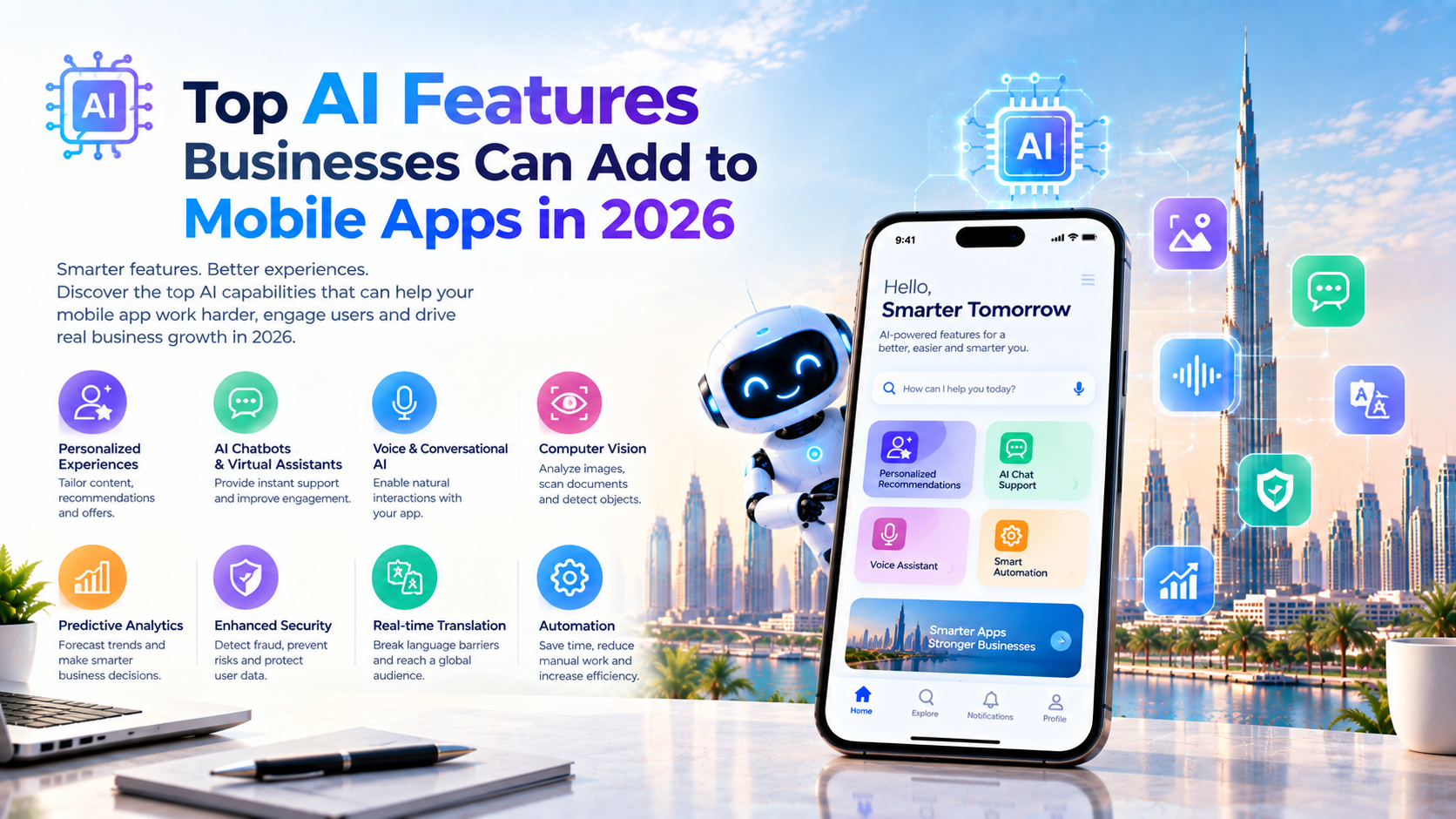
Top AI Features Businesses Can Add to Mobile Apps in 2026
Artificial intelligence is changing how businesses design and improve mobile applications. In 2026, Mobile App Features are moving beyond basic logins, payments, notifications, and dashboards, with AI enabling applications to become more personalized, automated, predictive, and interactive. For founders, business owners, and companies planning to develop an app, choosing the right AI capabilities can create better customer experiences while supporting business growth and operational efficiency.
The goal is not to add AI simply because it is trending. Businesses should identify AI features that solve real customer problems, automate repetitive work, generate useful insights, or create new digital services.
Why AI Features Matter for Business Apps in 2026
Customers increasingly expect mobile applications to be fast, convenient, personalized, and easy to use. AI can help businesses deliver these experiences by understanding user behavior, processing information, automating workflows, and supporting natural-language interactions.
AI can be useful across industries such as:
- E-commerce
- Healthcare
- Real estate
- Fintech
- Logistics
- Education
- Hospitality
- Travel
- On-demand services
- Professional services
For businesses considering Mobile App Development Dubai, AI can become part of the product strategy from the MVP stage or be introduced into an existing application.
Top AI Features Businesses Can Add to Mobile Apps
1. AI-Powered Chatbots and Virtual Assistants
AI chatbots are among the most practical features businesses can integrate into mobile applications.
An AI assistant can answer frequently asked questions, help users find products, track orders, schedule appointments, explain services, and guide customers through application features.
For example, an e-commerce app could allow customers to ask:
“Find me a laptop suitable for business use under my budget.”
Instead of navigating multiple categories, users can interact naturally with the application.
Businesses can also connect AI assistants to approved business information and workflows while maintaining appropriate access and security controls.
2. Personalized Recommendations
AI can analyze user behavior to provide personalized recommendations.
An application can consider previous purchases, searches, preferences, browsing activity, and interactions to recommend relevant products, services, content, or offers.
Examples include:
- Product recommendations for e-commerce
- Property recommendations for real estate
- Course recommendations for education
- Restaurant recommendations for food delivery
- Content recommendations for media platforms
Personalization can make the customer journey more relevant while creating opportunities for businesses to improve engagement.
3. Intelligent Search
Traditional mobile app search often relies on exact keywords.
AI-powered search can understand the meaning and intent behind a user’s request.
For example, instead of searching for “black running shoes,” a customer could enter:
“Show comfortable running shoes for outdoor workouts.”
The application can interpret the context and return more relevant results.
This feature can be particularly useful for e-commerce, marketplaces, real estate, travel, and service-based applications.
4. Generative AI
Generative AI can help applications create or transform content based on user requests.
Depending on the business, it can support:
- Text generation
- Product descriptions
- Personalized messages
- Summaries
- Marketing content
- Business reports
- Customer responses
- Document assistance
For example, a business application could summarize a long customer interaction into a short actionable report.
Generative AI should be implemented with appropriate validation, privacy controls, and human oversight where inaccurate output could create business or customer risks.
5. Predictive Analytics
AI can help businesses understand patterns in customer and operational data.
Instead of simply showing historical reports, predictive capabilities can help identify potential trends and likely outcomes.
A business application could use AI to analyze:
- Customer churn patterns
- Product demand
- Sales trends
- User engagement
- Inventory requirements
- Operational performance
For business owners, predictive analytics can turn a mobile application into a more useful decision-support platform.
6. AI Voice Assistants
Voice-based interaction can make applications more convenient, particularly when users need hands-free access.
Businesses can integrate voice capabilities for:
- Voice search
- Customer support
- Application navigation
- Appointment booking
- Order tracking
- Information requests
For example, a delivery application could allow users to ask about an order using a voice command instead of manually searching through the application.
Voice functionality can be especially valuable when accessibility and convenience are important parts of the customer experience.
7. Image Recognition and Visual Search
Computer vision allows mobile applications to understand images and visual information.
Businesses can use image-based AI for:
- Visual product search
- Document processing
- Product identification
- Property analysis
- Image categorization
- Quality inspection
- Educational applications
For example, an e-commerce application could allow customers to upload a product image and find visually similar items.
The feature’s feasibility depends on the quality of available data, accuracy requirements, and the specific business use case.
8. AI Fraud and Anomaly Detection
For applications involving payments, transactions, accounts, or financial activity, AI can help identify unusual behavior.
The system can analyze transaction patterns and flag activity that differs from established behavior for additional review.
Potential applications include:
- Fintech
- Banking
- E-commerce
- Payment platforms
- Marketplaces
- Subscription services
AI should work alongside established cybersecurity, authentication, monitoring, and fraud-prevention measures rather than replacing them.
9. AI-Based Customer Sentiment Analysis
Businesses can use AI to analyze customer feedback, reviews, surveys, support conversations, and other text-based interactions.
Sentiment analysis can help identify whether customer feedback is broadly positive, negative, or neutral and highlight recurring themes.
This can help businesses understand:
- Customer complaints
- Product feedback
- Service quality
- Customer satisfaction
- Recurring support issues
For larger businesses, this can provide a scalable way to analyze large volumes of customer feedback.
10. AI-Powered Automation
One of the biggest opportunities for businesses is using AI to automate repetitive processes.
Depending on the application, automation can include:
- Lead qualification
- Customer query classification
- Document processing
- Appointment assistance
- Support ticket routing
- Product categorization
- Report generation
- Data extraction
- Personalized notifications
Automation can reduce manual workloads and allow employees to spend more time on activities requiring human judgment and customer relationships.
Which AI Features Should Your Business Build First?
Not every business needs all ten features.
Founders and business owners should prioritize AI capabilities based on their business model and customer needs.
For example:
E-commerce: Recommendations, intelligent search, AI customer support, visual search.
Real estate: Property recommendations, intelligent search, lead qualification, AI assistants.
Healthcare: Appointment assistance, information support, document processing, patient engagement.
Fintech: Anomaly detection, customer support, personalization, predictive insights.
Logistics: Demand forecasting, route intelligence, delivery optimization, operational analytics.
Education: Personalized learning, AI tutoring, content recommendations, progress analysis.
The right feature is the one that provides a clear business or customer benefit.
How AI Features Affect Mobile App Development Cost
Adding AI can affect Mobile App Development Cost because businesses may require additional APIs, cloud infrastructure, backend development, data processing, testing, monitoring, and ongoing AI usage.
A simple chatbot using an existing AI API may require considerably less development than a custom machine learning platform.
Before development begins, businesses should consider:
- AI technology requirements
- Number of users
- Data volume
- API usage
- Cloud infrastructure
- Security
- Integration requirements
- Maintenance
- Scalability
A focused MVP can help businesses validate an AI feature before expanding the product.
Choosing the Right Development Partner
Building AI-powered applications requires more than mobile UI development. Businesses should look for expertise across mobile development, backend engineering, APIs, cloud infrastructure, AI integration, security, UI/UX, and testing.
A Mobile App Development Company in UAE can help businesses evaluate which AI features are technically practical and commercially useful.
Companies searching for Mobile App Development Services in Dubai should also consider the development team’s experience with their industry, target users, integrations, scalability, and post-launch support.
Depending on the target platform, businesses may need an Android App Development Company or an iOS App Development Company.
For businesses operating in Abu Dhabi, a Mobile App Development Company in Abu Dhabi can help plan platform requirements, integrations, AI functionality, and deployment.
A capable Mobile App Development Agency should also help determine which features belong in the MVP and which should be introduced later.
For businesses specifically looking for a Mobile App Development Company in Dubai, the evaluation should focus on technical expertise, relevant project experience, communication, security, development methodology, and long-term support.
How A2Solutions Can Help Build AI-Powered Mobile Apps
A2Solutions helps businesses transform app ideas into practical digital products through product planning, UI/UX design, mobile development, backend engineering, AI integration, testing, deployment, and ongoing improvements.
Whether you are a startup founder validating an idea, a business owner looking to improve customer experience, or an established company planning a new digital platform, AI can be introduced according to your specific business requirements.
The objective should be to build an application where technology supports the business—not an application overloaded with unnecessary AI features.
Frequently Asked Questions
What are the most important AI features for mobile apps in 2026?
Important AI capabilities include intelligent chatbots, personalized recommendations, AI search, generative AI, predictive analytics, voice interaction, computer vision, fraud detection, sentiment analysis, and workflow automation. The most suitable features depend on the application’s users, business model, data, and specific objectives.
Can AI features be added to an existing mobile app?
Yes. Existing applications can often be upgraded with AI through APIs, backend services, recommendation engines, intelligent search, chatbots, analytics, voice functionality, or other technologies. The feasibility depends on the application’s current architecture, data, security, integrations, and technical infrastructure.
Do AI features increase mobile app development costs?
They can. AI may introduce additional development, API, cloud, data-processing, testing, monitoring, and maintenance requirements. However, the cost impact varies significantly depending on whether the business uses an existing AI service or requires custom AI functionality.
Should startups add AI to an MVP?
Startups can include AI in an MVP when it directly supports the core value proposition. A focused feature such as an AI assistant, recommendation engine, or intelligent search can be tested before investing in a larger AI ecosystem.
Which industries can benefit from AI mobile apps?
E-commerce, healthcare, real estate, fintech, logistics, education, travel, hospitality, and on-demand businesses can all potentially use AI. The value depends on whether AI addresses a genuine customer or operational problem.
How do I choose an AI mobile app development company?
Evaluate experience in mobile development, AI integration, backend systems, UI/UX, APIs, cloud infrastructure, security, testing, and post-launch maintenance. Businesses should also review relevant industry experience and whether the development partner can create a scalable product roadmap.
Final Thoughts
AI is becoming an important part of modern mobile application strategy, but businesses do not need to implement every available technology.
For founders and business owners planning Mobile App Development Dubai, the best starting point is identifying the customer or operational problem the application needs to solve. From there, AI features can be selected based on business value, technical feasibility, budget, data availability, and scalability.
Whether you are planning a new startup app or upgrading an existing business application, the right combination of AI and mobile technology can create more personalized experiences, automate repetitive processes, improve decision-making, and open opportunities for new digital services.
The objective for 2026 should be simple: build the AI features your customers and business actually need—not just the features that are trending.
