




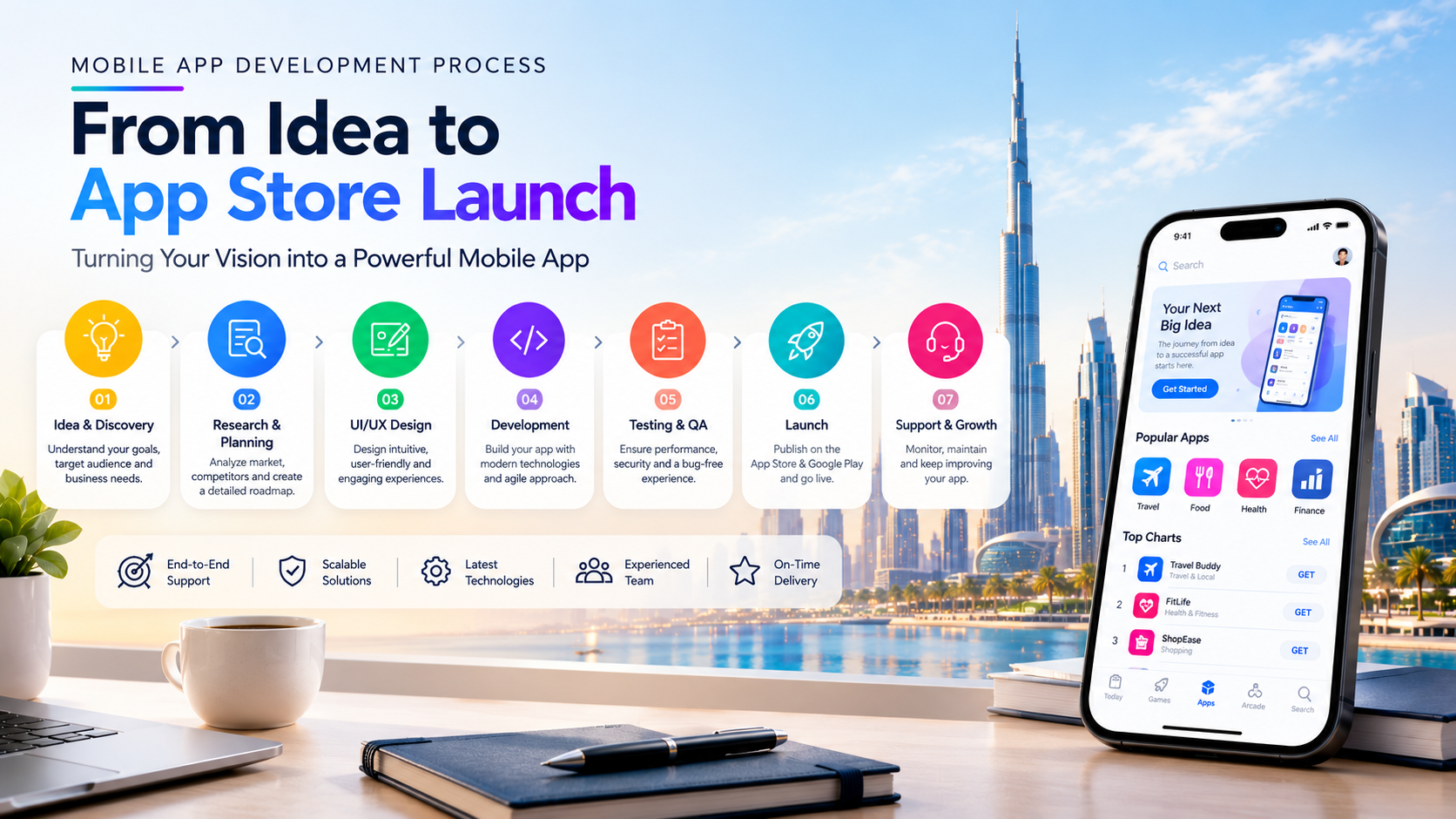
Mobile App Development Process: From Idea to App Store Launch
Turning an app idea into a fully functioning product on the App Store or Google Play isn’t a single event — it’s a structured journey with distinct phases, each requiring different expertise, tools, and decisions. Whether you’re a first-time founder or a business owner adding a digital channel to an established brand, understanding the Mobile App Development Process upfront helps you set realistic timelines, avoid costly mid-project changes, and choose the right team to bring your vision to life.
This guide walks through every stage of building an app — from the first spark of an idea to a successful launch and beyond — so you know exactly what to expect, what questions to ask your development partner, and where most projects succeed or stumble.
Stage 1: Idea Validation and Market Research
Before a single line of code is written, the strongest apps start with validation. This stage answers one critical question: does this app solve a real problem for a real audience?
Key activities in this phase include:
- Competitor analysis — studying existing apps in your category to identify gaps and differentiation opportunities
- Target audience research — understanding who will use the app, their pain points, and their mobile behavior
- Market demand assessment — validating that enough people actually want this solution before investing in a full build
- Defining success metrics — deciding upfront what “success” looks like (downloads, revenue, engagement, retention)
Skipping this stage is one of the most common reasons apps fail post-launch. A reputable Mobile App Development Company in Dubai will often push back on vague ideas and insist on this research phase before quoting a full build — not to slow you down, but to protect your investment.
Stage 2: Scoping and Requirement Planning
Once the idea is validated, it needs to be translated into a concrete plan. This is where founders work closely with their development partner to define:
- Core features vs. nice-to-have features — separating what’s essential for launch (MVP) from what can be added later
- Platform decision — iOS, Android, or both, and whether native or cross-platform development makes more sense
- Technical requirements — backend needs, third-party integrations (payments, maps, SMS/OTP), and scalability expectations
- Budget and timeline alignment — matching ambitions to realistic cost and delivery windows
A detailed scope document at this stage prevents “scope creep” later — one of the biggest causes of budget overruns in app projects. This is also where working with an experienced Mobile App Development Agency pays off, since they can flag technical risks or unrealistic timelines before development even begins.
Stage 3: UI/UX Design
Design isn’t just about how an app looks — it’s about how intuitively users can navigate it. This stage typically includes:
- Wireframing — low-fidelity sketches mapping out screen layouts and user flow
- Prototyping — clickable mockups that simulate the app experience before development starts
- Visual design — branding, color schemes, typography, and iconography
- Usability testing — gathering early feedback from real users to refine the flow before coding begins
In a market as visually competitive as the UAE, users are exposed to some of the world’s most polished apps daily, so generic, template-based design can quietly hurt downloads and retention. A strong design phase — including Arabic RTL support where relevant — is often what separates an app used once from one that becomes part of a user’s daily routine.
Stage 4: App Development (Front-End and Back-End)
This is where the app actually gets built. Development typically runs in parallel across two tracks:
Front-end development — building the interface users interact with, following the approved design, and ensuring smooth performance across devices.
Back-end development — building the server, database, APIs, and admin systems that power the app behind the scenes, including user authentication, data storage, and third-party integrations.
Depending on your goals, this stage may involve:
- Native development — building separately for iOS and Android using platform-specific languages (Swift/Kotlin), often chosen for performance-heavy apps
- Cross-platform development — using frameworks like Flutter or React Native to build once and deploy on both platforms, often reducing cost and timeline
Working with a specialized Android App Development Company in Dubai or iOS App Development Company in Dubai ensures the app is optimized for each platform’s specific guidelines and performance benchmarks, rather than treated as an afterthought.
Stage 5: Quality Assurance and Testing
Before any app goes live, it must be rigorously tested to catch bugs, performance issues, and usability problems. This stage includes:
- Functional testing — verifying every feature works as intended
- Performance testing — checking load times, responsiveness, and behavior under heavy use
- Security testing — especially critical for apps handling payments, personal data, or sensitive information
- Device and OS compatibility testing — ensuring consistent performance across different phones, screen sizes, and OS versions
- User acceptance testing (UAT) — having real users or stakeholders test the app before public release
Rushing or skipping this stage is a common — and costly — mistake. Bugs discovered post-launch damage user trust and app store ratings far more than a few extra weeks of testing ever would.
Stage 6: App Store Submission and Launch
Once testing is complete, the app is ready for submission to the Apple App Store and/or Google Play Store. Each platform has its own review guidelines, and rejected submissions due to overlooked policy details are common for first-time app owners. This stage involves:
- Preparing store listings — app title, description, screenshots, and keywords optimized for App Store Optimization (ASO)
- Meeting platform-specific guidelines — privacy policies, permissions disclosures, and design standards
- Submission and review — Apple’s review process is typically stricter and can take longer than Google’s
- Launch strategy — coordinating marketing, PR, or promotional activity around the go-live date
A launch isn’t the finish line — it’s the starting point for gathering real user data and feedback.
Stage 7: Post-Launch Support and Iteration
The most successful apps treat launch as day one, not day one hundred. Ongoing work after launch typically includes:
- Monitoring analytics — tracking downloads, engagement, retention, and drop-off points
- Bug fixes and OS updates — keeping the app compatible as Apple and Google roll out new OS versions
- Feature updates — adding functionality based on real user feedback
- Marketing and ASO refinement — improving visibility and conversion in the app stores over time
A trustworthy Mobile App Development Company in UAE will offer clear post-launch support packages rather than disappearing after go-live, since long-term app success depends heavily on this ongoing care.
Why Understanding This Process Matters for Founders and Business Owners
Whether you’re a founder building your first product or a business owner adding a mobile channel to an established brand, understanding the Mobile App Development Process helps you:
- Set realistic expectations on timeline and budget from day one
- Ask the right questions when evaluating development partners
- Avoid costly scope creep by locking in requirements before development starts
- Plan for post-launch costs, not just the initial build
For business owners specifically, this process isn’t just a technical exercise — it’s a strategic investment. A well-planned app strengthens customer loyalty, opens new revenue channels, and provides behavioral data that traditional channels can’t match. In a market as mobile-first as the UAE, businesses that skip this planning often end up with apps that look good but fail to perform.
Choosing the Right Partner for Each Stage
Not every Mobile App Development Company in UAE manages all seven stages with the same rigor. When evaluating a partner, ask specifically:
- Do they include research and scoping, or jump straight into development?
- Do they show wireframes and prototypes before writing code?
- What does their QA process actually involve?
- Do they offer post-launch support, or is the relationship over at submission?
If you’re exploring Mobile App Development Services in Dubai or looking for Mobile App Development Dubai-based support with a full end-to-end process, choosing a partner who owns the entire journey — not just the coding phase — makes a measurable difference in your app’s long-term success.
About A2Solutions
A2Solutions is a trusted Mobile App Development Company in Dubai, guiding startups, SMEs, and enterprises across the UAE through every stage of the app development journey — from idea validation and UI/UX design to development, testing, App Store launch, and long-term maintenance.
As a full-service Mobile App Development Agency, A2Solutions doesn’t hand off projects after coding is complete. The team stays involved through app store submission, post-launch monitoring, and ongoing feature development, ensuring founders and business owners have a true long-term partner rather than a one-time vendor. With experience across iOS, Android, and cross-platform builds, A2Solutions helps clients avoid the common pitfalls that derail app projects — scope creep, rushed testing, and unclear post-launch plans — by managing the entire Mobile Application Development lifecycle under one roof.
Frequently Asked Questions
Q: What are the main stages of the Mobile App Development Process?
A: The core stages are idea validation, scoping and planning, UI/UX design, development, quality assurance testing, app store submission, and post-launch support and iteration.
Q: How long does the entire mobile app development process take?
A: A basic app typically takes 6–10 weeks from start to launch, mid-complexity apps take 3–5 months, and complex or enterprise apps can take 6–12 months or longer, depending on features and platforms.
Q: Why is the idea validation stage important if I’m confident in my idea?
A: Validation confirms real market demand before investing in a full build, helping avoid the common and costly mistake of launching an app that looks great but has no real audience.
Q: What happens if I skip proper QA testing before launch?
A: Skipping thorough testing often leads to bugs, crashes, and poor performance after launch, which damages user trust, app store ratings, and can be far more expensive to fix post-launch than during development.
Q: Does app development end once the app is live on the App Store?
A: No. Post-launch support — including bug fixes, OS compatibility updates, and feature iterations based on user feedback — is essential for long-term app success and user retention.
Q: Should business owners follow the same process as startups?
A: Yes. Whether it’s a startup’s first product or an established business adding a mobile channel, following a structured development process reduces risk, controls cost, and improves the odds of long-term success.
Final Thoughts
The Mobile App Development Process is a structured journey, not a single transaction — and understanding each stage empowers founders and business owners to make smarter decisions at every step. From validating your idea to designing an intuitive experience, building a stable product, testing it thoroughly, and supporting it long after launch, every phase plays a role in whether your app becomes a lasting business asset or a costly experiment. Choosing a development partner who manages this entire journey — not just the coding — is often the single biggest factor in an app’s long-term success.
Also Read:- How Much Does It Cost to Build a Mobile App in the UAE?
